
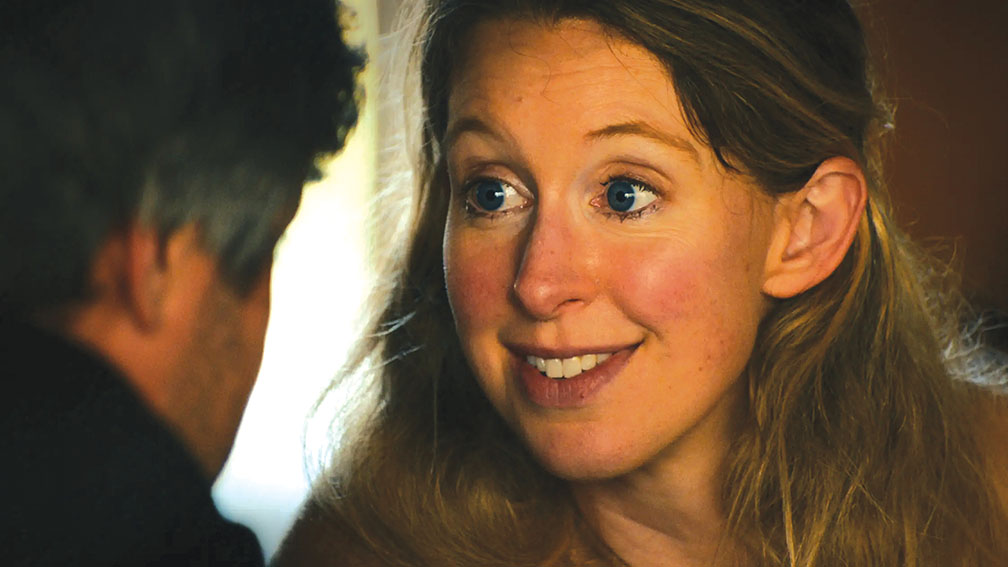
In 2026, you don’t expect an American movie – even a documentary – to include an almost Talmudic discussion focusing on the meaning of the word “can.” But it’s a critical scene in “You Can See Everything,” the hit documentary (co-directed by Jewish filmmakers Nathan Fielder and Lance Oppenheim) that follows Elizabeth Holmes, the creator of Theranos – a machine she claimed could perform multiple tests using just a single drop of blood – and her family over the 36 days before she was to report to prison and serve an 11-year sentence for fraud.
Holmes and her husband, Billy Evans, decided to allow the filmmakers complete access to their lives as an exercise in “radical transparency.” Fielder, a writer and performer best known for his HBO shows “Nathan for You” and “The Rehearsal,” is both a strange and inspired choice to take on the project. His previous work marked him as the foremost practitioner of cringe reality. In “Nathan for You,” he offers to help troubled businesses turn themselves around, usually with suggestions so far “out of the box,” they’re either genius or idiotic; think “Kitchen Nightmares,” only with less cursing and food. As an observer, he’s the kind of kid who probably pulled the wings off of flies, not out of cruelty, but because he wanted to give them newer, prettier wings. If those new wings are too heavy and keep the fly grounded…
For “The Rehearsal,” he helps people who are in tough situations – an uncomfortable conversation, breaking up with someone, a family intervention, etc. – by meticulously recreating the place they will have the conversation and gaming out all the possible (and some less than possible) variations. In season 2, he built a replica of Houston’s George W. Bush International Airport on a soundstage so precise and true-to-life, it was repurposed to help neurodivergent people navigate the stresses of air travel.
His superpower is his deadpan delivery; he can make even the most bonkers suggestion sound reasonable. He’s not a journalist; his questions can sometimes seem so blunt and haltingly asked his interlocutors can’t decide if he’s inept, or just dense. Don’t expect him to craft incisive follow-up questions, but he’s not afraid to ask the obvious question that’s on everyone’s mind. In one of his first meetings with Holmes and Evans, she’s beating eggs for breakfast. Evans brusquely grabs the bowl from her. Instead of letting it slide, he stops his line of questioning to ask why he grabbed the bowl. In “Everything,” he is low-key but persistent, repeatedly drilling down on a point until it throws off the person being asked, and they give up more information than they intended.
Fielder takes the idea of “radical transparency” to its limit, even following Evans into the shower for some full-frontal nudity. It’s a very claustrophobic film; much of it is shot in extreme close-ups, a single face filling the screen. Shot in the old, squarish Academy aspect ratio of 1.375 to 1, the couple’s rented beach house feels uncomfortably close even when the camera pulls back.
Holmes claims the reason they agreed to do the documentary (she confesses she had never heard of Fielder before they met) was to correct the way she’s been misrepresented in the press. She’s especially incensed over a New York Times profile where she was quoted saying, “They’re not playing me. They’re playing a character I created.” She never said that; Holmes and Evans claim they have a tape of the interview that proves their point, but never let Fielder hear it. (During post-production, Fielder interviewed the story’s author, who stood by their reporting, but could not produce any definitive proof.)
But Holmes remains an impenetrable figure. She is innocent, she repeatedly tells Fielder. She did nothing wrong and no one was defrauded. And about midway through the nearly three-hour movie, after being repeatedly told that Theranos can perform hundreds of tests, Fielder tries to pin down what exactly Holmes and Evans mean when they say “can.” Does that mean it can perform the tests now, or does it have the (as yet, still unfulfilled) potential of performing hundreds of tests? And do they see how people could be misled by their claim?
To help make his point, Fielder turns, not to Hillel and Shammai, but Abbott and Costello … specifically their classic “Who’s on First?” routine. He plays the clip for Holmes and Evans, then asks Holmes why the skit is funny. It’s because they’re yelling past each other, she tells him. She doesn’t understand that the joke is that the names of the players could also be questions. Fielder looks perplexed; he can’t believe she missed the entire point of the gag. He won’t let the subject drop until Evans tells him that “her brain works different.”
That might very well be true, but not in the way Evans intended. With her saucer eyes and perma-grin, Holmes could be a cult member.
Evans comes off as the villain of the story. It’s obvious from the start he did not have the same enthusiasm about inviting the filmmakers as Holmes and doesn’t do much to mask his distaste. Aggressive, controlling and acting as if he’s the smartest guy in the room, he’s an almost stereotypical tech bro. You hear him on the phone trying to entice investors in what he calls “Theranos Two-point-oh” with vacuous Silicon Valley-talk. He even manages to get a rise from the usually even-keeled Fielder, telling the filmmaker “I know how you feel.” Fielder snaps back, “No, you don’t!”
Evans also sets off the film’s most audacious move. Before Holmes heads to jail, he insists on meeting Fielder and executives of producer A24 Films, demanding some compensation for their appearing in the film, even though he’s told it’s ethically dubious. (There’s an unanswered question of how much Holmes knew and if she approved his demand.) He also discovers that Evans has licensed Holmes’ image (the famous photo of her in a black turtleneck holding a small vial of blood, which Holmes hates), is creating an AI avatar of Holmes, and is posting as Holmes to her X account. He has, he tells Fielder, power of attorney.
Disturbed by this, he recruits Amanda Seyfried, who played Holmes in Hulu’s limited series about Theranos, “The Dropout,” to get her opinion. He then “casts” Seyfried to play Holmes in recreated conversations. In a brilliant coup de theatre, he shows Seyfried video of Holmes watching Seyfried as Holmes in “The Dropout.” They discuss Holmes’ and Evans’ relationship, asking if it’s a smart idea for a woman who blamed her previous business and romantic partner, Sunny Balwani, for the problems with Theranos, to trust a man like Evans. Seyfried asks Fielder if he’s falling for Holmes. He might have; he certainly became more protective of her, as she got closer to reporting to prison.
Is Holmes guilty of fraud? Did Evans act with her approval? And what is the meaning of “can”? None of the questions are definitively answered by “You Can See Everything” but the movie is a funny, disquieting and, even with a three-hour running time, absorbing story that will leave you questioning if it is possible to ever know everything about anyone.