

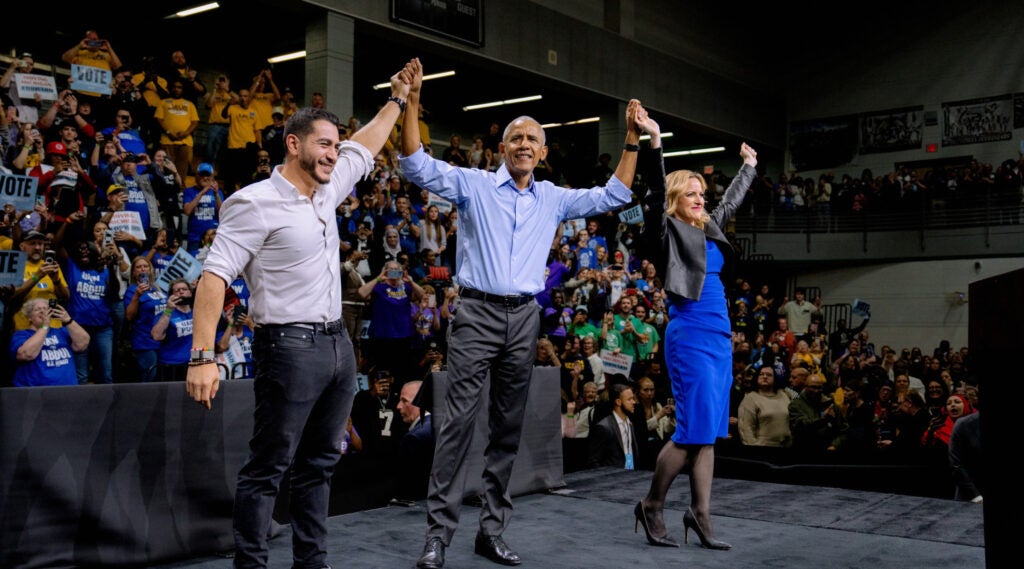
ANN ARBOR – Shortly before an Oct. 24 rally featuring Michigan U.S. Senate candidate Abdul El-Sayed and former President Barack Obama in Detroit, 250 rabbis from across the country urged them both to take their concerns more seriously about El-Sayed’s position on Israel.
The rabbis were speaking on behalf of a group called Nonnegotiable Michigan, and they require El-Sayed to commit to their five demands before they will support him. In this case, they wanted him to vocalize support for “Jewish statehood in Israel” and a commitment to safety for “Zionist Jews” — and to do it onstage.
To their disappointment, neither headliner mentioned the movement or its demands — and El-Sayed will soon wrap his campaign, likely without having done so at all. Now the nascent movement is facing criticism from Jews to its left that the tactic backfired and made Jews more vulnerable.
In the campaign’s final days, Nonnegotiable’s attempt to find a voice in the race has also been overshadowed by pro-Israel Democratic congresswoman Haley Stevens’ endorsement of El-Sayed’s opponent, Republican former congressman Mike Rogers.
Still, the letter was the biggest rabbinical foray into U.S. politics since more than 1,100 clergy signed an open letter last year condemning “rising anti-Zionism and its political normalization” shortly before the election of New York City Mayor Zohran Mamdani. The Michigan letter also signaled that even beyond the state, a sizable cohort of Jews are trying to state their principles amid shifting fault lines in the Democratic Party.
The organizers of Nonnegotiable are undeterred by the party’s silence. They are seeking a new national platform for liberal Zionist Jews to assert their priorities in politics.
“I do think it’s a template for a national model,” Rabbi Aaron Starr, one of Nonnegotiable’s co-founders, told the Jewish Telegraphic Agency. “I’m certainly looking beyond this election. In two years there will be a presidential election, and another slate of candidates for elected office.”
Starr, of the Conservative Congregation Shaarey Zedek in Southfield, a Detroit suburb, said Nonnegotiable’s biggest goal was to “name the priorities that were most core to mainstream American Jews.” He believes they have accomplished that.
As Israel seems sure to remain a hot-button topic for the American electorate in the 2028 presidential race, Starr sees the need for Jews to assert their priorities as urgent.
“Everyone recognizes the growing extremism among political parties and politicians these days,” he said. “Everybody, and especially rabbis, recognizes that extremists could pop up in their own districts and their own states. So they want a forum to be able to communicate ways by which we reject extremism.”
National spotlight
Nonnegotiable’s organizers told (JEWISH REVIEW) they have gathered 1,900, mostly anonymous, signatures to date within Michigan. That figure would be larger than the combined totals of named Michigan Jews who have signed open letters pledging to vote for El-Sayed (1,000) and Rogers (560).
Nationally, the organization says 4,560 people have signed the petition, including the rabbis from out of state who have joined up with the movement in its final days. The other clergy were sourced from rabbinical networks on social media, and come from 34 different states and Washington, D.C. A good chunk of them serve active congregations.
Many are from liberal or swing states, including Rabbi Samuel Stern of Temple Beth Sholom in Topeka, Kansas, where another close Senate race is unfolding. Stern told (JEWISH REVIEW) he signed in order to call out “the anti-Zionist hatred that we see coming out of different political sides and candidates.”
For the rabbis on the letter, El-Sayed’s rhetoric in Michigan looms large in their states, too — in some cases, larger even than more local antisemitism controversies.
At a recent rally in Kansas, President Donald Trump used the term “Shylock,” widely considered to be an antisemitic slur, when referring to a controversy involving the GOP incumbent senator suing patients with medical debt.
Stern, though, said that his Kansas congregation was generally more concerned about El-Sayed’s rhetoric on Israel several states away than Trump’s remarks closer to home.
“It really didn’t play that much here,” the rabbi said, of Trump’s comment. “I don’t know what that means for us, or for any of the other Jewish communities, but it wasn’t as prevalent here. We’ve heard more about what Dr. El-Sayed has said, his anti-Zionism, and been more concerned about that, than about the offhand comment by President Trump.”
Nonnegotiable has also expanded onto college campuses, with an organizing campaign that has quickly formed at the University of Michigan. Around two dozen Jewish students have publicly added their names to the letter.
“I really resonated with what Nonnegotiable stands for,” student organizer Jacob Reich, who is involved in various Democratic Party initiatives on and off campus, told (JEWISH REVIEW). “I felt torn between both my Jewish identity and my identity as a Democrat.”
Among Reich’s biggest concerns about El-Sayed, he said, was the candidate’s widely criticized “hurt people hurt people” remark made after a March attack on the state’s Temple Israel. The attacker’s family members were killed in Lebanon in an Israeli strike.
El-Sayed has since apologized for those comments, and his campaign has sent mailers to Jewish households in which he pledges to fight antisemitism. Reich said he appreciated the letter, but added, “I don’t think it went far enough to address a lot of the missteps that he’s taken.”

Whose nonnegotiables?
Rabbis friendlier with El-Sayed have argued the movement is ineffective at messaging; could boost Republican policies most Jews strongly oppose; and ignores ways in which the candidate has sought to improve his relations with Jews.
Some have aired those grievances to the movement’s leaders directly.
“Nonnegotiable describes itself as an invitation rather than an ultimatum,” Rabbi Alana Alpert, of Detroit-area Congregation T’chiyah, wrote privately to the campaign’s organizers in an Oct. 8 letter. “It has had the opposite effect, driving a wedge between the campaign and Jewish interests.”
In her previously unpublicized letter, which she recently shared with (JEWISH REVIEW), Alpert compared Nonnegotiable to Uncommitted, the 2024 activist campaign in Michigan that sought to pressure then-President Joe Biden on Gaza by withholding primary votes for him. The Uncommitted movement later refused to endorse replacement nominee Kamala Harris. Trump went on to win Michigan, and the general election.
The two campaigns used “similar language,” Alpert wrote. She told her fellow rabbis that they were now “dealing with the choices, coalitions, and consequences of an actual general election with far-reaching implications.”
Rabbi Nate DeGroot, who heads the progressive Shalom Center and serves two Michigan synagogues, laid out 10 alternative “nonnegotiables” of his own that he argues “Michigan Jews care just as much about.”
In an essay shared with (JEWISH REVIEW) in advance of its publication, DeGroot’s own nonnegotiables include “fierce condemnation of Christian nationalism”; support for abortion rights and trans rights; and a “commitment to beating swords into plowshares,” a phrase originating in the Bible that DeGroot said should also apply to opposing the U.S.-Israeli war in Iran.
Rogers would fail to meet those criteria, DeGroot wrote. Both he and Alpert are supporters of Michigan Jews for Democracy, an ad-hoc group organizing for El-Sayed.

One argument Nonnegotiable’s critics have made is that the movement has had the net effect of benefitting Rogers, who has made an aggressive play for the Jewish vote while employing campaign language about the Muslim Brotherhood that many have argued embraces Islamophobic tropes.
Organizers have expressly denied that their cause is partisan, though some of the big names who signed the Nonnegotiable letter have since cast their ballots for Rogers.
At a recent Republican Jewish Coalition event staged for Rogers, some speakers directly referenced El-Sayed’s refusal to engage with Nonnegotiable as part of the reason not to vote for him.
“When rabbis and Jewish leaders within El-Sayed’s own party came to him with five basic, nonnegotiable commitments, fundamental principles of Jewish safety, identity, and self-determination, they asked him to affirm these commitments clearly and unequivocally,” Lauren Slutsky, a parent of a Temple Israel preschooler, told the crowd. “Weeks later, we’re still waiting.”
She argued, “If a candidate cannot clearly say that Jewish safety, including the safety of Zionist Jews, is nonnegotiable, why should our community or anyone in our community give him our vote?”

Accusations flying
Nonnegotiable’s organizers have denied that their group is affiliated with any Jewish cause but their own. Zioness, which bills itself as a progressive Zionist group, is boosting them.
Yet some Jews see in the movement an echo of more hardline pro-Israel sentiment.
J Street, the national liberal Zionist lobby, seized on a video accidentally posted to Nonnegotiable’s Instagram account that showed the account holder texting with David Victor, a former president of AIPAC and a Michigan resident. The pro-Israel lobbying giant has spent millions against El-Sayed in both the primary and the general election.
The gaffe, J Street vice president of political and digital strategy Tali DeGroot told (JEWISH REVIEW), was potential evidence that Nonnegotiable’s organizers were coordinating with AIPAC-aligned figures.
“Our fear from the start with Nonnegotiable is that it plays directly into the hands of Republicans who are cynically using the issue of antisemitism for their own political gain,” DeGroot, who has no relation to Nate DeGroot, told (JEWISH REVIEW). The texting, she insisted, “just validates that fear even more.”
J Street has not formally endorsed El-Sayed, but the lobby is generally supportive of his campaign and is spending against other AIPAC-aligned candidates this midterm cycle. Neither AIPAC nor Victor responded to (JEWISH REVIEW) requests for comment.
Nonnegotiable organizers, however, dispute this account and have expressly denied any involvement from AIPAC in the group.
“If I had been aware of any of the establishment forces being involved in this, or if there was a whiff of partisanship, I would not have gotten involved,” Matt Zerwekh, an initial signer of the letter who leads Temple Emanu-El in the Detroit suburb of Oak Park, told (JEWISH REVIEW).
Some have even vocally opposed the powerhouse lobby. One of Nonnegotiable’s co-founders, Rabbi Josh Whinston of Ann Arbor’s Temple Beth Emeth, published an op-ed in the Detroit Free Press on Friday condemning AIPAC for quoting him in anti-El-Sayed mailers distributed to Jewish households.
On Sunday afternoon, hours after Stevens’ endorsement of Rogers, Nonnegotiable gathered again on Zoom with guests including Zionist pundit Hen Mazzig and Michigan U.S. Rep. Hillary Scholten.
At the exact same moment as the call, pro-Israel congressional candidate Jeremy Moss was joining a cohort of Democrats castigating Stevens for her endorsement. Nonnegotiable leaders saw it differently: Starr praised Stevens for her “bravery.”
Others, such as Scholten, didn’t raise the subject at all. The congresswoman instead praised the U.S.-Israel relationship and the Iron Dome defensive system. “I’m so proud to stand as a friend and ally of our Jewish community right now,” she told those on the call.
The real purpose of the call, though, was for Nonnegotiable to suggest that Jews could write in a candidate instead of voting for either nominee.
Their top write-in pick: Emma Lazarus, the 19th-century Jewish poet best known for having her work engraved on the Statue of Liberty.
A Season of Big Decisions. From the Knesset campaign to American midterms, Jewish communities are weighing what comes next. Help (JEWISH REVIEW) keep delivering the deeper context.

