

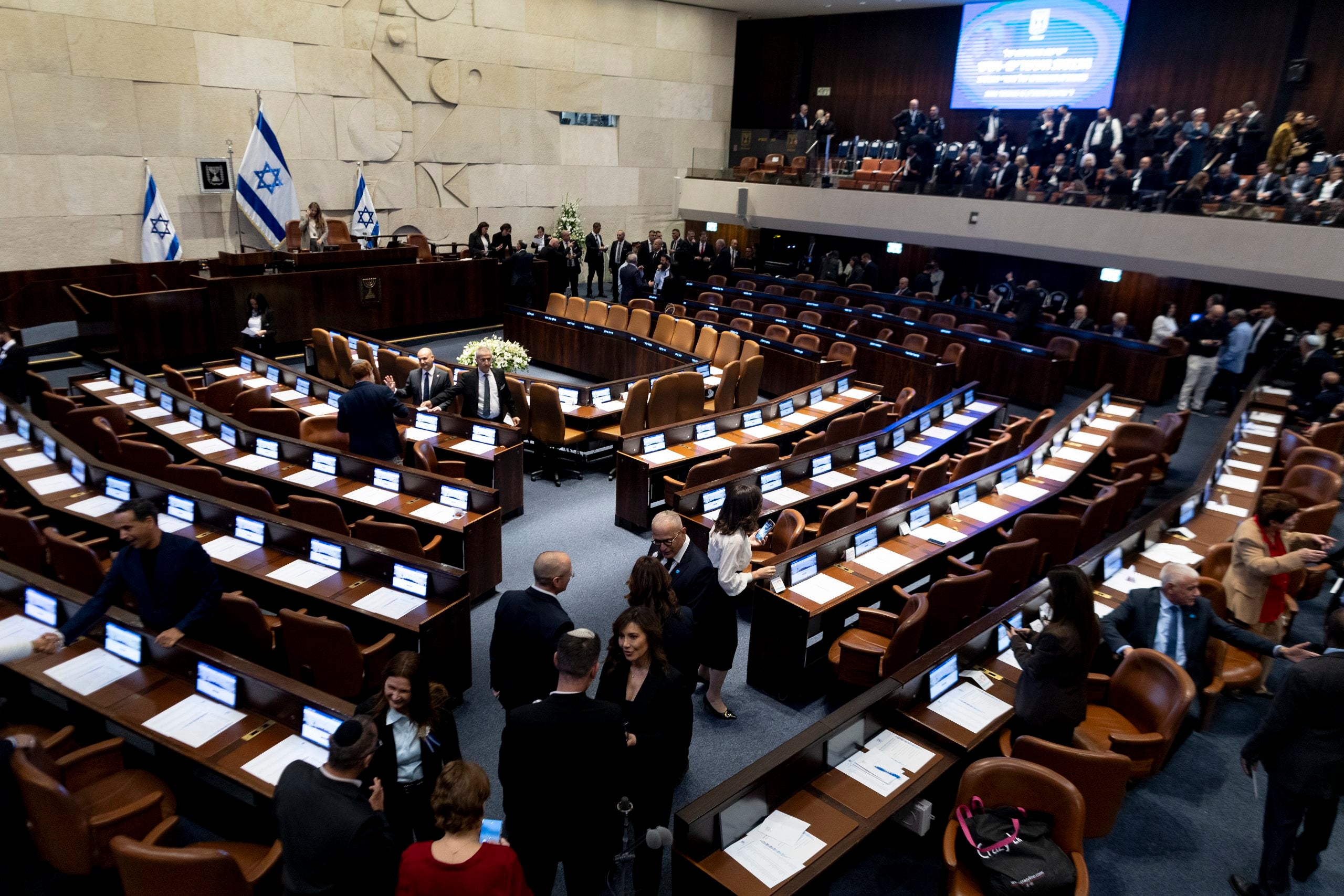
JERUSALEM – Israel’s 26th Knesset, or parliament, was sworn in on Tuesday, even as national elections two weeks ago produced no clear winner or indication of who will be Israel’s next prime minister.
On Sunday, President Isaac Herzog officially tasked former IDF chief and political novice Gadi Eisenkot with forming the government after a majority of newly elected lawmakers said they would prefer him as prime minister.
Incumbent Prime Minister Benjamin Netanyahu lost his parliamentary majority in the vote, even though his party, Likud, remained the largest of those entering the Knesset with 27 seats in the 120-member parliament.
Netanyahu has called on Eisenkot to join him in forming a national unity government, but in his ceremonial toast in the Knesset on Tuesday he ended up pushing Eisenkot’s change bloc even further away from the idea of a unity government under his leadership by casting suspicions on all of their potential partners in a future government.
Eisenkot and his bloc of four parties – his own Yashar Party, B’Yachad headed by former prime ministers Naftali Bennett and Yair Lapid, Avigdor Liberman’s Yisrael Beitenu, and the Democrats led by Yair Golan – have campaigned on a promise to change the current government and the prime minister. Following Netanyahu’s speech, Eisenkot said in a statement that now he was even more certain that change was needed.
Eisenkot’s bloc garnered 48 seats in the election, and since then has drawn additional support from the two Arab parties, which together hold 19, and an expression of support from United Torah Judaism, an ultra-Orthodox party previously aligned with Netanyahu. The extra support gives him a shaky majority in the Knesset.
Eisenkot has reiterated that any party, including Likud, is welcome to join him as long as they embrace his four conditions: Recognition of Israel as a Jewish and democratic state, acceptance of the values of the Declaration of Independence, mandatory military or civilian service for all, and recognition of Hamas as a terrorist organization.
Ilana Shpaizman, a senior lecturer in the Department of Political Studies at Bar-Ilan University, told the Jewish Telegraphic Agency that even though a new government has not yet been formed, “the Knesset can act on everything.”
“The Knesset can do oversight, the same thing as it did before; it can also pass legislation… but only private legislation and not government legislation,” she said, adding that the current government under Netanyahu will continue to function until it is replaced, just without the majority it had previously.
Shpaizman added that even if Eisenkot does not succeed in forming a government, and the country goes to another election, the Knesset sworn in on Tuesday will have at least six months to legislate as it chooses.
“This is a lot of time to legislate, so this is very important, and especially things like the finance committee, which can control the budgetary transitions of the government,” she pointed out.
Opening the Knesset swearing-in ceremony, Herzog called on the new Knesset members to “do everything possible to avoid another round of elections.”
“The people who chose you long for routine, security and tranquility,” the president said, outlining many of the challenges that Israel has faced over the past three years.
“The people you represent here yearn to see an outstretched hand that will bring unity to the nation and hope,” Herzog said. “A people that carries within it pain, devotion, and sacrifice longs to see you translate those strengths into cooperation, into unifying dialogue, and into listening.”
He added: “I ask of you: be measured toward one another. Reach out a hand for compromise, even between rivals. Look upon one another with generosity. There is much work to be done here, and it requires the ability and experience found in every part of this House.”
Before the swearing-in ceremony, each of the 11 elected parties held its first faction meeting in the Knesset. Eisenkot took the opportunity to announce that his bloc had reached agreements on nominations for key Knesset positions.
Former minister and incoming MK Matan Kahana from Yashar is slated to be the next Knesset speaker, a powerful position that sets the Knesset plenum’s daily agenda. MK Roy Folkman, also from Yashar, will be nominated as chairman of the Arrangements Committee, which is responsible for organizing the Knesset’s work at the beginning of its term.
In addition, Liberman will take over as chairman of the Foreign Affairs and Defense Committee, and MK Liran Avisar Ben-Horin from B’Yachad, will be nominated head of the Finance Committee, another powerful role.
As soon as the swearing-in ceremony concluded, Eisenkot’s party announced that it had submitted a series of bills that would reverse some of the more controversial laws passed by the previous government, including those relating to the judicial overhaul plan.
In addition, a bill was submitted calling for the establishment of a State Commission of Inquiry to investigate Hamas’s Oct. 7 massacre and how it was allowed to happen.
Of the 120 Knesset members sworn in on Tuesday, 46 are new to the parliament and roughly one in ten members has buried a loved one lost to terror or war, including Eisenkot whose son and two nephews were killed in combat.
According to statistics shared by Herzog in his speech, the most veteran Member of Knesset is Netanyahu, who has served in 15 Knessets since 1988, while MK Yonatan Shalev, a member of B’Yachad, is the youngest MK. At 24 years old, Shalev breaks a 66-year-old record.
In addition, the 5050 Initiative of the Centers for Social Justice, an Israeli non-profit, said in a statement that the new Knesset would set “an all-time record for the number of women serving in the Knesset: 33.”
“Today is a very good day for democracy because the new Knesset is being sworn in,” Shpaizman said. “It means that the election was fair and was peaceful.”
“I think the previous Knesset got to a point where the trust in it as an institution was the lowest ever, so it is a very good thing that new people are entering, new people who come in good faith from both sides who want to bring change and to make Israel better,” she added.
A Season of Big Decisions. From the Knesset campaign to American midterms, Jewish communities are weighing what comes next. Help (JEWISH REVIEW) keep delivering the deeper context.