
Kristallnacht (“Night of Broken Glass”), memorialized each year on Nov. 9-10, doesn’t have the same notoriety as International Holocaust Remembrance Day (Jan. 27), and Yom HaShoah (Hebrew calendar, Nisan 27 — in April or May).
But it really should. Kristallnacht, back in 1938, was the notorious precursor to the actual fireworks of the Holocaust — before the gas chambers and crematoria were even conceived. The Nazis eventually graduated from broken glass to lethal gas.
Riots spread across Germany, Austria and Czechoslovakia, destroying Jewish-owned shops, homes and 1,400 synagogues — reducing them to shattered windows and torched ruins. Nearly 30,000 Jewish men were arrested and sent to concentration camps.
Given Israel’s war in Gaza these past several years — and the twisted perversity and inverted reality of accusing Jews of committing the very genocide that gave the Holocaust its name — remembering the Holocaust has become largely taboo. According to progressives and professors, Jews are only to be viewed as white oppressors and never as victims. The Holocaust — the apex by which all mass murders are measured — obliterates that thesis.
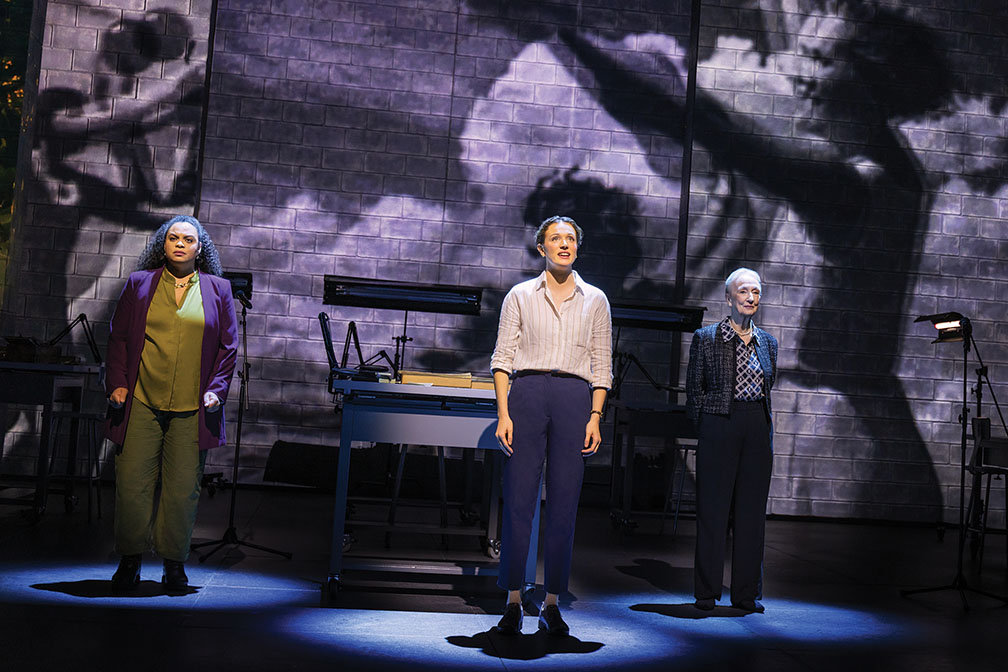
But two very different events took place this week that gave Kristallnacht renewed significance — one truly despicable, a barrage of bicycles swarming Jewish businesses in Philadelphia, demanding that they leave the neighborhood; and the other sublime, the opening of the play “Here There Are Blueberries,” a Pulitzer Prize finalist, at the Ethel Barrymore Theater on Broadway.
The first was a new low for rank antisemitism. Antizionists chose Kristallnacht as an occasion to target Jewish businesses with a hostile boycott. The cycling club, “Philly Bike on Your Left,” pedaled to the drumbeat of, “No business for Zionists!” They circled Jewish restaurants on Rittenhouse Square, pelting them with, “Zionist establishments must go!”
Taking a ploy from the Nazi playbook and importing it to Philadelphia nearly to the day, 88 years later, has become a common indignity that Jews have been forced to endure.
Taking a ploy from the Nazi playbook and importing it to Philadelphia nearly to the day, 88 years later, has become a common indignity that Jews have been forced to endure.
The next evening, however, in New York City, on the actual date of Kristallnacht, a magnificent night of theater shattered the pretensions of antisemites that they are on the right side of history — calling into question whether they know any history at all.
On the actual date of Kristallnacht, a magnificent night of theater shattered the pretensions of antisemites that they are on the right side of history—calling into question whether they know any history at all.
“Here There Are Blueberries,” conceived by Moisés Kaufman, is based on a true story involving the discovery in 2007 of what became known as the Höcker Album, a collection of 116 photographs from Auschwitz featuring not emaciated Jewish skeletons, but SS personnel living the good life outside a gate with the duplicitous sign, “Arbeit Macht Frei” (“Work Will Set You Free”).
It is a fascinating autopsy into the morality of indifference. Projected light fills the stage with surreal photographs of joyous Nazis availing themselves to some reprehensible R&R. The audience undertakes a deep dive into the down time of otherwise harmless-looking monsters taking a respite from evil.
It is equal parts detective story, diary of a death camp and trial in absentia.
Archivists from the U.S. Holocaust Memorial Museum, historians and the grandchildren of Nazis, some who served as doctors at Auschwitz, try to make sense of macabre images of mass murderers, and their enablers, relaxing, laughing, sunbathing, planning a Christmas party for the children of Nazis, and, yes, eating blueberries in a chalet just outside the barbed-wire, electrified fence that surrounded Auschwitz and Birkenau.
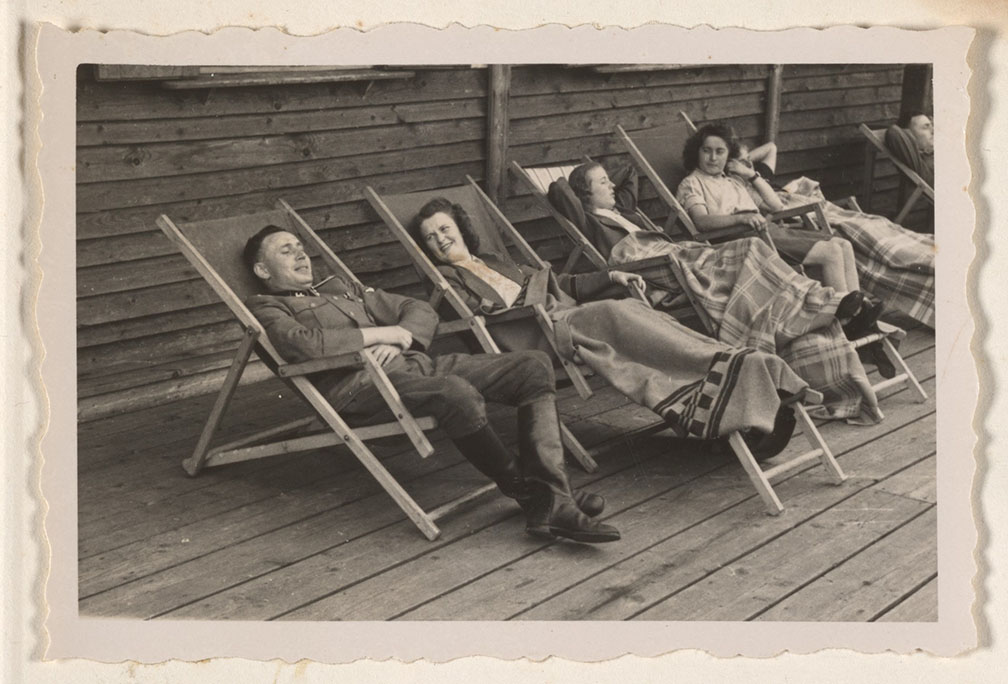
The film “The Zone of Interest” (2023) covered similar ground, but specifically focused on the life of Rudolf Höss, who constructed Auschwitz, and the ordinary domestic life of his wife and children. There are photographs of Höss in this play, too, but it also includes the entire Nazi brass of barbarians. Dr. Josef Mengele, known as the “Angel of Death,” is pictured here, the only ones ever discovered of him actually at Auschwitz.
It also includes alluring photographs of young women who worked as telephone, telegraph and radio operators — smiling girls who relayed information about incoming transports and how many Jews were to be gassed soon after the train’s arrival.
Two books delved into the dark arts of ordinary people engaged in unimaginable atrocities: Robert Jay Lifton’s “The Nazi Doctors: Medical Killing and the Psychology of Genocide” (1986), and the international bestseller, Daniel Jonah Goldhagen’s “Hitler’s Willing Executioners: Ordinary Germans and the Holocaust” (1996).
But “Here There Are Blueberries” is, like all live theater, up close and personal. Watching professional archivists and the relatives of Nazis trying to comprehend how men and women could so easily smile for the camera, under such a black cloud of daytime employment, is chilling.
Except for the doctors, many of the actual officers had been mere bank tellers, office clerks and even a chocolate maker before the Holocaust. Auschwitz gave them their big break. One grandchild revealed that his grandfather once waxed nostalgically, “That was the best time of my life.”
Some of the characters in the play repeat a widely misused insight about how ordinary people coped while surrounded by so much death. We are told that they all compartmentalized the small piece they played in the criminal enterprise of mass murder. They never saw the whole, focusing instead on the innocuous task at hand. This analysis borrows from Hannah Arendt’s landmark but dangerously misguided, “Eichmann in Jerusalem: A Report on the Banality of Evil.”
Contrary to Arendt’s moral blunder, Eichmann, the architect of the Final Solution, was no mere cog in the Nazi’s mass murdering machine — just a harmless stooge following orders and trying to impress his boss. Eichmann knew precisely what he was doing and found all that Jewish death caused by gassing to be intoxicating. There was nothing banal about it: systemically annihilating 6 million Jews, including 1.5 million children, was so unique, it was given its own name.
Think about that the next time someone mentions Palestinian children killed as casualties of war and not as victims of genocide.
The Höcker Album should also not be mistaken for humanizing those engaged in inhuman acts, unaccountably oblivious to their moral depravity. One grandchild of a Nazi doctor hears this bit of sophistry: “That was nothing. Nothing going on. And I didn’t do anything.” A woman says this about her sister: “I’m telling you, my sister didn’t know anything.” Even Höcker, himself, who took the photographs, testified at his trial, “The interior conditions of the camp were unknown to me. I was only concerned with administration. … I know nothing about the gas chambers.”
In a subsequent trial, the prosecution enters into evidence a receipt signed by Höcker for the delivery of Zyklon B.
Höss’ own grandson, whose father grew up in Auschwitz’s backyard, willingly acknowledges: “My family always said to the press: ‘We never saw anything.’ It was bulls—. They knew exactly what was going on, what happened on the other side of their wall.”
The aftermath of Auschwitz for many of those depicted in the Höcker Album is mostly unknown. Some of the officers were captured, tried and executed. Others, like Mengele, escaped.
“Here There Are Blueberries” arrives on Broadway at the perfect moment. New York City is teeming with hate crimes against Jews. The mayor cynically draws no connection between “Globalize the Intifada!” and the thousands of antisemitic acts that directly result from calling for violence against Jews.
This is also the city where immediately after Oct. 7, 2023, many New Yorkers performed their own versions of Kristallnacht by tearing down posters of Israeli hostages taken by Hamas, attacking Jews identified by skullcaps, spray-painting graffiti on the walls of synagogues, smearing red paint and fake blood and, yes, even breaking the glass of Jewish storefronts.
“Here There Are Blueberries” will be a hot ticket for its limited engagement on Broadway. The mayor and his closest allies absolutely should see the play. My guess is that he’ll skip the opportunity to show that a Muslim caretaker of the largest number of Jews outside of Israel can show empathy for his city’s people. Should he, as a gesture to his Jewish constituents, deign to sit in the audience, it would be nice to think he might learn something about the nature of antisemitism. But something tells me he wouldn’t.
Thane Rosenbaum is a novelist, essayist, law professor and Distinguished University Professor at Touro University, where he directs the Forum on Life, Culture & Society. He is a contributing writer for White Rose magazine. His most recent book is titled, “Beyond Proportionality: Israel’s Just War in Gaza.”