
This article was produced as part of (JEWISH REVIEW)’s Teen Journalism Fellowship, a program that works with Jewish teens around the world to report on issues that affect their lives.
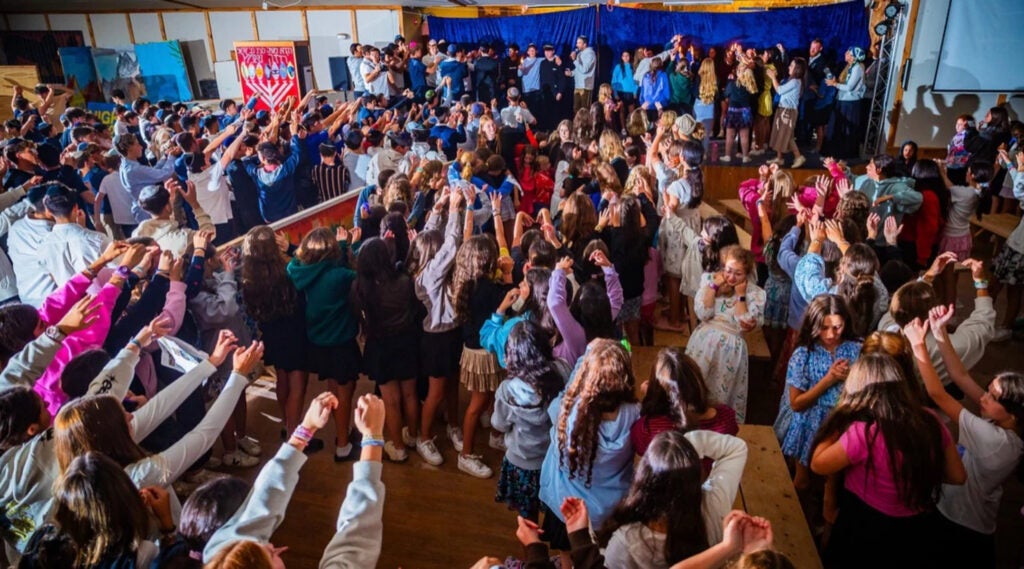
Hope Friedlander usually knows how she will spend her summer. The 15-year-old New Yorker has attended Camp Lavi in Lakewood, Pennsylvania since 2018, and her family’s connection to the camp dates back to 1977.
But when news of Camp Lavi’s sale spread last summer, Friedlander’s plan of returning to Lavi as a camper — and one day a counselor — began to fade.
“The camp has meaning to it. When you think of Lavi you think of certain things, and if you were to erase those things the camp just wouldn’t have the same meaning to it,” Friedlander said.
She isn’t alone. Families of Camp Lavi in Pennsylvania and Camp Mesorah in New York — two popular Modern Orthodox Jewish sleepaway camps — have spent months bracing for the worst. Now, with both camps under new ownership, the question has shifted: Families are asking not whether these camps will reopen, but what they will look like under new leadership, and whether the communities built around them will remain intact.
The changes facing both camps can be traced back to financial troubles that began months prior. Camps Lavi and Mesorah were in bankruptcy proceedings after SIMAD Holdings, owned by brothers Michael and David Shabsels, filed for Chapter 11 bankruptcy on June 4. According to The Real Deal, the brothers placed both camps — along with 28 others across the East Coast — as collateral for $195 million in bonds on the Tel Aviv Stock Exchange last December.
As part of the bankruptcy process, SIMAD’s 30 camps were put up for sale.
For Lavi families, the uncertainty quickly turned to alarm. In the days that followed, parents sent hundreds of emails and nearly 5,000 signed a “Save Camp Lavi” petition.
As SIMAD’S 30 camps underwent the bankruptcy process, families who watched their children grow up at Lavi and Mesorah wondered how much of the camps their children had grown to love would remain the same.
In a comment under the petition, one longtime camper and counselor of 16 summers pleaded: “This is not just a camp. It really is my forever home…. Please let this magical place stay as Camp Lavi in its true and current form — a home for Modern Orthodox children to have an amazing summer while growing as Torah-learning Jews.”
When the former co-owner of Camp Lavi, Joey Hoening, stepped forward as part of a team of new co-owners on Aug. 20, families were relieved. “Joey has been great to the camp over the years, and I do not think the camp could have been put in better hands,” said a Camp Lavi parent, Zhanna Osna.
“We are not here to reinvent camp,” Hoenig wrote in an email to Lavi families announcing his new position. “We are here to continue something that has always been incredibly special.”
His co-owners and co-directors include Yael Rudolph and her husband Elnatan. Rudolph’s mother ran Girls Campus at Lavi, and Rudolph spent 22 summers there, as a camper, an assistant director and now the co-owner and operator. “I really grew up there,” she said. “That’s what Lavi gave me, and I want kids today to have that same experience.”
Former campers, some of whom hope to return as counselors, are watching the changes closely, concerned about what the new ownership might mean for the camp they grew up with.
Jacob Kaufthal, 15, of Englewood, New Jersey, worries that the camp’s religious standpoint will stray away from the Modern Jewish Orthodox values it was known for. With the leader of Camp Lavi’s daily Torah and Kollel, or Jewish religious education, relocating to another camp, Kaufthal hopes the camp will maintain its commitment to Torah education.
“Not only did Kollel benefit the camp in a great environment, it got the campers inspired to attend shiurs [Torah classes],” said Kaufthal. “When they saw their role models and counselors attend night seders [Torah study sessions] daily, these campers were inspired.”
Anticipating changes, Kaufthal said that Lavi is no longer the right fit for him as a counselor. Instead, Kaufthal will move to a camp that is more accommodating to his religious expectations.
Meanwhile, former camper Friedlander said that under the previous directors, Shawn and Shayna Steinmatz, enrollment at Camp Lavi grew significantly after Joey Hoenig’s first tenure as director, which ended in 2018. “The camp was at 400 kids max when Joey was in charge, and now it’s at 700 kids,” she said. “He never controlled the camp when it was that size or the religious level they [the Steinmatzes] made it.”
As a result of this and other uncertainties about the new administration, Friedlander hasn’t decided whether she’ll be returning.
As part of a series of Lavi open houses hosted across the U.S. by various Camp Lavi families, families gathered in New York City on Nov. 2 to put such questions directly to Hoenig and Rudolph.
The new directors emphasized their desire to maintain the camp’s current religious identity. According to Hoenig, all upper staff positions have been filled except for head rabbi. “There’s no need to worry about that as we are interviewing incredible people daily,” he said.
Parents appeared delighted as they learned about extensive renovations occurring on campus, and efforts to revive old and favorite Lavi traditions, including a dune buggy course, while introducing new programs, trips and experiences.
Among the most significant changes are new bunks and a revamped gym.
“We’ve heard everything,” said Hoenig, referring to the many concerns brought by Camp Lavi families. In response, the two spoke of plans to improve some of the camp’s amenities, including update water treatment, revamped menus and food, a ban on keeping food in the bunks to avoid attracting animals, tightened security and increased staffing.
Despite the changes still underway, enrollment appears promising. According to the new operators, more campers have signed up for the upcoming summer than had registered at the same point last year. Prices for both camps remain unchanged.
Concurrently, Mesorah is also under new ownership, with significant plans for the camp’s improvement, according to The Jewish Link. New York real estate investor and vice chairman of El Al, Daryl Hagler, is taking the reins alongside co-owner Avishai Neuman. Campers will notice a brand-new indoor trampoline park, an outdoor golf driving range and a dune buggy course.
For Rabbi Yitzi Lanner, a former staff member at both Lavi and Mesorah, preserving both camp’s core experiences are just as important as introducing new staff and facilities. “These camps are very fundamental to the development of children’s growth and attachment to Judaism,” said Lanner, who spent two summers at the camps.
Reflecting on his time at camp, Lanner highlighted the enjoyment he got in spending time with campers, and hopes that the camps maintain “the sheer fun that is generated simply by children being children and having fun.”
Emma Yalovsky, 15, of Dallas, Texas remains committed to Lavi. “I’ve made so many connections and so many best friends through Lavi,” said Yalovsky, who has been a camper since 2021. “All the years that I was there it’s always been a future goal to work there. I would always look up to and admire all of my counselors.”
Yalovsky said she was wary when she heard about the bankruptcy. “Once I found out that the people who were going to be running it next year were the owners from when my siblings started, I was like ‘wait, that seems great!’”
Count yourself in. Independent Jewish journalism runs on thousands of readers. Join them with a year-end gift. We can’t do it without you.