

This article was produced as part of (JEWISH REVIEW)’s Teen Journalism Fellowship, a program that works with Jewish teens around the world to report on issues that affect their lives.
Will Sussman first made his name on campus, not on the campaign trail — pushing back against what he described as antisemitism in student politics, faculty discourse and pro-Palestinian activism.
Now, after Gov. Kathy Hochul endorsed the New York City mayoral bid of Zohran Mamdani, a young democratic socialist whose anti-Zionist views rattled many Jews, he is taking that fight into electoral politics.
Sussman, a registered Republican, is a 26-year-old Jewish engineer and educator from Port Jefferson who officially launched his campaign for New York State Assembly in the Fourth District last month.
“I thought we had an ally in the governor’s mansion,” Sussman said. “But it turns out she’s more interested in pandering to her far left wing than actually protecting Jews on Long Island and in the state of New York.”
A member of both North Shore Jewish Center, a Conservative synagogue in Port Jefferson Station, and Temple Isaiah, a Reform synagogue in Stony Brook, Sussman is rarely seen without his unofficial uniform: a black suit jacket and blue jeans, an American flag pin on his lapel, a hostage tag necklace around his neck and wire-rimmed glasses.
The decision to run for office, he told (JEWISH REVIEW), was not impulsive. It was the result of watching affordability slip further out of reach for his generation and seeing what he views as a growing moral vacuum in Albany when it comes to antisemitism.
His Jewish identity and experiences with antisemitism at college play an equally central role. “My grandparents actually told me I should rethink applying to Yale because they [had] a quota,” he recalled. “ I thought that kind of antisemitism was a thing of the past. I guess I was wrong.”
In 2021, Yale’s undergraduate student government passed a resolution accusing Israel of committing genocide, two years before Oct. 7 and the war it ignited. The moment was a turning point for Sussman, who who was studying toward his B.S. in electrical engineering and computer science. “The rabbi sent out an email saying antisemitism cannot be confined neatly to the quota era of the past, but is a reality of life for today’s Jewish students. That just shocked me,” he recalled.
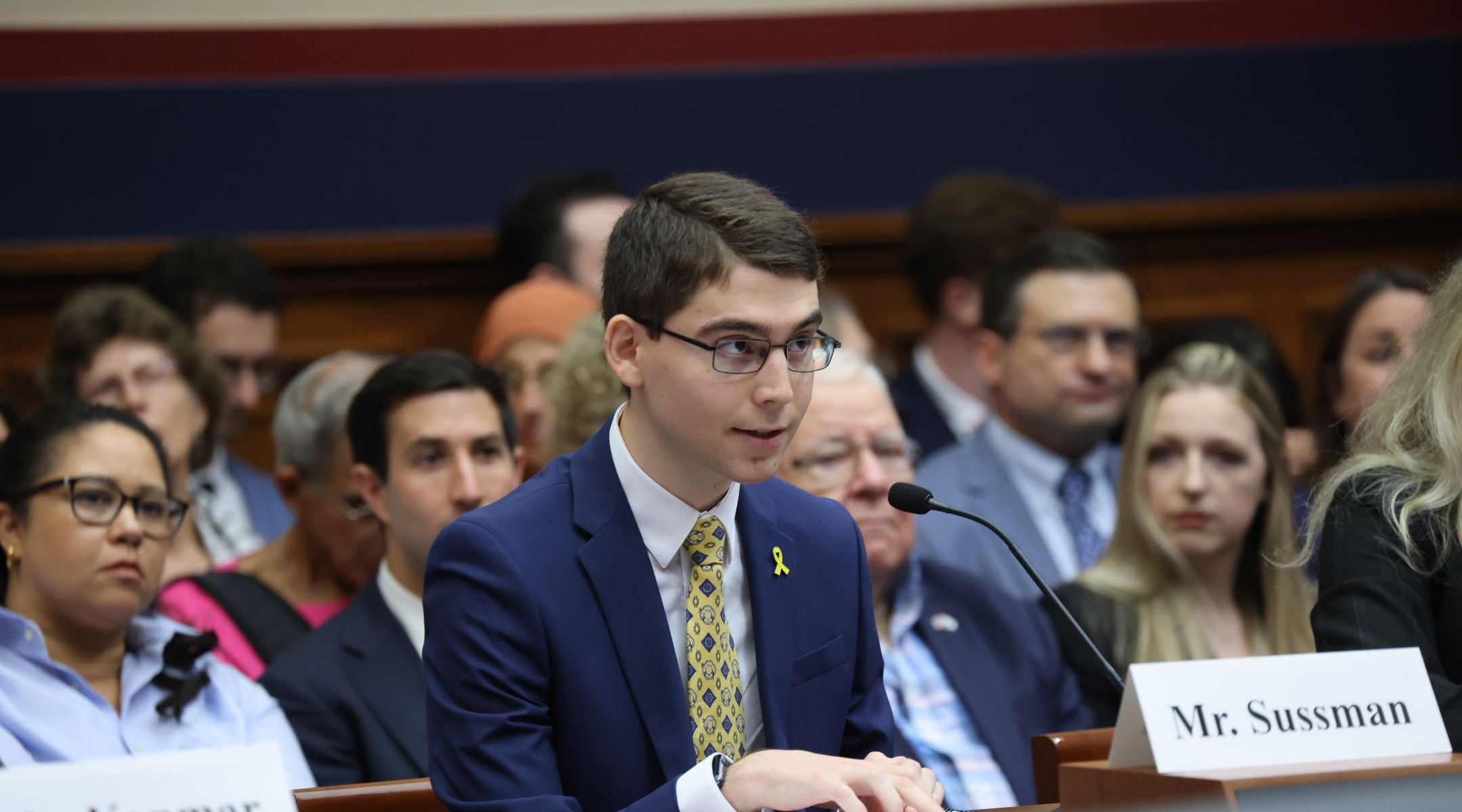
The experience pushed him deeper into Jewish campus life. During graduate school at MIT, Sussman became president of Hillel in the summer of 2023, just months before antisemitism surged nationwide following Oct. 7. In July 2024, he testified before the U.S. House Committee on Education and the Workforce, saying he shouldn’t be required to pay dues to a graduate student union that engaged in anti-Israel advocacy.
He currently serves as an adjunct professor at Yeshiva University, where he teaches mathematics for computer science.
While unable to discuss many details due to the ongoing lawsuit, Sussman, alongside The Louis D. Brandeis Center Coalition to Combat Anti-Semitism, is suing MIT. As he explained in an opinion piece for the New York Post, the suit alleges that the university failed to protect him from harassment after a tenured professor publicly used inflammatory anti-Zionist language online and then repeatedly targeted Sussman by name on social media. Sussman has described the episode as emblematic of what he sees as institutional unwillingness to confront antisemitism directly.
That same concern shapes his views on public universities like Stony Brook University, located in the Fourth District. While he supports administrative measures such as Title VI coordinators, he believes they do not address the core issue. “That assumes that when your child is harassed on campus, there will be a staff person paid six figures to collect paperwork after the fact,” he said. “It misses the root of the problem. We need leaders who will call out the hate for what it is, who will hold faculty accountable, and who will expel students who abuse the opportunity they’re given.”
The Fourth Assembly District is a politically mixed stretch of Suffolk County with a large population of students and young professionals. Despite running in a district with more registered Democrats than Republicans, Sussman is confident. The Fourth Assembly District is often described as a purple pocket in a red county, and recent elections have been decided by razor-thin margins.
If Sussman receives the Republican nomination, he will face Democratic incumbent Assembly member Rebecca Kassay, who unseated Republican Edward Flood by a mere 900 votes in 2024.
In a statement Kassay provided to (JEWISH REVIEW), the assemblywoman cited her record on affordability, environmental protection, public safety and outreach to the district’s Jewish community. “For our Jewish community members, I share their relief that the fight against antisemitism will remain a priority in District Four regardless of election results in November,” she stated.
Will Sussman holds a copy of a local newspaper announcing his candidacy for State Assembly, Jan. 8, 2026. (Team Sussman)
Kassay noted partnerships she forged with local rabbis and faith leaders and her support for legislation aimed at addressing hate and discrimination in communities and on college campuses.
The race is expected to be highly competitive. Lawrence C. Levy, executive dean of the National Center for Suburban Studies at Hofstra University and a longtime observer of Long Island politics, described the area as “one of the more competitive Assembly districts on Long Island,” where “both parties have a real shot at taking the seat.”
“Right now, the Democratic brand is a bit shinier than the Republican,” he said, pointing to “President Trump’s falling approval ratings and Governor Hochul’s rising favorability.” As a result, Levy said, “the Republican candidate, regardless of age, religion, or professional experience, probably starts out more of an underdog than in an average year.”
Despite this, Sussman’s social media pages claim that he has raised over $33,000 in grassroot donations since September. Sussman has been endorsed by The Israeli-American Civic Action Network, a pro-Israel political advocacy organization and by Run Gen Z, a conservative advocacy group that supports Gen Z politicians.
On social media and on Substack, Sussman has expressed support for President Donald Trump’s immigration policies and for what he describes as the administration’s forceful response to antisemitism on college campuses.
“I’m grateful to President Trump for bringing all of the hostages home, including Long Island’s own Omer Neutra,” Sussman said. “Domestically, I appreciate the administration’s strong stand against antisemitism on college campuses. No one has a right to harass Jews, especially not foreign students who are guests in this country.”
In the Fourth Assembly District, questions of cost of living, campus climate and generational frustration collide. Sussman says that combination makes his candidacy not just plausible, but necessary.
“My district includes Stony Brook University, so there’s a lot of young people, and many of us feel that our elected representatives are failing us,” Sussman said in an interview at Mongo’s Coffee in Syosset while sipping a latte and eating a blueberry scone. “It’s nearly impossible to live here, just economically.”
That concern is not theoretical. Sussman rents an apartment in Port Jefferson and, like many young Long Islanders, worries about whether he will be able to remain in the place he considers home. “Even for myself, I worry about staying here long term,” he said. “That’s terrifying to me, because this is my home. It’s where I’ve always lived. It’s where I want to always live.”
Sussman places much of the blame on Albany and policies that have made it harder for young people to put down roots. “Albany seems to be putting up roadblocks at every turn, rather than making it easier for people like you and me to build a life here,” he said. He has spoken about high taxes and heavy regulation as evidence of these roadblocks.
His policy focus begins with affordability, particularly taxes. “I don’t think it’s a coincidence that people move to Florida where there’s no income tax at the state level, and here in New York we’re paying some of the highest taxes in the nation. At the very least, what I would do is say no to tax increases that just make it harder and harder for people to stay.”
Sussman acknowledges that affordability has become a signature, and successful, issue for progressives. He points to Mamdani as an example of someone who identified the problem, if not the solution. “He used this issue very effectively,” Sussman said. “I’ll give him credit for that. I hate to say it, but at least he’s talking about the problem. What I intend to do is talk about the problem as well, but offer real solutions that will actually make things a little easier.”
Sussman also cites examples of fraud and waste in other states as warnings. “Budgets just keep ballooning at the expense of taxpayers, and with that comes more opportunities for fraud,” he said. “We need someone who will take a microscope to the budget and ensure taxpayer money is being spent appropriately.”
“At the end of the day,” Sussman said, “people find it refreshing to hear someone actually think through the issues, instead of just peddling political talking points.”