
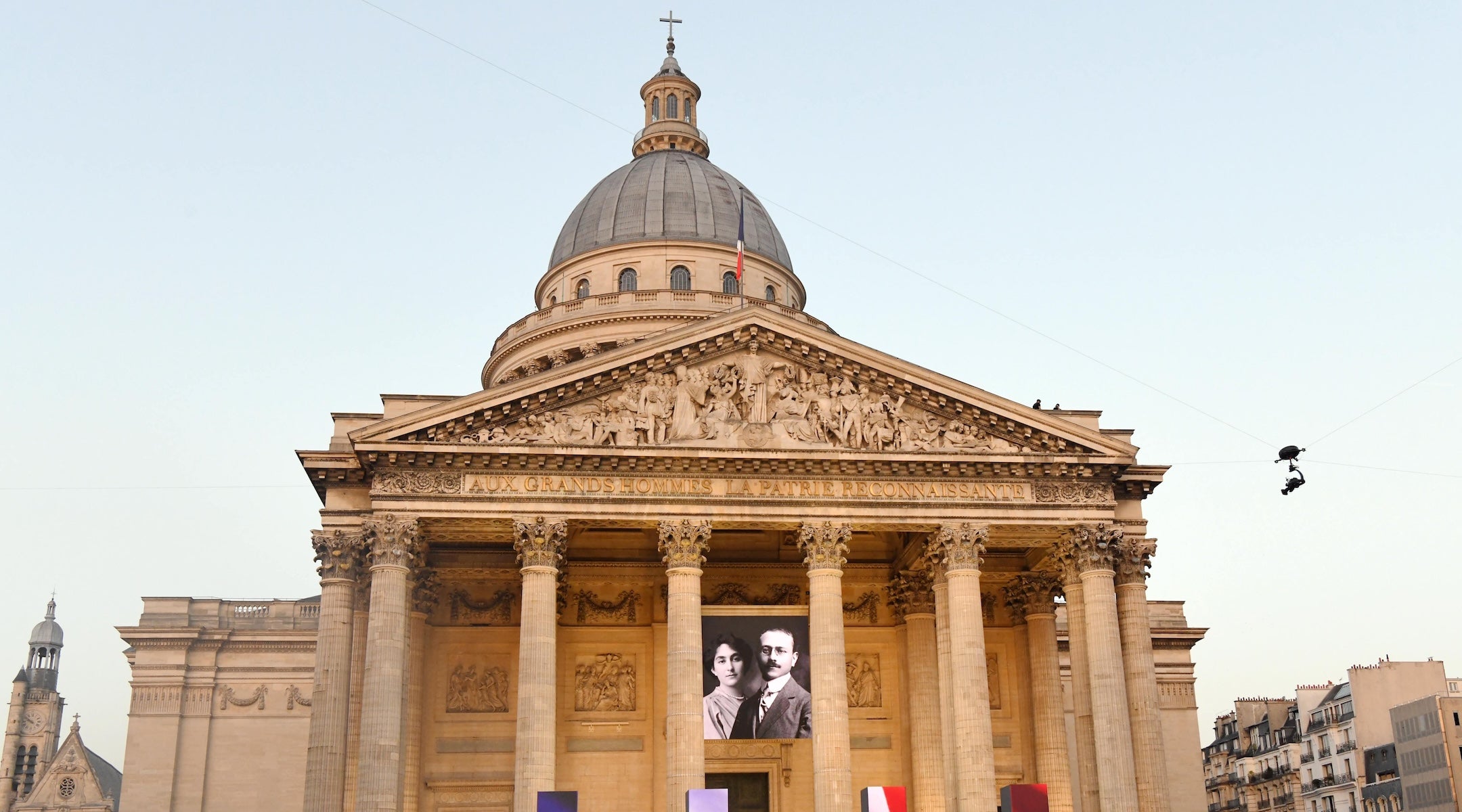
The symbolic internment in France’s Pantheon mausoleum of Marc Bloch, the Jewish French scholar and World War II resistance fighter executed by the Nazis, has been haunted by persistent divisions over who in France gets to commemorate the terrors of its Nazi occupation.
Bloch’s descendants asked the government to ban far-right leaders — who have claimed him as their own model patriot — ahead of the ceremony Tuesday, which marked the country’s highest honor.
About 80 national heroes have been inducted over two centuries in the Paris monument, from philosopher Voltaire and writer Victor Hugo to magistrate and Holocaust survivor Simone Veil.
Bloch’s wife Simonne Vidal, who also supported the French resistance, had her casket interred alongside his. The caskets were empty of remains and instead included medals, photos and writings the couple left their children. Bloch’s family requested his ashes remain in the village where he was buried in central France, and Vidal’s remains have never been found.
Bloch, the first historian to be interred in the Panthéon, has in recent years been elevated by French politicians of all parties as a paragon of a leader committed to truthtelling, even at risk to one’s life. His posthumously published book, “Strange Defeat,” excoriates wartime French leadership for its failures and capitulations to the Nazis.
Jordan Bardella, the head of the far-right National Rally — whose founders included former Nazi soldiers — last year quoted Bloch in a letter demanding statistics on illegal immigration from the interior minister.
“As Marc Bloch, historian and hero of the Resistance, wrote — whom the nation will honor by transferring his remains to the Panthéon on June 16, 2026 — ‘Our people deserve to be told the truth and to be trusted with it,’” Bardella wrote. “These words resonate strongly today.”
Bloch’s descendants have repeatedly expressed offense at far-right leaders invoking his legacy over recent years, as have historians.
Carole Fink, a professor emeritus of The Ohio State University who wrote Bloch’s first major biography in 1989, told the Jewish Telegraphic Agency that right-wing leaders who championed Bloch in their crusades against immigration presented “a complete distortion.”
“There is nothing in his biography that shows this,” said Fink, who visited Paris for the ceremony at the Panthéon earlier this week. “They grab Bloch as their own because of his tough-minded French patriotism.”
French scholars have also expressed irritation at Bardella’s citation of Bloch. “For Jordan Bardella to dare to quote Marc Bloch is an outrage to all the victims of France’s collaboration with the Nazis,” wrote professors Joëlle Alazard and Annette Becker in Le Monde.
Bloch, a pioneering scholar of medieval history and decorated World War I soldier, lost his professorship at Sorbonne University under France’s Nazi-backed Vichy regime. In 1943, he joined the underground resistance movement in Lyon. He was tortured and shot by the Gestapo in 1944, shouting as his last words, “Vive la France.”
Suzette Bloch and Matis Bloch, the granddaughter and great-grandson of Marc Bloch, pleaded for the exclusion of far-right leaders in a letter to President Emmanuel Macron, who presided over the ceremony.
“The work of this committed patriot is profoundly anti-nationalist, built in opposition to the national narrative and the reduction of French history to national borders,” the descendants wrote.
“This commitment was realized even in death,” they continued. “In this sense, it seems essential to us that the far right, in all its forms, be excluded from any participation in the ceremony.”
The government, in keeping with protocol, invited National Rally leaders. Bardella, apparently deferring to the family’s wishes, announced that he would not attend or send any representatives.
The founders of the National Rally, formerly known as the National Front, include Jean-Marie Le Pen, who was repeatedly convicted of hate speech and Holocaust denial — and whose daughter, Marine Le Pen, led the party from 2011 to 2021 — and Pierre Bousequet, who served in the Nazi Party’s Waffen-SS.
The National Rally has disavowed this past, with Marine Le Pen leading a campaign to “detoxify” the party and expelling her father from it in 2015. The party leaders have renounced antisemitism and adopted a pro-Israel platform, now emphasizing restricting immigration and strengthening French nationalism. Recent polling suggests that Bardella is on track to win the presidency in France’s election next spring.
The role of a political movement descended from figures who were Nazi collaborators or who soft-pedaled the Holocaust has roiled France in recent decades, as the National Rally has made inroads with the electorate. The suffering of the French under the Nazis, and the heroism of those who resisted them, looms ever large in monuments and French popular culture.
Macron pointedly said during his speech in the Panthéon that the “spirit of Vichy” persisted as “a slow poison in our public life that must be fought tirelessly.”
This was a spirit that “claims to save France by steering it away from our principles of liberty, equality and fraternity, the spirit of defeat, constantly fueled by those who proclaim themselves to be more French than you,” said Macron.
Bloch’s fate showed “where antisemitism inevitably leads, once anyone embarks on that path of darkness,” he said.
Bloch’s family asked in their letter that the tribute be “purely secular,” as Bloch requested in his will.
Bloch learned about the ramifications of antisemitism as an adolescent, when his father campaigned for Alfred Dreyfus, a French Jewish army officer falsely accused of spying for Germany in 1894. Though Bloch never rejected his Jewish identity, he was an atheist, and his family wrote that he “placed his faith in only one idea: the Republic.”
Bardella celebrated Bloch’s elevation on social media Tuesday, praising his “unrelenting indictment of the cynicism, selfishness, and blindness of a portion of the French elites who led our country into the abyss in 1940.”
Bardella’s acolytes have observed that Bloch was arrested by a French collaborator who was a Communist before the Nazi occupation, without noting that he had long renounced Communism by the time of the arrest. A right-wing argument, dismissed by scholars, that Nazis were a manifestation of socialism has gained popularity in recent years.
Bardella’s post drew a rebuke from Jean-Luc Mélenchon, the leader of the left-wing France Unbowed party, and himself a presidential candidate who is forecast to surge in 2027. Mélenchon has also been accused of echoing antisemitic tropes, dog whistling and downplaying the threat of antisemitism in France, which he has called “residual.”
Mélenchon said it was the National Rally’s founders who “drove our country to the abyss.”
“Don’t think we’ll fall for your electoral disguise,” he said.
Reporting the stories that define our era. When history unfolds in real-time, the Jewish world turns to JR. Your support ensures we can document the complexities of war and the resilience of Jewish communities with integrity.