
JACKSON, Mississippi — Days after their synagogue was burned in an arson attack, dozens of Jews in this city stood for prayer in a communal service.
The interfaith prayer event at the Thalia Maria Hall in downtown Jackson, billed by Mayor John Horhn as an “All-City Call to Prayer and Action,” had been planned as a general ceremony for the city.
But after Beth Israel Congregation was set ablaze Saturday morning, Benjamin Russell, who serves as the student rabbi and spiritual leader of Beth Israel Congregation, said Horhn had called and said he wanted to tweak the event “pray for you and provide blessings.” The call came amid cascading support from across the city.
“We pretty much expected it all,” said Russell of the outpouring of support. “For the most part, we’ve always felt welcome, and so this was more of a confirmation of what we already knew.”
In Jackson, Beth Israel Congregation’s 140 families are far outnumbered by the city’s 400 churches. The gathering Thursday night underscored the complexity of Jewish life in Jackson, a place where the small community has been widely supported by its neighbors at a time of crisis, but always conscious of its minority status in a city defined by Christian institutions.
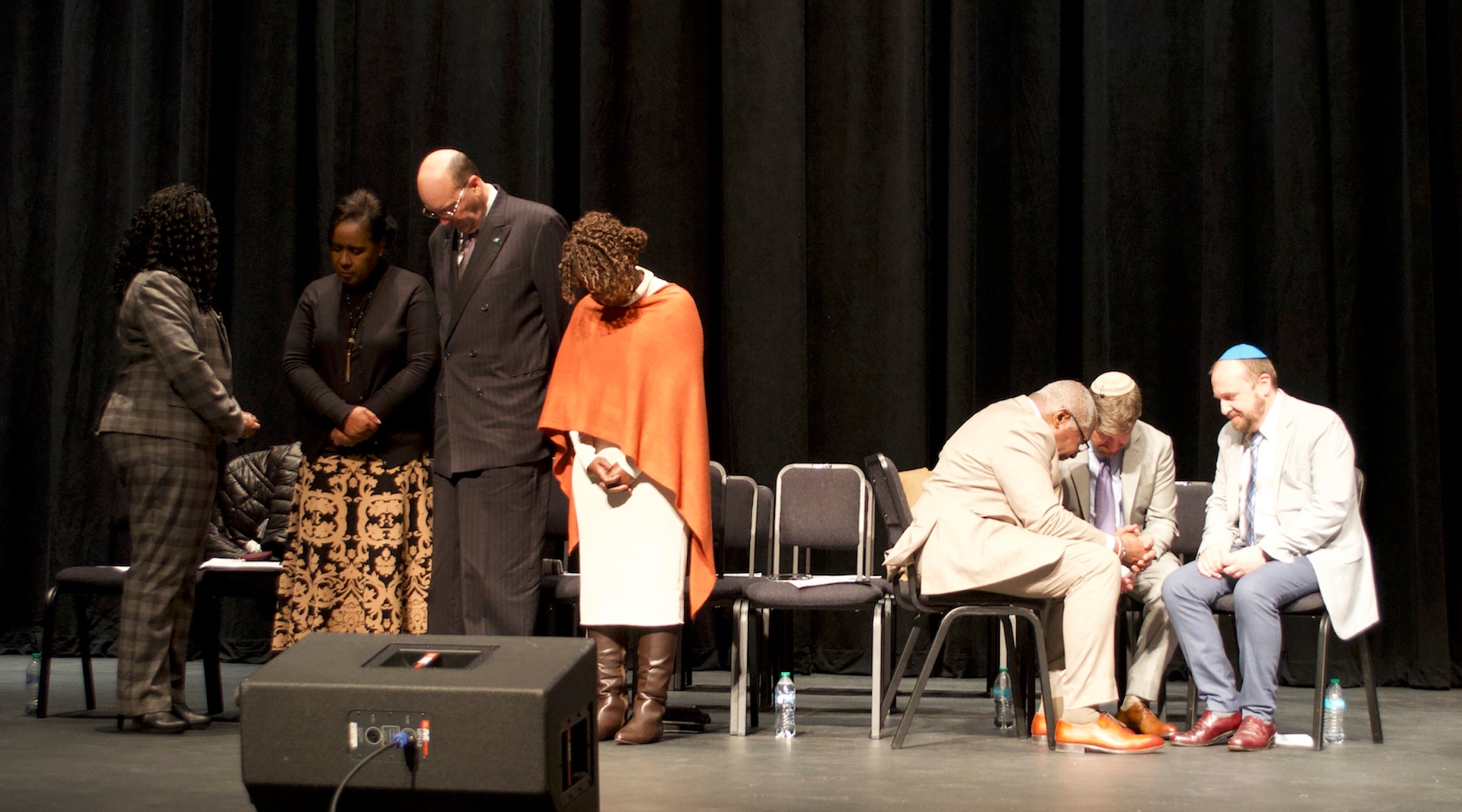
Throughout the service, participants were invited to huddle with their neighbors in prayer circles as the program’s faith leaders, who were almost all pastors, bishops and reverends, gave blessings over different aspects of Jackson’s city life.
“It is our intent to not make this a spectator-type event where you just watch us up on the stage pray. Know everybody is going to get in on prayer tonight,” said Bishop Ronnie Crudup. “I want you to find a few folk you can huddle with, you can create a circle with. You can reach over and touch if you want to, and make them your prayer partners for this time tonight.”
Some Jewish audience members stay seated during an interfaith service in Jackson, Mississippi, on Jan. 15, 2026. (Jewish Telegraphic Agency)
While the third prayer of the evening centered on “peace and restoration” for the congregation following the fire, the rest of the service was laden in references to the city’s predominantly Christian faith.
During the second prayer, which called for a “good working relationship” between Horhn and the city council, the pastor who led the prayer said, “in the name of Satan, you don’t have no power in him, there’s too much faith in him, it’s too much belief in you and in the name of Jesus.”
Following the prayer, Horhn told the crowd, “oftentimes, when I hear someone say I’m praying for you, I say, I thank you, keep me covered in the blood of Jesus.”
Toward the end of the service, former Mississippi Republican Rep. Charles Pickering called for Jackson to bring “God’s kingdom to earth,” which he described as “one people with one mission and one language and one faith.”
Russell said the display was typical for the community.
“We live in the buckle of the Bible Belt,” said Russell. “Sometimes we just have to be grateful for the support that we’re receiving … even if some of the messages may not be exactly what we would say.”
Many of Jackson’s roughly 400 churches serve the city’s large Black Protestant community. About 80% of Jackson’s roughly 150,000 residents are Black.
“Because this event was geared so much toward the city of Jackson itself, that was its kind of main focus, that it made it a little harder for everyone to kind of hold everything in which is, again, is one of the things that we understand living here,” said Russell. “We’ve been here since 1860, and that goes with a lot of history and a lot of learning how to interact with each other, so we do it, we do a dance very well.”
The city is home to long and deeply etched ties between its Jewish and Black communities. In 1967, members of the Ku Klux Klan bombed Beth Israel after its rabbi at the time, Perry Nussbaum, advocated for civil rights and desegregation. Months later, Nussbaum’s home was also bombed by the group.

Extensive damage to the Beth Israel Congregation synagogue after an arson attack in Jackson, Mississippi, Jan. 10, 2026 (Beth Israel Congregation)
“Moving forward from the 60s, during the first bombing, there was an interfaith committee that was put together,” said Russell. “We’ve had several organizations that have kind of helped keep, at least in the metro area, the different faith traditions together, which has been really instrumental in things like we saw tonight where people are willing to reach out.”
Michele Schipper, the CEO of the Institute of Southern Jewish Life, which is housed in the synagogue building, grew up in Jackson going to Beth Israel Congregation. She was a toddler at the time of the bombing.
“Once the temple was bombed and the rabbi’s house was bombed, that really was when the community really came together and stood strong,” said Schipper. “I think harkening back to that time, we’re reflecting. We made such great strides from that time, [and] we will continue to move forward in a very positive direction, because we’re here for the long haul.”
Speaking at a local cafe ahead of the interfaith service, which streamed Christian pop songs from the sound system, Schipper reflected on what it meant to live as a Jew in Jackson.
“Hate is not inborn, hate is learned, and I’ve always said, especially being here in Jackson, being the minority, I’ve always felt like certain questions that people asked were one of just ignorance,” said Schipper. “It wasn’t negative, it was just ‘I don’t know anything about Judaism, so I don’t know how to ask the right questions.’”
The prayer service, which included a link to the synagogue’s rebuilding fund on its flyer, was not the only display of support from the city’s Christian community.
In the immediate wake of the attack, as congregants began to flock to the synagogue’s parking lot to see the devastation for themselves, the church across the street, St. Philip’s Church, immediately opened its doors to allow grieving members a space to process.
On Friday, the congregation’s first Shabbat service since the attack will be held at the Northminster Baptist Church.
Shari Rabin, an associate professor of Jewish studies and religion at Oberlin College and the author of the 2025 book “The Jewish South: An American History,” told the Jewish Telegraphic Agency that synagogues facing attacks in the South had largely been met by support from the community, even as Jews have also faced antisemitism in the region.
“Obviously, there have been times when there is more sort of Christian antagonism towards Jews and missionary zeal and the like,” she said. “But I think there also has generally … just been a sort of public outcry and support when synagogues are attacked.”
Rabin said the attack on Beth Israel Congregation underscored a deeper vulnerability facing Jewish communities, even those with long roots in the South.
“I think it is a reminder that Jews can live in a place, have a community in a place for decades, 150-plus years, they can be acculturated and part of the community and prominent members in all sorts of ways, and there still is sort of an underlying precarity that makes them vulnerable,” she said.
Following the 1967 bombing, Rabin said Nussbaum had taken aim at the leading Southern Baptist minister in Jackson, telling him “go to hell when he came around with his condolences, telling him to preach the following Sunday to his front pews, where all the rightists regularly gathered.” She said he had been motivated by a clarity about where the attack’s ideological roots lay.
“For him, like that attack was coming out of a sort of radical, certain kind of Christian discourse that he wanted to call out,” said Rabin.
Speakers on Thursday night likewise lay blame for Saturday’s attack. The man charged with the arson, Stephen Spencer Pittman, referred to Beth Israel as a ”synagogue of Satan” and espoused Christian content online. He was not mentioned by name Thursday night.
Hohrn told the crowd that it was “an indictment on our country, on our community, that there wasn’t a way, someone to stand in the gap, to turn him around, to make him inspired not to make that journey.”

Derrick Johnson, NAACP President and CEO, attends the 56th NAACP Image Awards Creative Honors at The Novo on February 21, 2025 in Los Angeles, California. (Paras Griffin/WireImage)
The president and CEO of the NAACP, Derrick Johnson, blamed the Trump administration, charging that the “political climate” in the country that fueled the attack.
“I have no illusion of what is taking place, it is germinating directly from the White House,” said Johnson. “Some people say, ‘but don’t be politically praying,’ but let’s be very clear, the tone that is set for this country about accepting one another or other-izing our communities will be the tone that our young people buy into. It can be socialized on social media, to be radicalized, to carry out these disastrous attacks.”
The comments elicited the only open dissent during the event. An audience member shouted from the back of the auditorium, “It’s not coming from the White House.”
But Johnson continued his remarks, telling the audience that “as we pray for Beth Israel, we should be even more vigilant and accepting of one another and all that we bring to the table.” He was met by a chorus of “amens” and applause.
Johnson’s address came shortly before the prayer for Beth Israel Congregation commenced, in which dozens of Jewish audience members were called to rise from their seats.

Jewish audience members rise during an interfaith service in Jackson, Mississippi, on Jan. 15, 2026. (Jewish Telegraphic Agency)
“God bless the families and the leaders of Beth Israel, may they feel the love of a community surrounding them from the ashes of despair,” said Bishop David Tipton, a district superintendent of the United Pentecostal Church.
A second Christian clergy member, Pastor CJ Rhodes of the Mt. Helm Baptist Church, also offered a prayer for the synagogue. In it, he referred to Jesus as a “Palestinian Jew” and told the crowd, “We thank you for being the God who watches over Israel, Palestine, the entire world.”
Rhodes then used the Hebrew words, including one meaning God, to call for benevolence toward Jackson’s Jewish community.
“God, we come before you asking for your chesed, your lovingkindness, be poured out abundantly upon Congregation Beth Israel,” continued Rhodes. “We thank you for the compassion and the comfort they receive, not only from you Adonai, but from all of your people.”
Following the prayer, the synagogue’s president, Zach Shemper, thanked those present for their support.
“Thank you for standing with the Jewish community this evening, for the overwhelming, overwhelming outpouring of support in words and in actions, for speaking out against this historic antisemitic event, for being a part of a rebuilding and believing that we all have a right to safely pray for one another,” said Shemper.
Shemper also recalled the solidarity displayed by the city’s Christian communities with Beth Israel Congregation during its initial dedication in 1967, a few months before the Klan bombing.
Russell also addressed the audience, expressing gratitude for the “outpouring of care and love” from the community.
“This act was meant to make us feel unsafe and unwelcome in our own city, it was meant to push us inward, it was meant to tell us that we do not belong,” he said. “But the response from all of you, from all of our neighbors, has made something unmistakably clear. Instead of fear, we have felt peace, instead of isolation, we have felt embrace, instead of being pushed to the margins, we have been healed by a wider community practicing radical love in a real, intangible, embodied way.”