
KIRYAT SHMONA, Israel — When sirens once again sounded in this northern Israel town on a recent Thursday, Ala Ghassan, a paramedic trainee with Magen David Adom, gazed up at the sky with concern.
Pausing for only a few seconds to check for incoming missiles or outgoing interceptors, Ghassan, wearing an MDA flak jacket and helmet, raced toward the shelter located in the basement of the MDA’s Kiryat Shmona station.
The day before, Hezbollah coordinated with Iran to launch a strike on northern Israel, firing more than 200 missiles in the span of just a few hours. Since Hezbollah joined the conflict on March 2, it has launched more than 3,500 rockets, missiles and drones at Israel. Multiple Israelis have been killed, including a woman on the verge of being married on Wednesday and a man in Nahariya on Thursday.
The assault on the border region has ignited sharp anger from some local leaders, who have demanded that the Israeli government come up with a better strategy to protect residents. But inside the shelter, Ghassam, 21 and on the job for only weeks, was focused only on the job at hand, waiting to learn where he would be dispatched to assess damage and treat victims.
Ghassam recounted why he had decided to join Israel’s volunteer emergency response service. “Seeing what they did in Majdal Shams is why I am here,” he said.
Soldiers and emergency workers treat a person injured by a rocket fired from Lebanon on March 23, 2026 in Kiryat Shmona, Israel. (Amir Levy/Getty Images)
He recalled how, during Israel’s last war with Hezbollah before the negotiated ceasefire in November 2024, a Hezbollah missile struck a soccer field in the Druze town of Majdal Shams, killing 12 children.
“The oldest was only 16,” Ghassan recounted, with tears in his eyes, tugging at his collar to reveal a pin depicting the Druze national colors.
Ghassan is Druze like much of the community in the Golan Heights, which Israel annexed during the 1967 war and which the United States recognized in 2019 as under Israeli sovereignty. The Druze community in the Golan is small and incredibly tight-knit, forbidding intermarriage and maintaining a strong sense of collective identity.
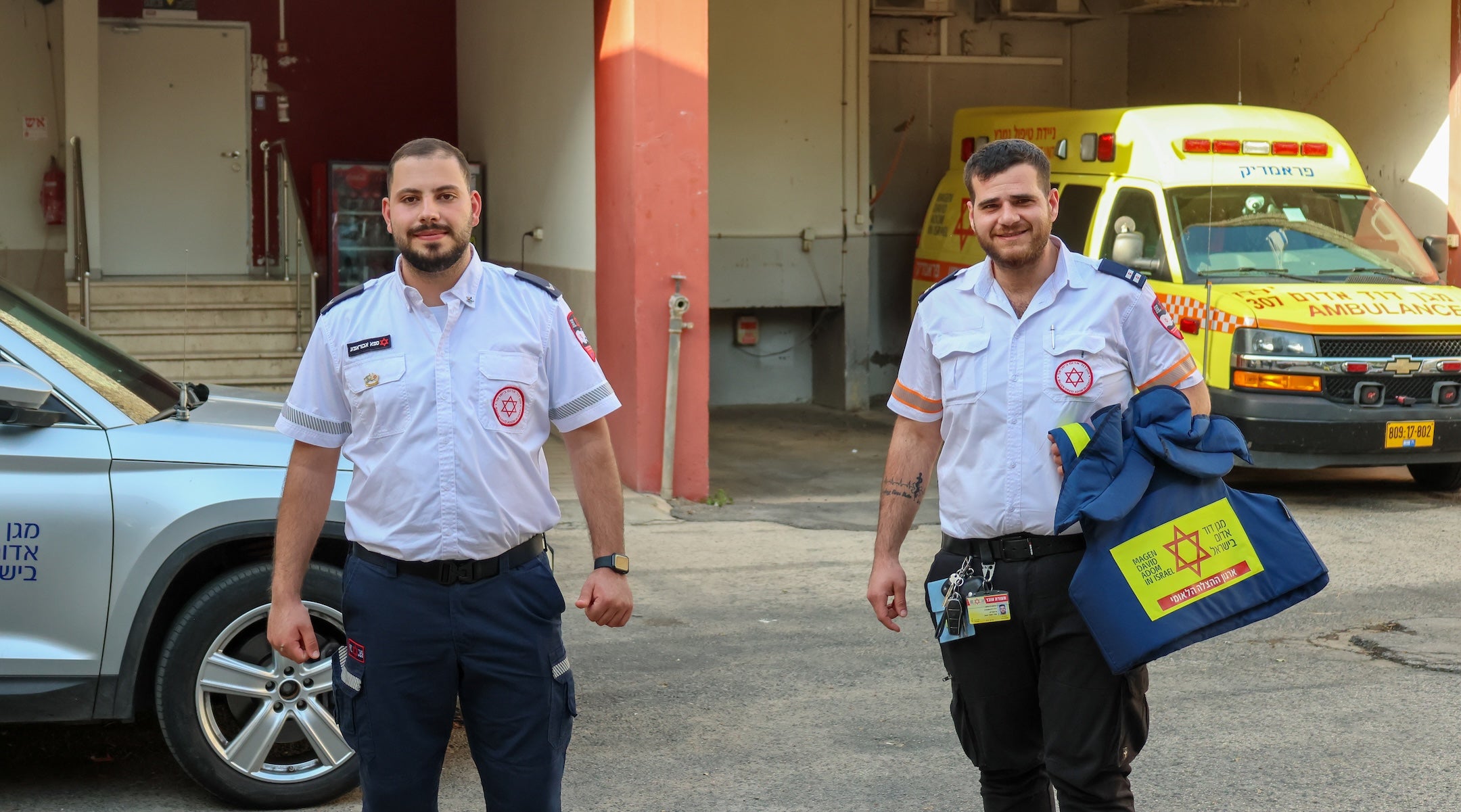
Like Ghassan, most of the paramedics at the Magen David Adom station in Kiryat Shmona are either from the community or have lived there for years. They are Druze, Christian and Jewish and range across decades in age.
And they all harbor a shared hope: that as Israel endures yet another war with Hezbollah, “this will be the last,” Omri Hochman, the Kiryat Shmona station director, said hopefully.

An ambulance is parked outside the Magen David Adom station in Kiryat Shmona, Israel, March 2026. (Theia Chatelle)
Magen David Adom is Israel’s civilian ambulance and emergency response service. Drawing on a network of more than 37,000 employees and volunteers, it has been on the front line of every disaster and conflict response in Israel since it was founded in 1930.
In peacetime, the group functions like a 911 operator, with volunteers listening in on radios to hear about injuries and illnesses near them and dropping everything to respond. MDA volunteers have delivered babies, resuscitated heart attack victims and even and even turned their own homes into field treatment sites on Oct. 7. This year, the group has even launched a mental health service that dispatches both paramedics and psychiatrists to callers facing mental health crises — a desperate need in a country where a third of adults say they need mental health support after years of war.
Now, as missiles, cluster bombs and Hezbollah rockets fall across Israel during the latest two-front war, MDA volunteers are often the first on the scene, treating the injured and assessing the destruction. They unfortunately have years of experience.
“Lessons learned from previous rounds of conflict with Hezbollah and Iran have significantly strengthened our readiness, including improved coordination with security forces,” said deputy spokesperson Nadav Matzner.
Eli has been working with Magen David Adom in Kiryat Shmona for more than 20 years, the first 15 as a volunteer and the last five on staff, as an operations manager. Speaking from behind his desk at the Kiryat Shmona station, Eli, identified only by his first name due to security concerns during wartime, recounted how the whole team had stepped up after the latest round of fighting.
“We usually have two teams operating during any given shift; now we have nine,” Eli said. In addition to drawing from other response centers in quieter parts of the country, he said, local volunteers are pulling double shifts.
Before he completed his three years of training to become a paramedic, Eli was working as a store manager, supporting his wife and their five children. But after his father died of a heart attack, Eli recalled, “I didn’t know how to do CPR. I vowed that I would never be in a position like that again.”

Ala Ghassan loads a display in the basement of the former Metula Local Council building, only his second time stationed at the location, and prepares to respond to calls, March 2026. (Theia Chatelle)
The rest of the staff at MDA in Kiryat Shmona — mostly volunteers — have also been working double shifts since the start of the war. When asked how he finds time to sleep, or to be with his five children, one of whom is currently serving in the army in Lebanon, Eli said, “I sleep, well, sometimes.”
“Right now, most of what we’re seeing are injuries of elderly residents on their way to the shelter,” said Eli, who himself served in a combat battalion in Lebanon during Israel’s occupation of the south in the 1980s. “But it’s only going to get worse from here, and like the last war with Hezbollah, we expect most injuries to be from shrapnel.”
There is a severe lack of shelters in northern Israel, something that is front of mind for residents. Only about 40% of homes in the city are equipped with safe rooms. Maya Gazbo, another volunteer with MDA in Kiryat Shemona, recounted how many of the town’s elderly residents have simply given up on going to public shelters, as they are too far away and mobility issues make it nearly impossible.
Others who try to make it end up injuring themselves on the way, which constitutes a significant portion of MDA’s calls in the city.
After the last round of evacuations in 2024, which left residents living either in government-funded hotels or with family members away from the front lines for more than a year, many did not return, leaving the community fractured, according to Hochman.
Since the start of the war, Magen David Adom in Kiryat Shmona has had a team of paramedics on standby at a location within a kilometer of Lebanon’s border — at a site that cannot be identified due to security concerns — in case there is a mass-casualty event requiring the evacuation of wounded soldiers.

Hagar, a Magen David Adom worker, smokes a cigarette and sips coffee before heading out on a call, Kiryat Shmona, Israel, March 2026. (Theia Chatelle)
On the way into the kibbutz, the roads were empty. Few residents venture out of their homes after dark due to the pattern of missile fire from Hezbollah directed at both civilian centers and Israeli military bases around Mount Meron.
Arriving at what used to be a municipal office for the kibbutz, the team immediately entered the shelter. The former government office, largely deserted due to the war, displayed pictures from the kibbutz’s early era, with members holding both assault rifles and farming implements.
Safa Aburafa, 32, is something of a veteran, having worked with Magen David Adom in Kiryat Shmona for more than five years. He has been showing Ghassan the ropes and providing comfort during wartime.
Aburafa set up a command-and-control station in the basement of the shelter, waiting for incoming calls from MDA dispatchers. Periodically, outgoing fire from an Israeli artillery installation sounded and, occasionally, the sound of interceptors shooting down drones launched by Hezbollah.
Aburafa recalled treating dozens of wounded Israeli civilians in the north in the aftermath of Hezbollah missile attacks. He said the work has grown harder this time around, as Israelis who have already lived through one war with Hezbollah are growing accustomed to the conflict and, in many cases, choosing not to go to the shelter.
“Lebanon is right there, and by the time the alarm sounds, residents have just seconds to make it to the shelter,” Eli said, gesturing toward the border. “They have to go right away, but we’re seeing that so many don’t.”
Eli explained that MDA has direct lines of communication with both the police and the army, and during wartime those channels become even more important. There was concern after Oct. 7 that Hezbollah would launch a similar cross-border attack, so contingency plans were built to prevent such an eventuality.
So far, the war has claimed the lives of more than a dozen Israelis and injured many more. The work continues for MDA.
“So far, things have been intense, a challenge for all of us, but we’ve been preparing for this since Oct. 7, and it didn’t catch us off guard,” Eli said.
Reporting the stories that define our era. When history unfolds in real-time, the Jewish world turns to (JEWISH REVIEW). Your support ensures we can document the complexities of war and the resilience of Jewish communities with integrity.