

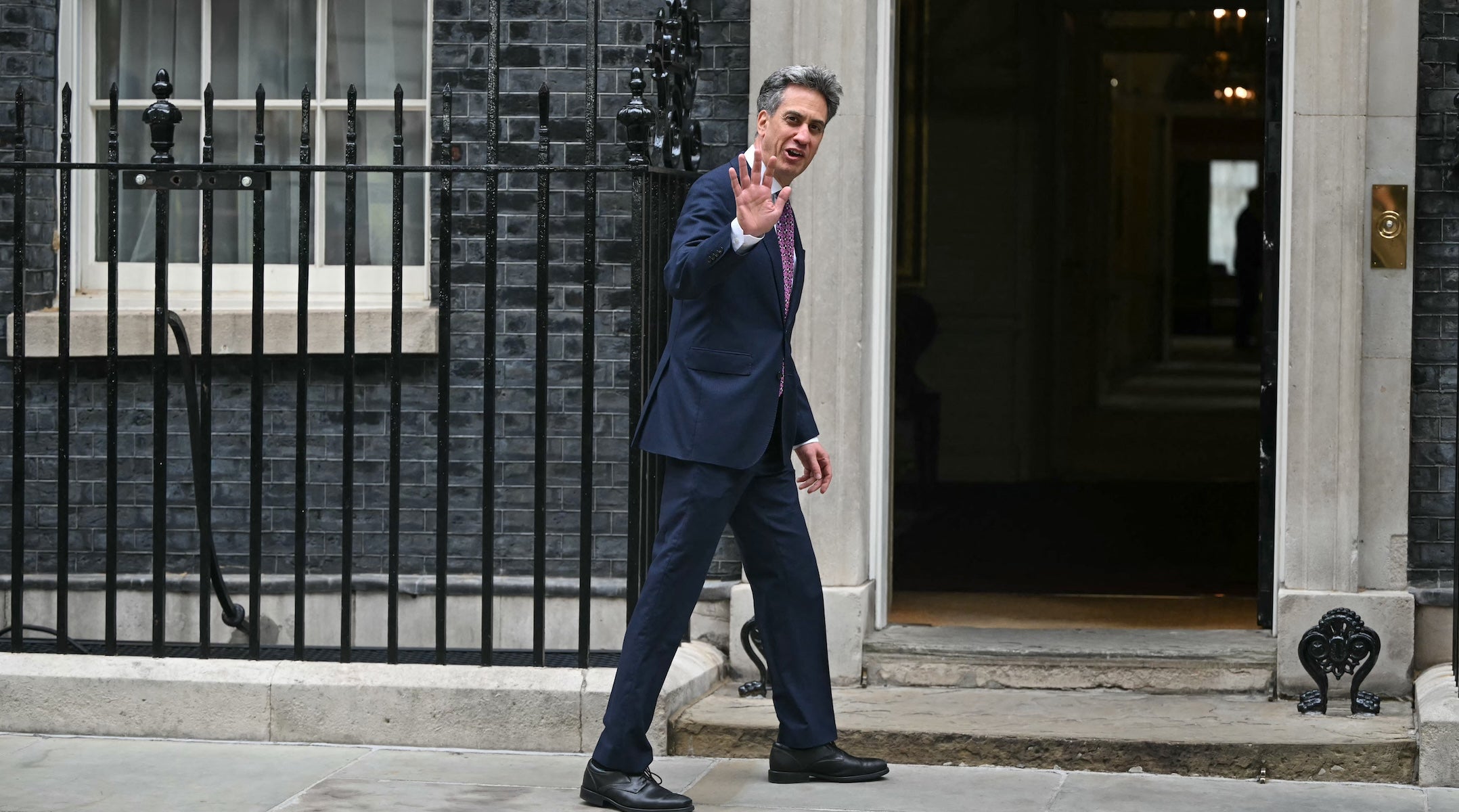
Tapped to become Britain’s new foreign secretary, Ed Miliband said he would strive to honor the memories of his Holocaust refugee parents.
“My parents came to Britain as Jewish refugees from the Nazis,” Miliband tweeted just hours after Prime Minister Andy Burnham named him to the post. “To them, Britain was both a sanctuary and a beacon of hope in the global fight against fascism. I will carry my parents’ faith in that spirit of Britain to my role representing our country.”
The appointment by the new prime minister positions Miliband as the highest-ranking Jewish official in the British government, assuming a role once held by his older brother David and at a time when questions of the country’s relationship to Israel are a pressing priority. Miliband has long decried antisemitism, including within his own party, and is also known as a critic of Israeli Prime Minister Benjamin Netanyahu.
Among the priorities facing the office is whether Britain should move forward with an effort to ban imports from West Bank settlements, which has support across the political spectrum, and how to handle surging anti-Israel and anti-Jewish violence that authorities say has been orchestrated by actors abroad.
Ed Miliband led the Labour Party when it was in opposition from 2010-2015; his brother was among the candidates he bested in the party’s 2010 leadership race.
He has said he has no Jewish practice or formal education and that his parents favored politics over religion. His mother, Marion Kozak, who died last month, was an early supporter of Jews for Justice for Palestinians, a British group, but ceased speaking out publicly as her sons ascended in British politics.
David Miliband, now the president of the International Rescue Committee, has also said his career choices stem from the suffering their parents endured as Jewish refugees.
Ed Milliband’s stances on Israel have caused consternation among British Jewish groups in the past. In 2014, he led his party in a symbolic vote to recognize a Palestinian state and also criticized the toll of Israel’s operations during that year’s Gaza war.
“I defend Israel’s right to defend itself against rocket attacks,” he said then. “But I cannot explain, justify or defend the horrifying deaths of hundreds of Palestinians, including children and innocent civilians.”
He also told the Jewish News at the time that he did not eschew the “Zionist” label.
“I am proud to be Jewish,” he said. “I’ve no issue with people calling me a Zionist.” He described Israel as “the homeland for the Jewish people.”
The Board of Deputies of British Jews and the Jewish Leadership Council said they recognized Miliband’s overall support of Israel, but also chided him for his comments about the Palestinian civilian death toll. “These comments regrettably ignore the ideology of Hamas, the psychology of Hamas, the actions of Hamas and thus the reality faced by Israel,” they said then in a joint statement at the time.
Miliband was succeeded as Labour Party leader by Jeremy Corbyn, whose strident pro-Palestinianism and perceived insensitivity to Jewish sensibilities marked the worst relations between the party and the Jewish community in decades.
Miliband was cautious about criticizing his successor but made clear his unhappiness with how Corbyn was handling the antisemitism charges in 2018 when he took the organized Jewish community’s side in lambasting the party leadership for rejecting a definition of antisemitism that includes some forms of anti-Israel rhetoric and activity.
“Labour should adopt the full IHRA definition,” he said then, referring to the International Holocaust Remembrance Alliance. “The argument that it is somehow incompatible with criticizing the actions of the Israeli government is wrong. The views of the vast majority of the Jewish community are very clear.
Miliband condemned Hamas’ Oct. 7, 2023, attack on Israel, but also persisted as one of Labour’s most forceful critics of Israel’s government.
During the 2024 general election campaign, he called Oct. 7 “an appalling terrorist atrocity,” saying, “We in the Labour leadership are completely committed to the security for the people and security for the state of Israel.”
However, he added that “the continuing Israeli action in Gaza is not either beneficial now for Israel, or for the people of Gaza.”
One of the first questions Miliband will face is how he will handle relations with U.S. President Donald Trump, who is famously averse to people who have criticized him in the past. “These are dark days for America and the world,” Miliband wrote in 2017, as Trump assumed his first term of office. The same year, Miliband also said Trump had “lowered the bar for idiocy.”
Reporting the stories that define our era. When history unfolds in real-time, the Jewish world turns to JR. Your support ensures we can document the complexities of war and the resilience of Jewish communities with integrity.