

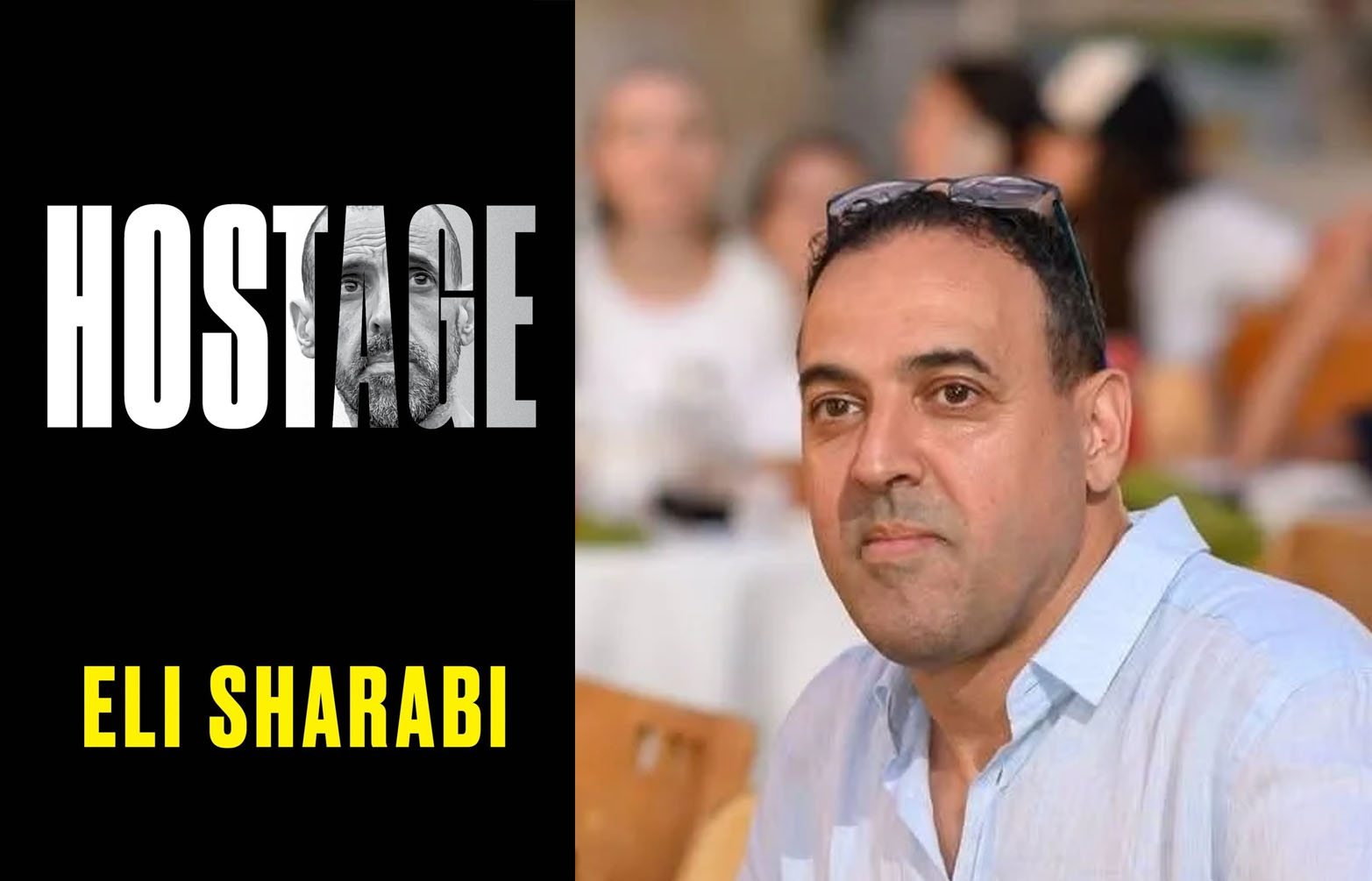
One week after its release in Israel, “Hostage” by Eli Sharabi became a national bestseller, selling more than 20,000 copies. The book repeated that success in the United States following its release on Oct. 7, 2025, quickly climbing The New York Times’ bestseller list. Sharabi is the first hostage taken by Hamas to publish a book, and though the subject matter is difficult, the book itself is a compelling read, grabbing readers from the first page all through the last.
From the very beginning, readers carry a devastating knowledge that Sharabi himself did not have while he was in captivity: that his wife and two daughters were murdered in Kibbutz Be’eri on the day he was abducted. That painful gap — between what the reader knows and what Sharabi continues to hope for — casts a shadow over every page.
Yet the book is not only a chronicle of loss, it is a powerful story of resilience, survival and the triumph of the human spirit when all seems lost.
Sharabi takes readers with him as he is dragged into Gaza, first held in the homes of his captors and later in the dark, terrifying tunnel network below ground. He writes about his experiences in stark, unflinching prose, describing both the cruelty of captivity and the fragile bonds formed among the hostages. Among them is Alon Ohel, with whom Sharabi developed an unbreakable, father-and-son-like bond. Throughout the narrative, Sharabi reveals how his faith sustained him, giving him the strength to endure brutal conditions and overcome profound mental anguish.
Until Oct. 7, 2023, Sharabi was a happily married man living in Kibbutz Be’eri with his British wife, Lian Brisley. The two met in 1995, when then 20-year-old Brisley was volunteering at the kibbutz. They married five years later and had two daughters, Noya, 16, and Yahel, 13. On that day, Brisley and their two daughters were murdered. Sharabi’s brother, Yossi — who was also abducted — was later killed in captivity.
Once he was captured, Sharabi made a decision: “There is no more regular Eli. From now on, I’m Eli the survivor.”
Sharabi recounts being taken first to a mosque in Gaza, where terrorists interrogated him and accused him of being a soldier. He denied the accusation, but they refused to believe that he was 51 years old. He was later transferred to a private home belonging to a middle-aged couple and their three sons. Fluent in Arabic, Sharabi was able to communicate with the father, and the two even reminisced about their grandparents’ childhoods in Jaffa. At times, Sharabi played card games with the family and taught the children basic economics.
Though not a professional writer, Sharabi was able to beautifully depict his 491 days of ordeal, both the painful ones and the emotional ones and there were plenty of both. In one of the chapters he described how he was once allowed to stand with his captor by a window and breathe in the sea air and feel the breeze on his face. “We stand like friends, like brothers. Like something that can’t be defined … As if he’s not a religious extremist. As if he doesn’t hate my people,” he writes.
However, Sharabi didn’t delude himself into thinking they were truly friends. He understood the reality of his situation: if he had even attempted to escape, the man would have shot him in a heartbeat.
Yet for every fleeting moment of connection or beauty, there were repeated reminders of his captors’ control and cruelty. Sharabi also described the repeated humiliation he endured whenever he needed to use the bathroom. His captors would then grab him and lead him to the bathroom where they would “pull our boxers down so we can relieve ourselves,” he writes. “It’s humiliating. You’re standing there, exposed, blindfolded, hands tied, legs bound, performing the most basic, private act after someone has stripped you down, knowing his gaze is fixed on you.”
Still, despite these sustained efforts to strip Sharabi and his fellow captives of their most basic humanity and dignity, they found small ways to resist. When they spotted an unopened bottle of Fanta lying on the floor of the tunnels, for example, they seized the moment, snatching it while the terrorists weren’t paying attention and quickly drinking it. When their captors later suspected the hostages had taken it, they denied it, feigning innocence as Hamas flew into a rage. The act itself was insignificant, but the defiance behind it was not. For hostages who had been deprived of everything — their freedom, privacy, autonomy and control over their own bodies — it was a rare moment of quiet victory, a reminder that their will had not been fully broken.
Throughout his captivity, Sharabi’s body bore the marks of constant abuse: his ribs were badly broken, he was starved, and he lost 66 pounds. By the time he was released, he weighed just 97 pounds. Yet Sharabi emerges not as a victim defined by physical collapse, but as a man of extraordinary inner strength.
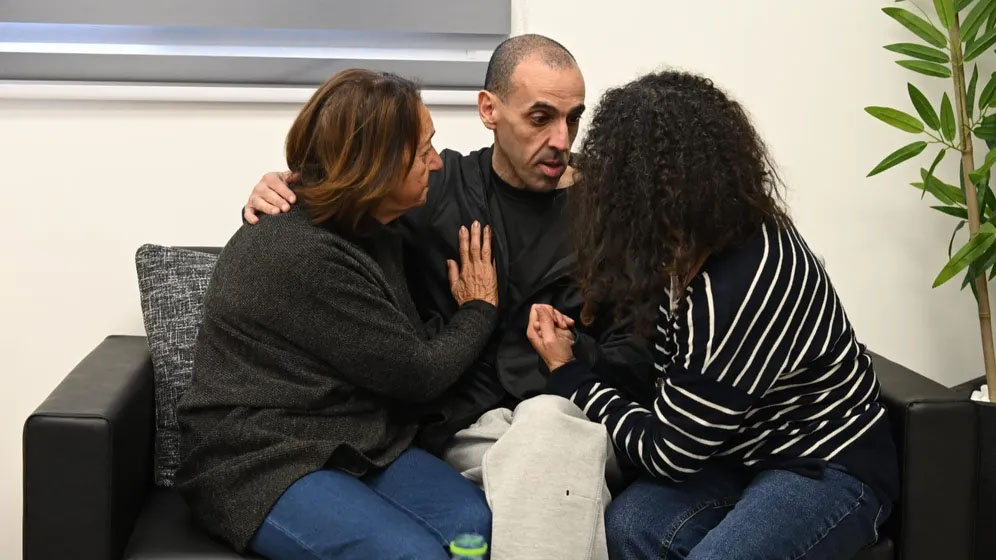
His body may have been broken and deprived of food, but his determination to survive remained intact. One example of this astonishing resolve was an evening ritual he initiated among the hostages, in which they were encouraged to share the “good” things that had happened that day. Sometimes, that meant celebrating having gone an entire day without being beaten, being given an extra half piece of pita, or simply knowing that the cruelest terrorist hadn’t been around for a few days.
When Sharabi was released on Feb. 8, 2025, his return was broadcast around the world. Gaunt and visibly weakened, he stepped out of captivity and back into Israel — only to learn that the family he had been waiting to return to no longer existed.
Since that day, Sharabi has refused to retreat into silence. Even as he continues to heal, he has taken on a public role few could imagine enduring — speaking openly about his captivity and using his voice to press for the release of those being held.
On Oct. 13, he was finally able to mark a long-awaited moment of hope: the release of Ohel, who had spent 738 days in captivity. The two men, who had shared imprisonment underground, were reunited in a moment captured on camera, embracing tightly, a wordless expression of survival, loss and the bond forged in captivity.
In recent months, Sharabi has traveled across the United States, addressing communities and leaders alike, and leaving audiences deeply shaken — not only by what he survived, but by the strength, composure and moral clarity with which he tells his story. A true survival story.