

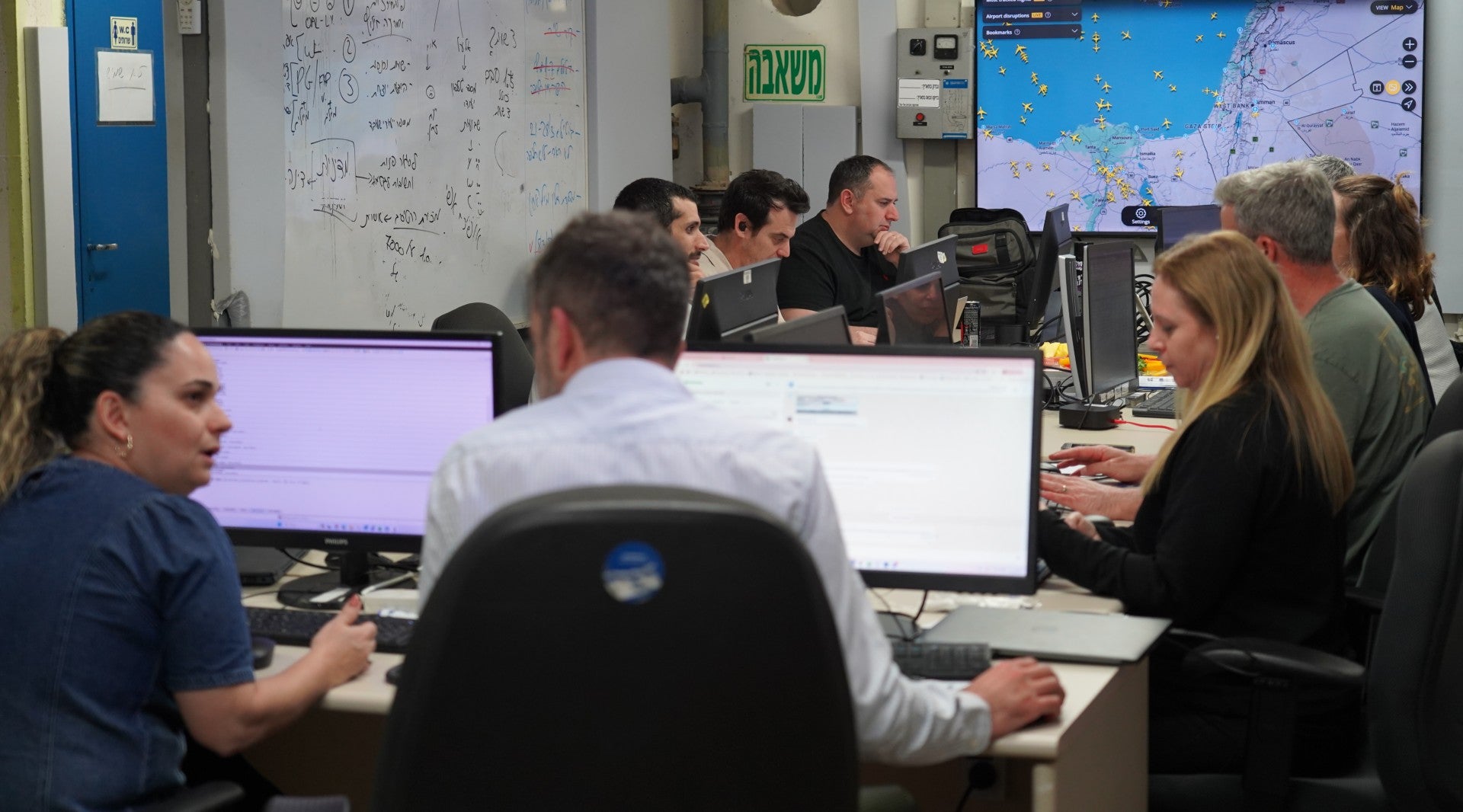
Ilanit Ninay-Lion remembers as if it were yesterday the frantic call she received in November 2023 from the family of Yoni Asher. His wife and their two daughters were kidnapped from Kibbutz Nir Oz on Oct. 7 and taken into Gaza. Hamas terrorists had already killed his mother-in-law, whom they were visiting.
The family holds German citizenship, and Asher was desperate to get to Germany for a diplomatic mission to help secure their release. The trouble was that most airlines had suspended all service to and from Israel, and Tel Aviv’s Ben-Gurion Airport was already taking rocket fire.
“It was an intense situation,” said Ninay-Lion, who oversees customer relations at EL AL, Israel’s flag carrier. “Only EL AL was flying.”
Despite a severely limited flight schedule, Ninay-Lion and her team were able to secure Asher the seats he needed to leave the country. Soon after, a miracle: After 49 days in captivity, the two girls and their mother were released in the first group of hostages freed on Nov. 23.
“Knowing that I was not alone, that I had your support, your empathy and your warm embrace, gave me the strength to wake up and fight every day,” wrote Asher to EL AL. “The road to recovery is still ahead, but I am certain we will one day see peace. Your support during these hard times was a beacon of morality and humanity. I will never forget it.”
It’s all in a day’s work for Ninay-Lion, who’s been with the airline since 1996. During these past 30 years, she’s learned a thing or two about EL AL passengers.
“I can assure you they want from EL AL things they wouldn’t expect from other carriers — the Magen David, the Israeli flag and the blue-and-white colors are symbols for them,” Ninay-Lion said, referring to the airline’s logo. She explained how, after Oct. 7, her team was busy returning passengers home while other airlines had stopped flying to and from Israel. “We know how to manage situations like this.”
During the most recent war with Iran, which began on Feb. 28 of this year, Israel endured almost a month and a half with limited flight operations until the ceasefire in April. More than 3,000 flights were cancelled due to airspace restrictions. Nearly 600,000 passengers received cancellation notifications; of these, roughly 100,000 were traveling to or from North America.
During that time, EL AL transported roughly 110,000 passengers on 800 flights under a special flight schedule, according to Simon Newton-Smith, the airline’s senior vice president for the Americas.
“We’ve got one job to do, and we’ve been completely focused on that job — which is to keep EL AL connected to the world, and the world to Israel,” Newton-Smith said.
Newton-Smith, who’s based at EL AL’s U.S. corporate office near Fort Lauderdale, Fla., joined the airline only a month after Israel’s war with Hamas in Gaza began. Most of his 30-year career in aviation has been with other award-winning international carriers.
These days, EL AL is operating up to 55 flights a week between the United States and Israel. EL AL currently serves New York-JFK, Newark, Boston, Miami and Los Angeles with non-stop flights to and from Tel Aviv’s Ben-Gurion Airport.
Newton-Smith said that even though international tourism to Israel is way down, the “VFR” (visiting friends and relatives) segment is high.
“It’s a heavily trafficked, high-demand market, driven by strong family and religious connections. Sometimes we’re flying up to seven flights a day — five from JFK and two from Newark,” he said.
“The whole organization has had to step up,” he added. “A significant portion of our employees have had to backfill the space left by their brave colleagues on the war’s front lines. But whether there are missile attacks or not, we still have a business to run.”
Ronnie Solson knows all about that. Based at EL AL’s head office at Ben-Gurion Airport, he supervises international customer relations as well as all who correspond in languages other than Hebrew.
“We don’t brag that we worked under threat of bombs and airstrikes, but the fact is we worked — even while our spouses were serving in the military,” said Solson, who was born in Israel but grew up in Florida.
“Since Oct. 7, my team and I have done our best to serve the passengers,” he added. “During the worst of it, all the employees were in their shelters, with their families and kids. Every morning, we met via Teams to ask how they were doing, and update them on what was happening with EL AL.”
Solson said that the weeks following Feb. 28 were by far the most challenging period of his career.
“We were running seven, eight, nine times a day to the shelter,” he recalled. “I had to physically be here and lead by example. But we also gave employees the option to work from home because the roads were not safe.”
Solson said “our passengers understood the situation,” which often changed by the minute. Several times, he added, the authorities limited the number of passengers on flights to minimize time spent at the terminal for security reasons.
“We had to adapt to new requirements at a moment’s notice,” he said. “Tourists were stuck here in Israel and had to go abroad.”
“As customer relations manager, I had a professional duty to talk with passengers, to calm them down and explain that we were doing the utmost to help them,” said Ninay-Lion, who supervises more than 100 EL AL employees. “Whether the state authorities were telling us to close the skies or open the skies, it wasn’t under our control. But we always gave them the feeling that we were there for them.”
Despite the challenges, the airline is adding new routes to its schedule. In October, EL AL will launch three non-stop flights weekly from Tel Aviv to San Francisco, and in November, the airline will begin non-stop service linking Israel with Buenos Aires, Argentina.
EL AL is also expanding its Dreamliner fleet by exercising options for six Boeing 787-9 aircraft, with the possibility of acquiring six more at a later date. Some existing 787-9 orders will also be upgraded to the larger Boeing 787-10. The expansion is designed to increase seat capacity, improve flight availability and support the growth of long-haul routes, all while enhancing operational efficiency and passenger experience. EL AL’s Dreamliner fleet is set to grow from 17 to 28 aircraft by the end of the decade, with the potential to reach up to 65 aircraft in total.
“For nearly eight decades, EL AL has been more than an airline,” Newton-Smith said. “In moments of celebration, uncertainty and crisis, we’ve connected people to their families, their communities and their homeland. The past few years have tested our organization in ways few airlines have ever experienced, but they have also reinforced why our mission matters.”
He added: “No matter the challenges, our commitment remains the same: to keep Israel connected to the world and to ensure that when people need us, EL AL is there.”
As the Year Turns, Support the Journalism You Trust. JR covers the stories shaping Jewish life around the world — with the depth this moment calls for. As you reflect on the year ahead, consider a gift that keeps independent Jewish journalism strong.