
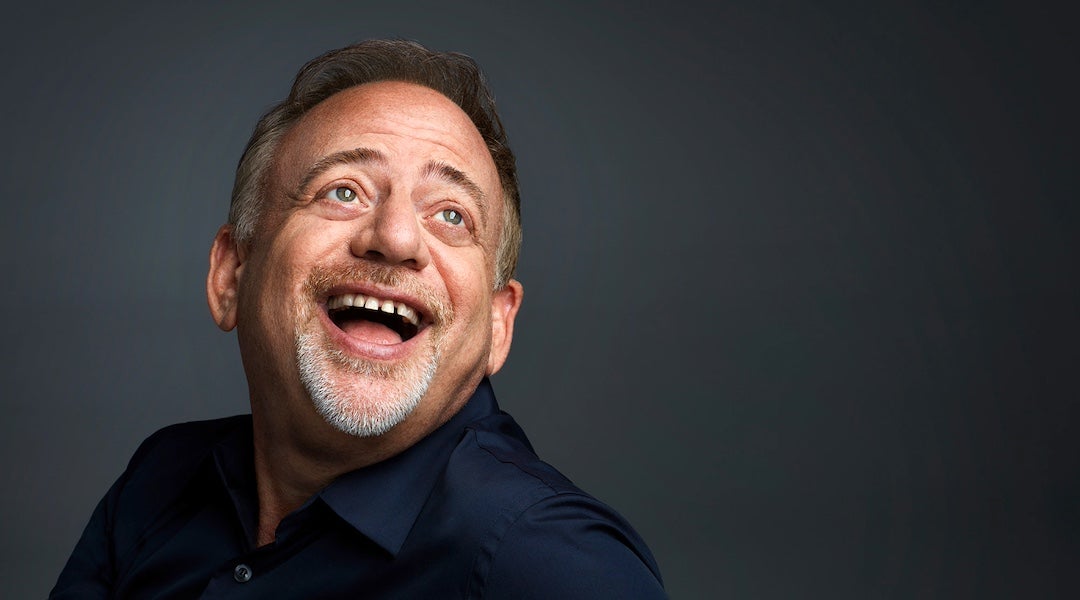
Marc Shaiman likes to joke that for half a century he’s been “the funny Jewish guy at the piano,” a role as old as vaudeville and as enduring as a well-timed joke.
But behind the punchline is a career that traces a distinctly Jewish path through American show business: a bar mitzvah where he improvised the music to his haftarah; collaborations with Bette Midler, Rob Reiner and a who’s-who of Jewish Hollywood; composing the music for Broadway’s “Hairspray,” and scoring the 1999 film “South Park: Bigger, Longer & Uncut” and co-writing its Oscar-nominated song, “Blame Canada.”
Now, in his new memoir “Never Mind the Happy: Showbiz Stories from a Sore Winner,” Shaiman reflects on a life shaped by chutzpah, fate, disappointment and the particular blend of humor, loss and resilience he credits to being Jewish — a sensibility that, he says, made show business feel less like a career choice than a birthright.
“It’s not hard to spend your whole life with Jews when you’re in show business,” he said in an interview with the Jewish Telegraphic Agency. “I know that sounds like maybe a trope or a bad thing to say, but there’s no question that the Jews have been a big part of show business from the beginning of time. I’m sure the first caveman who put on a show was circumcised.”
Shaiman joined that business when he left his hometown of Scotch Plains, New Jersey, at age 16 after getting his GED and headed for New York City. He performed with cabaret acts and comedy shows.
For the last 50 years, the 66-year-old Shaiman has indeed been that funny Jewish guy at the piano, as everything from an arranger and writer in the early years of “Saturday Night Live” to a creator of musical moments for Oscar broadcasts (along with seven Academy Award nominations for his work on films like “Mary Poppins Returns” and “Sleepless in Seattle”). Shaiman worked on music for nearly every film Reiner made, starting with “When Harry Met Sally” in 1989; he was nominated for an Oscar for scoring Reiner’s film “The American President.”
He even appeared as an animated version of himself, piano and all, in the “I’m Super” number in the “South Park” movie.
Many of those projects were written in collaboration with Scott Wittman, his romantic partner for many years, and still his songwriting partner.
The book is full of Jewish mother jokes and Yiddish asides, and the title comes from an expression used by his mother: One New Year’s Day, Shaiman’s sister told her mother, “Mom, I want to be the first to wish you a happy and healthy new year,” to which their mother replied, “Never mind the happy.” Shaiman calls it “the day that my mother defined Judaism.”
He describes the “South Park” gig leading into his biggest Broadway hit, “Hairspray” as beshert, or fated, because the right producer noticed it at the right time. He also credits his own chutzpah for much of his success.
Marc Shaiman and his partner Scott Whitman, shown here at a Drama League benefit in 2011, are known as the songwriting duo behind Broadway’s “Hairspray,” “Smash” and “Some Like It Hot.” (Rob Rich)
One of the first Broadway shows he ever saw was “Fiddler on the Roof,” not long after its debut in 1964, and when a young Bette Midler was making her Broadway debut as Tevye’s daughter Tzeitel.
“Bette Midler’s first two albums and [my] puberty both happened at the same time,” he said at a Philadelphia book event on Jan. 29. “And I became obsessed with Bette Midler.”
Shaiman ended up collaborating with Midler, first as her vocal arranger and then on movies like “Beaches” and “For the Boys.” He was also at the piano when Midler serenaded Johnny Carson as his final guest on “The Tonight Show” in 1992.
The “funny Jewish guy at the piano” trope, he says, dates back mostly to Oscar Levant, the Jewish actor and concert pianist who appeared in films from the 1930s through the ’50s. (Sean Hayes portrayed Levant in the 2023 Broadway play “Goodnight, Oscar.”)
“He was like me, times a million,” Shaiman said of the famously mordant and dyspeptic Levant.
“It’s just Jewish, show business and comedy,” he said. “Those three terms seem redundant to me [in] that you know you can’t have one without the others. You know, I take great pride in my Jewishness and the humor that comes from being Jewish.”
Shaiman didn’t come from an especially religious family, but he did have a bar mitzvah.
“My memory is that I might have used my musical ability to kind of ad lib some of the music to my haftorah, which I could get away with because I could do my own intervals that seemed right,” he said.
In adulthood, he’s become more skeptical of organized religion in general.
“Having said that, I love being Jewish. I love Jewish people. I love how what’s in our blood has made us the way that we are,” Shaiman said.
Friends of his had suggested that he write a book, but the true impetus, he said, was when he heard actress Jane Fonda on a podcast talking about her own memoirs. “She felt it was time for a life review,” Shaiman told (JR).
“And that’s stuck in my head. I think I was also in the midst of a disappointment in show business.
“Maybe even subliminally, I thought if I go back and relive all these moments and write out all these joyous, incredible opportunities I’ve had and stuff I’ve been able to create, it would do me some good,” he added.
Indeed, the book includes both highs, like winning Tony Awards, and lows, including the countless friends he lost to AIDS in the 1980s and 1990s. Some moments combine both: Accepting the Tony he and Wittman won for “Hairspay” — whose 1960s Baltimore setting he tried to infuse with the spirit of his early days in New York — Shaiman said he wished the theater balcony “reached all the way up to heaven,” so their lost friends could celebrate with them.
Another lost friend is Reiner. The book, which is full of Rob Reiner stories, was completed before the murder of the director and his wife, Michele, in December, and Shaiman is still coming to terms with the loss of his longtime collaborator and friend.
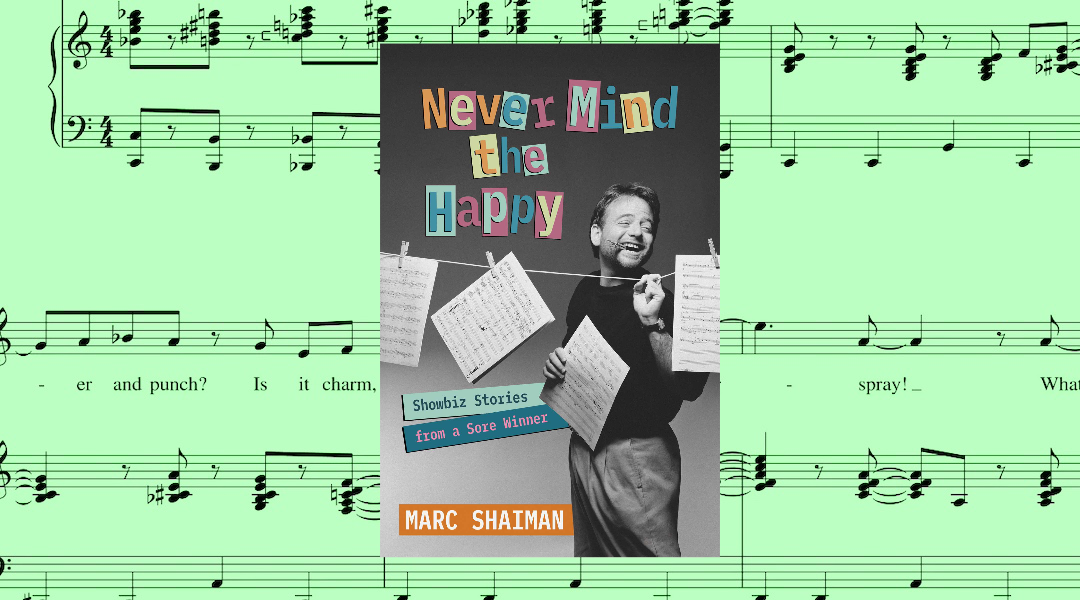
Shaiman writes about the bitter and the sweet of a long, successful career with setbacks that still sting. (Regalo Press)
“He was like my older brother, but he was also a mentor and such a mensch,” said Shaiman, remembering “not just what he did for me for my music and lyric career, but what he did for me as a gay man. [The Reiners] were vitally a part of the fight that got all the way to the Supreme Court that ended up creating legal same-sex marriage throughout the country.
“He was just a part of my life. And I really still haven’t come to terms with what’s happened. It’s too impossible to believe.”
“Never Mind the Happy,” as the title suggests, accepts the bitter and the sweet of a long, successful career with setbacks that still sting. But while he’d love to win that Oscar (despite his seven nominations, Shaiman is one O shy of an EGOT), he counts his blessings.
“I just wanted to tell these stories, honestly,” Shaiman said. “My book is a textbook example of how if you just keep putting yourself out there, that every single one of your dreams can come true.”