

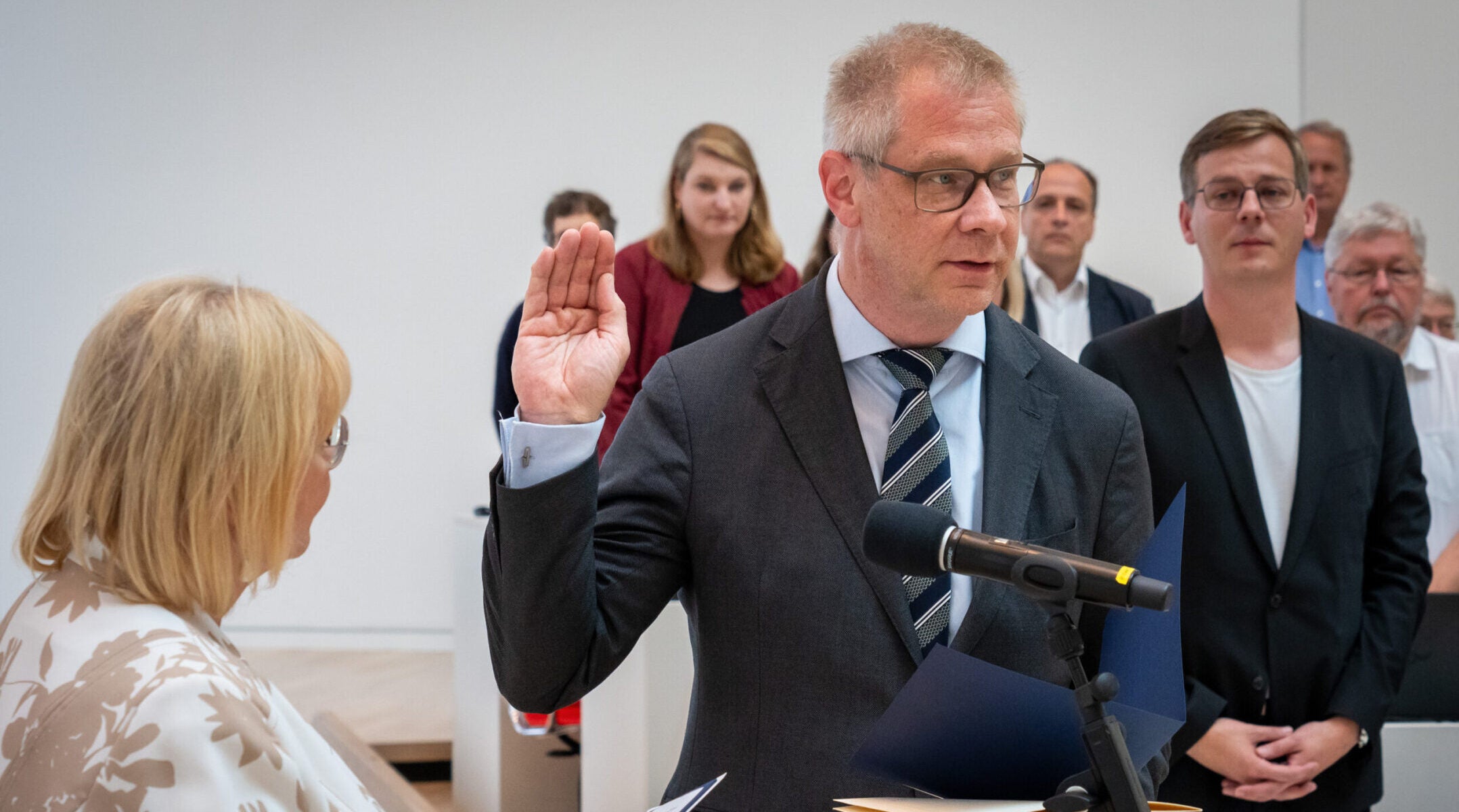
BERLIN – The antisemitism commissioner for the German state of Brandenburg has resigned from his far-left party over a resolution passed Sunday condemning Israel.
After 11 years in Die Linke (The Left), Andreas Büttner has quit its ranks over the position taken by members in Lower Saxony, in former West Germany. But it’s also personal: Büttner said he’s had enough of what he has described as harassment from within his party.
“It’s no longer possible. And I can’t go on … without betraying my own convictions,” Büttner wrote in a statement to party leaders. The letter was shared with the dpa, the German press association.
Die Linke is the successor to the Socialist Unity Party of Germany, the ruling communist party of former East Germany, and has a platform that is critical of capitalism and of NATO. Die Linke notched a better-than-expected finish in last year’s national elections, drawing 9% of the vote despite internal tensions over Israel and Germany’s handling of antisemitism.
According to news reports about Büttner’s resignation, Brandenburg’s party leaders expressed “great regret and respect,” and promised to continue fighting antisemitism with him.
“This is not a question of party affiliation,” wrote Stefan Wollenberg, the party’s managing director in Brandenburg.
The trigger for Büttner’s move was a resolution condemning current forms of Zionism, put forward by the party’s youth delegation in Lower Saxony. They insisted that the resolution — passed at their convention in Hanover last weekend — was not against Zionism per se, only against “existing political manifestations of Zionism.”
But Büttner, who has long stood up for Israel in defiance to his party, and has openly criticized antisemitism from all corners, said the message was unmistakable.
Resolutions that condemn Israel as a “genocidal state” and an “apartheid state” are “no longer acceptable to me,” he wrote in his resignation. He criticized the Lower Saxony party for coming perilously close to questioning Israel’s right to exist.
The fight against antisemitism should transcend party lines, he added. “All the more shocking for me is what I have had to experience within my own party for years,” he wrote, as cited in the Tagesspiegel newspaper.
Büttner, a former police officer who was elected in 2024 to his position as Brandenburg’s first commissioner for combating antisemitism, has had his differences with his party for some time over its views on Israel. Departing from his party’s official stance, Büttner supports the International Holocaust Remembrance Alliance’s definition of antisemitism, known as IHRA, which labels some criticism of Israel as eliminationist and thus antisemitic.
In 2025, members of his party tried and failed to have him expelled over his solidarity with Israel.
Büttner also has been targeted by unknown perpetrators, who in 2024 vandalized his car with swastikas and other Nazi symbols, and in January set fire to a building on his property, leaving a Hamas symbol as their calling card.
The new resolution, which condemns Hamas as well as Israel, characterizes terrorism as a result of “occupation, disenfranchisement, and a lack of prospects.”
It rejects “the Zionism that actually exists today” and recognizes “ethnonationalism and political Zionism as a major obstacle to a peaceful future for all people in the region.”
It says that both Israel and Hamas “harbor fantasies of annihilation” against one another.
The resolution refers to “two years of genocide” in Gaza, calls for an “end to apartheid in Israel and the occupied territories” and criticizes the alleged instrumentalization of antisemitism “to delegitimize criticism of actually existing political Zionism.” It presents a list of demands on Israel, but none on the Palestinian leadership or Hamas.
Die Linke has a long history of anti-Israel activism: In 2010, prominent party members took part in the ill-fated Gaza Freedom Flotilla, aboard the Mavi Marmara, which the Israeli military intercepted in an operation that killed 10 activists. The German politicians were among those arrested and deported home.
Reporting the stories that define our era. When history unfolds in real-time, the Jewish world turns to JR. Your support ensures we can document the complexities of war and the resilience of Jewish communities with integrity.