

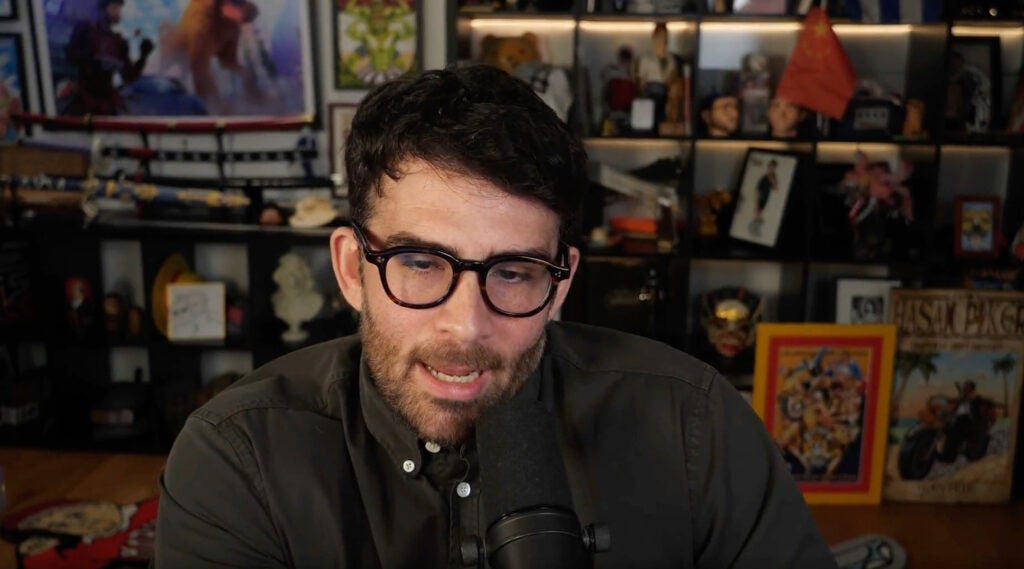
“People are probably going to yell at me for having this conversation,” Hasan Piker said from his livestreaming chair, midway through a video call with the Jewish Telegraphic Agency to discuss his views on Jews, Israel and Zionism.
By “people,” Piker meant his own: the 3 million followers he boasts on the streaming site Twitch, where the left-wing personality, from the same chair, opines about politics in between video game sessions for up to eight hours a day. That doesn’t include the many more who watch clips of his show on YouTube or follow him on X.
“People are going to say, ‘What are you doing? This is Jewish exceptionalism. Why do you care so much about making sure that Jews like you?’” he continued.
The 34-year-old New Jersey native, who has recently rocketed into the center of the Democratic Party’s identity crisis, then answered his own question.
“I still think that there’s value in reaching as many people as possible and helping them understand where I’m coming from,” he said, “so they’re not freaking out when they see their nieces or nephews watching me on Twitch, and then they think that their sons or daughters or nieces or nephews have turned into neo-Nazis.”
“That’s why I’m having this conversation with you,” he added. “So that more people can hear something in the Jewish newspapers that isn’t just, ‘This guy is a heinous antisemite.’”
Piker is an avowed anti-Zionist who has said that “Hamas is 1,000 times better” than Israel, has said that “I don’t have an issue” with Hezbollah, compared an Iranian-backed Houthi rebel to Anne Frank and likened liberal Zionists to “liberal Nazis.” And he reiterated to (JEWISH REVIEW), “I do still believe that Zionism is a racist ideology. Like, I genuinely believe that.”
The Anti-Defamation League’s Jonathan Greenblatt recently called Piker “one of the most outspoken, virulent antisemitic influencers in the world.” The stalwart pro-Israel Democratic congressman Ritchie Torres wrote the heads of Twitch “to express alarm about the amplification of antisemitism on Twitch at the hands of Hasan Piker,” saying he “has emerged as the poster child for the post-October 7th outbreak of antisemitism in America.”
Such criticism has escalated as Piker, a self-described Marxist and socialist, becomes an increasingly influential player in Democratic politics. He joined rallies for a Michigan Senate candidate earlier this month and has hosted several progressive members of Congress. Next month, the provocateur will appear in San Francisco with Saikat Chakrabarti, a congressional candidate who says Israel committed genocide in Gaza. His influence is beginning to extend beyond progressives, as California Gov. Gavin Newsom, a leading 2028 presidential candidate, has said he would appear on Piker’s stream.
Hasan Piker looks on as U.S. Senate candidate Abdul El-Sayed delivers a stump speech in Ann Arbor, Michigan, April 7, 2026. Piker, a popular Twitch streamer accused of antisemitism, prompted controversy for campaigning with El-Sayed. (Andrew Lapin/(JEWISH REVIEW))
Speaking to (JEWISH REVIEW) in his first extensive interview with a Jewish news outlet, Piker acknowledged that anti-Israel activism can morph into anti-Jewish rhetoric — but also said he can’t be responsible for what everyone in his movement says. He explained that he wants to combat antisemitism — in part because it undercuts anti-Israel activism. He condemned “heinous” violence against Jews, such as the Temple Israel attack in Michigan — but maintained that American Jewish organizations are fanning the flames and creating an atmosphere of “hysteria.”
How does Piker reconcile the tensions and contradictions that radiate within his worldview? The answer is important not just because his influence is rising but because there are signs that a growing number of Americans already share some of his fundamental beliefs: that Israel is a malign presence in the world and for the United States in particular; that the United States should stop sending aid to Israel; and that Israel’s character and conduct explains the violence its people face from the likes of Hamas and Hezbollah.
As American Jews adjust to a new reality in which old norms about antisemitism and the U.S.-Israel relationship are being shattered, Piker’s vision is one that, some warn, Jews will need to increasingly grapple with going forward.
Piker, though, says many Jews are on his side.
“There are a lot of young American Jews, at least in my community, who also feel this way,” he said. “They might be a little bit more shy about expressing their opinions in polite company.”
(JEWISH REVIEW) spoke to Piker several days before the attempted assassination of President Donald Trump and several cabinet members at Saturday’s White House Correspondents Dinner, an event that has prompted renewed concern about escalating violent rhetoric on both sides of the aisle. Some, including the pro-Israel right-wing Jewish influencer Lizzy Savetsky, have attributed the shooting specifically to rhetoric promulgated by Piker.
Born in New Brunswick, New Jersey, to Turkish parents but largely raised in Istanbul, Piker got his start on his uncle Cenk Uygur’s left-wing web network The Young Turks. In 2020 Piker left the company and launched a Twitch stream from his Los Angeles-area home in West Hollywood that has now outstripped Uygur’s influence.
Piker’s comments about Israel are nestled among hourslong streams that touch on a wide variety of topics he labels as anti-imperialist and anti-fascist. That includes criticizing America, which he has said “deserved 9/11.”
Yair Rosenberg, a staff writer at The Atlantic, argued in a recent piece that Piker exhibits a “soft spot for left-coded expansionist authoritarian regimes.” Rosenberg cited the influencer’s praise of Mao Zedong and lament of the fall of the Soviet Union, noting that “the tens of millions of victims of the Soviet Union went unmentioned.” Rosenberg is currently engaged in a back-and-forth with Piker after saying the streamer mischaracterized Albert Einstein’s views on Israel; a symptom, he said, of a fast-and-loose approach to facts.
Piker’s hold on younger left-leaning audiences has alternately alarmed many liberals and made them envious. Some in the party have likened him to the right-wing firebrand Tucker Carlson or even streamer Nick Fuentes, known for his praise of Hitler and attacks on “organized Jewry.”
He’s broken with at least one significant Jewish ally: Ethan Klein, a progressive YouTuber with his own history of incendiary comments, used to host a podcast about the left with Piker. That ended shortly after Oct. 7, when Klein, who is married to an Israeli, sharply diverged from Piker on Israel. Today, Piker posts memes comparing Klein to Sen. John Fetterman, the Democrat whose sharply pro-Israel views the left sees as traitorous.
But others see in him the potential to achieve an elusive goal: a “Joe Rogan of the left” who can draw young, largely male, disaffected voters to the Democrats through the force of his charisma and unfiltered opinions. Jewish New York Times columnist Ezra Klein recently joined several other prominent liberal pundits in encouraging engagement with Piker and said the streamer was an anti-Zionist, not a “Jew hater.” (Last week, Piker appeared on a Times Opinion podcast as a political commentator to argue in favor of petty theft as a form of political protest.)
Yehuda Kurtzer, founder of the liberal Zionist think tank the Shalom Hartman Institute, disagrees with Klein: to welcome Piker, he argued, means “embracing the changing of the goalposts in the acceptability of Jew-hatred in liberal societies.”
Either way, Piker doesn’t just want outreach; he wants to convince people of his positions. Chief among them is that the Democratic Party should become explicitly anti-Israel.
“If there was real expression of democracy in this country, yes, the Democratic Party would be the anti-Israel party,” he told (JEWISH REVIEW).

Demonstrators from the group Jewish Voice for Peace hold an emergency Passover Seder outside of ICE headquarters on April 14, 2025 in New York City. (Adam Gray/Getty Images)
When it comes to his position on the future of Israel itself, Piker described his ultimate goal as “a secular, solitary state where everyone has equal rights and representation, Jews, Muslims, Christians alike” — a state that would come with the Palestinian right of return, a truth and reconciliation committee, and “some form of reparations.” But he was open, he said, to “a binational solution” in the region “in the interim period, even if it’s not the most moral from my perspective.”
He dismissed concerns that his vision would put Jews at risk; once Palestinians were fully integrated into the Israeli security apparatus, he said, they would simply have no further need for Hamas.
He told (JEWISH REVIEW) that he sees himself as committed to combatting antisemitism, on his terms. In the conversation, he condemned some behavior that others on the left have justified or even celebrated.
“Antisemitism still exists. Heinous hate crimes still exist in the country, right? Synagogues being attacked, painting swastikas on the side of Hillel buildings, all this stuff,” Piker said. “This is real antisemitism, and it’s horrifying for people to experience, because they’re like, ‘I want to go to my place of worship with my family, and now I’m worried that someone could just ram their car into it.’ No one should have to live like that.”
Yet he didn’t walk back any of his earlier statements. (He has previously apologized for referring to ultra-Orthodox Jews as “inbred.”)

Hasan Piker films a video for The New York Times with Times editor Nadja Spiegelman and The New Yorker’s Jia Tolentino, April 22, 2026. (Screenshot)
Then there was the matter of antisemitism on the left. When first asked about it, he acknowledged its existence, in softer terms: “It is undeniable that there has been a shift, for sure, where people, I think, are not as careful in their expressions in the way that they communicate on these issues,” he said. But he also described it largely as a downstream effect of pro-Israel lobbying and American Jewish organizations that he said have created a “forced tying of Judaism and Israel.”
Was that also true for the self-proclaimed anti-Zionists who said that Temple Israel in Michigan, attacked last month, was a legitimate target for a man whose brother had been killed in an Israeli strike on Hezbollah operatives in Lebanon? Or the ones who were celebrating the murders of Israel Embassy staffers outside the Capital Jewish Museum last year?
“I don’t believe that, by the way. I don’t think it’s a legitimate target, for the record,” Piker responded. (On his stream the day of the Temple Israel attack, he declared, “There is no justification for f**king trying to go into a synagogue and murdering kids.”)
He chalked up left-wing antisemitism, in part, to it being “much easier to get Americans on board with just hating entire populations, than to actually be anti-imperialist, anti-genocide, anti-fascist, unfortunately.”
But then he again said the “biggest reason” is the downstream effect of pro-Israel lobbying — along with, as he puts it, “a lot of the Jewish advocacy organizations that claim to be Jewish advocacy organizations, but just simply are Israel advocacy organizations, like the ADL and numerous others.” Young people upset with Israel’s treatment of Palestinians, he said, are being taught by such messaging that they must be antisemitic, and some of them wind up believing it.
“It creates an environment of panic and hysteria that serves the interest of Israel,” he said. “And I think it’s actually not beneficial to American Jews at all.”
He acknowledged that not everyone on the left seemed to think that fighting antisemitism was a moral imperative. “This will come across as, maybe, messed up,” he prefaced. “But the attitude from some is, antisemitism is a problem — however, it’s nowhere near as large a problem as Islamophobia is.” When it comes to his fans, he said, “some people say, ‘Why should we care about this?’”
He was not one of those people, he insisted — even if, in his estimation, antisemitism is no longer “a systematic form of discrimination” in America the way it had been in the prewar period.

Nick Fuentes, the streamer and avowed antisemite who has previously said Hitler was “very f–king cool,” has been gaining more traction as a voice on the right. (Screenshot)
Piker believes his stated interest in fighting antisemitism sets him apart from anti-Israel streamers on the far right — including Fuentes, the avowed white supremacist and Hitler fan, to whom a growing number of Jewish and political figures are comparing him.
“In Piker’s case, his record speaks for itself, the same with Nick Fuentes. I don’t need to go into details about who they are or what they represent,” Ted Deutch, head of the American Jewish Committee, told Jewish Insider last month. “Neither one of them belongs in the middle of the political process as a result of candidates choosing to put them there.”
Piker is insulted by the comparison to Fuentes. He thinks Jewish groups consider him a threat precisely because he’s not Fuentes. That means, he said, that they may see him as a more persuadable, rational influence on young Jews.
“Nick Fuentes, we both know, is a neo-Nazi. He’s a Holocaust denier, right? He’s horrible. His worldview is repulsive,” Piker said. “He’s not going to be able to get Jonathan Greenblatt’s nieces and nephews to really reconsider their relationship with Israel.”
An ADL official sharply disputed Piker’s characterization. The organization is warning about Piker, said Oren Segal, the ADL’s senior vice president of counter-extremism and intelligence, because his praise of groups like Hamas and Hezbollah is normalizing them for his audience.
“I don’t think Hasan Piker is offering a nuanced understanding. He’s celebrating them. I mean, his favorite flag is Hezbollah,” Segal said. “He is giving them voice and legitimacy that I think many in the Jewish community are concerned about. Is that unreasonable, for people to be concerned when they hear that type of language? I don’t think it is.”
Segal also rejected the claim that the ADL and other Jewish groups were contributing to antisemitism, as when Piker said, “They’re fomenting more antisemitic tendencies amongst the population by consistently refusing to separate American Jews from the State of Israel.”
Segal said that view “ignores the various ways in which we’re combatting antisemitism every day.” He added, “It’s like saying an oncologist causes cancer.”

Jonathan Greenblatt speaks onstage at the 2025 Washington D.C. Concert Against Hate at Andrew W. Mellon Auditorium on November 10, 2025. (Tasos Katopodis/Getty Images for ADL)
The ADL monitors hate of all ideologies, tracks and responds to antisemitic incidents, and conducts research into antisemitism. But the group has also pulled back on some civil rights work following criticism from the right, and Greenblatt has defined anti-Zionism as a form of antisemitism — a move that reportedly angered members of his own staff, some of whom quit the organization over what they said was its overt emphasis on pro-Israel advocacy.
But Piker believes he’s far from the fringe of sentiments among Democrats, and even Jewish Democrats, when it comes to his views on Israel. There is evidence of discontent on that front: A recent survey from the Jewish Federations of North America showed that about 7% of Jews overall identified as “anti-Zionist,” almost as many as tell pollsters they are Orthodox, and that figure was twice as high for Jews under 35.
To that end, he said, he wants to build coalitions with liberal Zionists — the same group he has disparaged as “liberal Nazis.” Both his political hero, Vermont Sen. Bernie Sanders, and an up-and-comer he’s intrigued by, Georgia Sen. Jon Ossoff, are Jews who have voted to condition aid to Israel even as they are broadly supportive of a two-state solution.
That’s fine with Piker — despite the fact that he once said “you shouldn’t even let someone be the f**king local dog catcher” if “they’ve ever exhibited any sort of positive feelings about the state of Israel.”

An ad from pro-Israel lobying group AIPAC opposing Georgia Sen. Jon Ossoff, a Jewish Democrat, for his voting record on Israel, Dec. 5, 2024. (Screenshot)
He told (JEWISH REVIEW) he likes the stances that politicians like Sanders and Ossoff have taken to move the dialogue on the issue. He insists that, despite his strong language, he doesn’t see litmus tests the same way many in his cohort do post-Oct. 7, as more and more on the left have taken to freezing out “Zionists” from coalitions, not to mention public society in general.
“I’m a pragmatic person,” he said. “The way I see Palestine as a litmus test is not to say, ‘Oh, if you’re not fully on board with this, you’re evil and repulsive. And therefore I can never align with you in any meaningful capacity.’” Instead of insisting on anti-Zionists, he said, he looks for “people who have sympathies that I think don’t stand in the way of conversation further into a more productive place.”
He pointed to the reaction of young Jews he knew in Georgia who were outraged after more than 50 Jewish groups, including several synagogues and the ADL, penned an open letter criticizing Ossoff’s vote in 2024 to stop certain arms sales to Israel.
“There are people who are like, ‘What is this? This doesn’t represent me at all. Why are you using my name? Why are you using my religion to take this stance that I find to be unconscionable?’” he said.
Piker is convinced that the Democratic Party wouldn’t lose its strong base of Jewish supporters even if it became a full-bore anti-Israel party. Liberal Jews, he thinks, would simply decide their other concerns outweigh Israel.

Twitch streamer Hasan Piker interviews Zohran Mamdani during his New York City mayoral campaign, April 7, 2025. (Screenshot via YouTube)
“American Jews are American. If they were Israeli, they would live in Israel,” Piker said. “At the end of the day, American Jews have American problems, right? And I don’t think Israel is as high of a priority.
“Perhaps I’m wrong,” he mused. “For many American Jews, they might even say, ‘Hasan, how dare you say this. You don’t know this. That’s not the case. It is very important for me.’ And then they’ll go and vote for American-related issues.” He pointed to the election of New York City Mayor Zohran Mamdani, whom he had hosted on his stream, as a case in point: an estimated one-third of the city’s Jews voted for him, according to exit polls.
Fundamentally, Piker believes antisemitism is a distraction for the left. “If you see what Israel is doing to be a problem, as I do, and you want to solve this problem, you have to dial in on the actual root of this problem,” he said. “And I find that antisemitism, oftentimes, is moving people to focus on Jewish people rather than the actual issue itself.”
Isn’t he being disingenuous? After all, he talks about movement-building and claiming to fight antisemitism while also saying things he knows most Jews will consider antisemitic.
“No, I don’t think so,” he said, though he later added that he does “fully understand” why many Jews consider him antisemitic. “That’s why I’m having this conversation.”
He signed off soon after, popping up a few minutes later on his Twitch stream for the start of another session. His fans were tuned in already, waiting for him.
Passover may be over, but your chance to support independent Jewish journalism isn’t. Help (JEWISH REVIEW) keep reporting the stories that define our era.