
JERUSALEM — When World Zionist Organization officials working with the Israeli Foreign Ministry opened the grave of Theodor Herzl’s grandfather on July 29 in Zemun, Serbia, they found it empty.
Shimon Leib Herzl was not buried beneath his tombstone. So they kept digging to the side of his wife Rivka’s grave and found his remains there, according to Yizhar Hess, the WZO’s acting chairman, who was present at the exhumation.
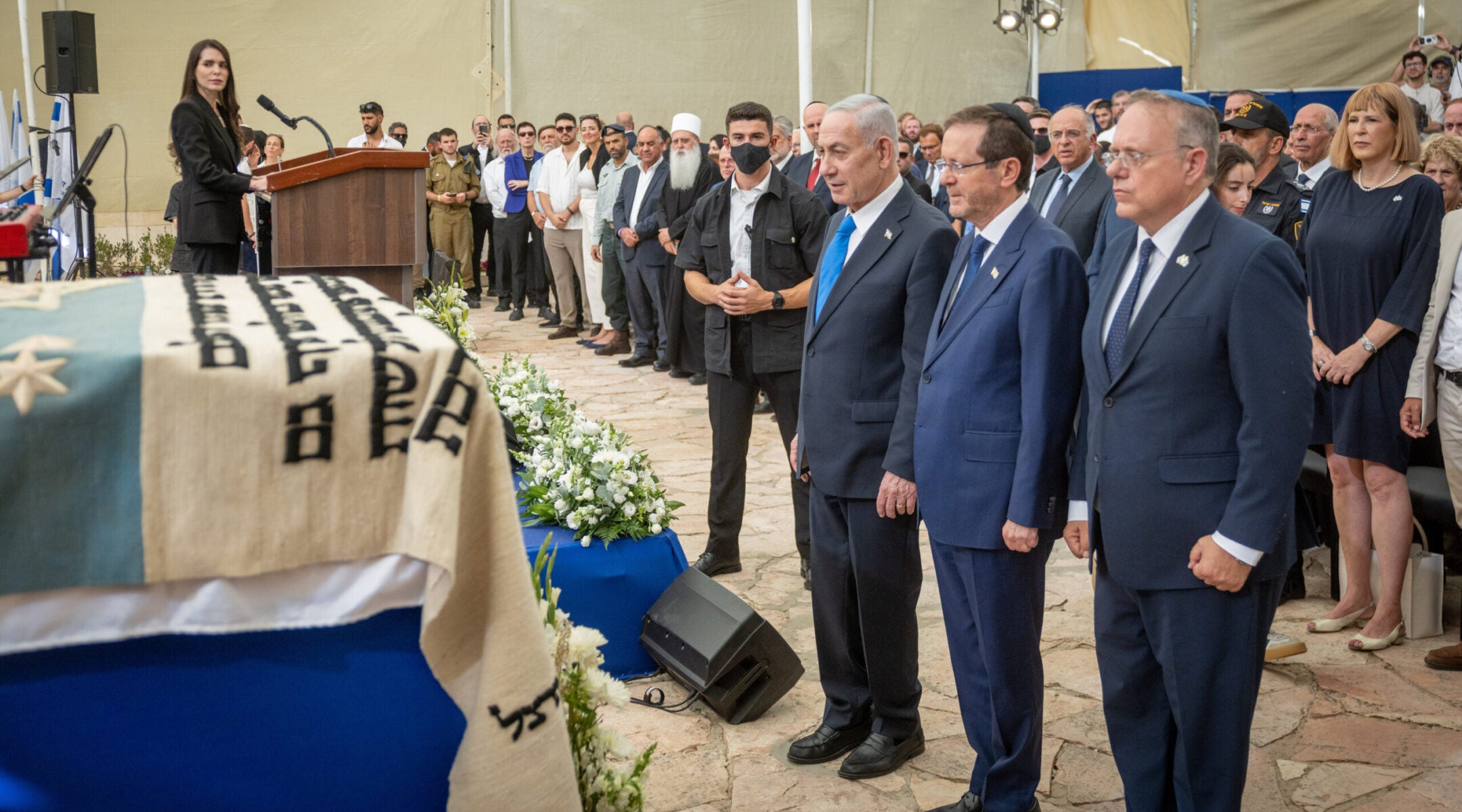
On Wednesday afternoon, with Prime Minister Benjamin Netanyahu and President Isaac Herzog in attendance, Herzl’s grandparents were reinterred on Mount Herzl.
“The long journey of the Herzl family, from foreign soil to the soil of Zion, ends here today on Mount Herzl,” Netanyahu said. “The vision has arisen and become reality. Zionism has won.”
The reburial came 77 years to the Hebrew date after Herzl himself was laid to rest on the Jerusalem hillside that bears his name. The Knesset had voted on Aug. 10, 1949, to bring his remains from Vienna in one of its first acts.
The WZO says the ceremony completes the last unfulfilled clause of Herzl’s 1903 will, which instructed that his body be transferred to the Land of Israel along with the coffins of his father, his sister Pauline and several close relatives.
“Having a chapter of his will that was not fulfilled is something that needed to be fixed,” Hess said. He credited the effort to Yaakov Hagoel, the organization’s chairman, who he said had worked on the exhumation for four years.
The transfer was ready to proceed two years ago, but it didn’t. “We could have done it after two years, actually,” Hess said. “But we could not bring them back, because the hostages were not home yet, and we felt there are more urgent things than to bring Herzl’s grandmother and grandfather to Israel. Now that the hostage affair is done, we felt it’s the right time.”
In a statement, Hagoel said the WZO was closing a historic circle and reconnecting the Herzl family’s roots to the land Herzl had devoted his life to. “When Zion brings her children home, she also brings home their forebears,” he said.
The remains of Shimon and Rivka Herzl, the grandparents of Theodor Herzl, founder of modern political Zionism, are reburied alongside their grandson on Mount Herzl, in Jerusalem, during a state ceremony, Aug. 5, 2026. (Theia Chatelle)
Diplomats and officials from across the Zionist institutional world filled the Mount Herzl plaza on Wednesday. Seated near the family plot were Knesset Speaker Amir Ohana, Deputy Supreme Court President Noam Sohlberg, Police Commissioner Danny Levy, the Serbian ambassador to Israel and Sheikh Muwaffaq Tarif, spiritual leader of Israel’s Druze community.
An honor guard carried the two caskets and set them on a pedestal before the crowd. The mood was both somber and defiant, and both Netanyahu and Herzog turned quickly from the burial to the ongoing war.
Herzog used his remarks to argue that the day was about inheritance rather than ceremony.
“Dreams are not bequeathed in writing,” he said. “They pass at the Shabbat table, they pass in the living room, they pass in the story a grandfather tells his grandson.”
The Jewish section of the Zemun cemetery is small. The two tombstones — Rivka’s, and one bearing her husband’s name that had not been there originally — were only 65 feet apart, Hess said. He believes it was toppled at some point and reset carelessly wherever there was room.
Shimon Leib Herzl was born in Zemun in 1805, the son of a rabbi. He served as gabbai in the Sephardic synagogue where Yehuda Alkalai was rabbi.
Decades before the First Zionist Congress in 1897, Alkalai argued that Jews could not wait for the messiah to arrive, that they would have to buy land and petition the Ottoman sultan themselves. Today he is thought of as one of the forerunners of Zionism. Whether his ideas were the impetus for his congregant’s grandson, the eventual founder of the Jewish state, has never been definitively established.
Oded Feuer, who directs the WZO’s Herzl Center at the entrance to the mount, thinks they were.
“His grandfather was in touch with Rabbi Alkalai, one of the first people to speak about Zionism in the Orthodox world back then, to make Judaism not only a religious thing, but also a national thing,” Foyer said. “And his grandfather was in his synagogue.”
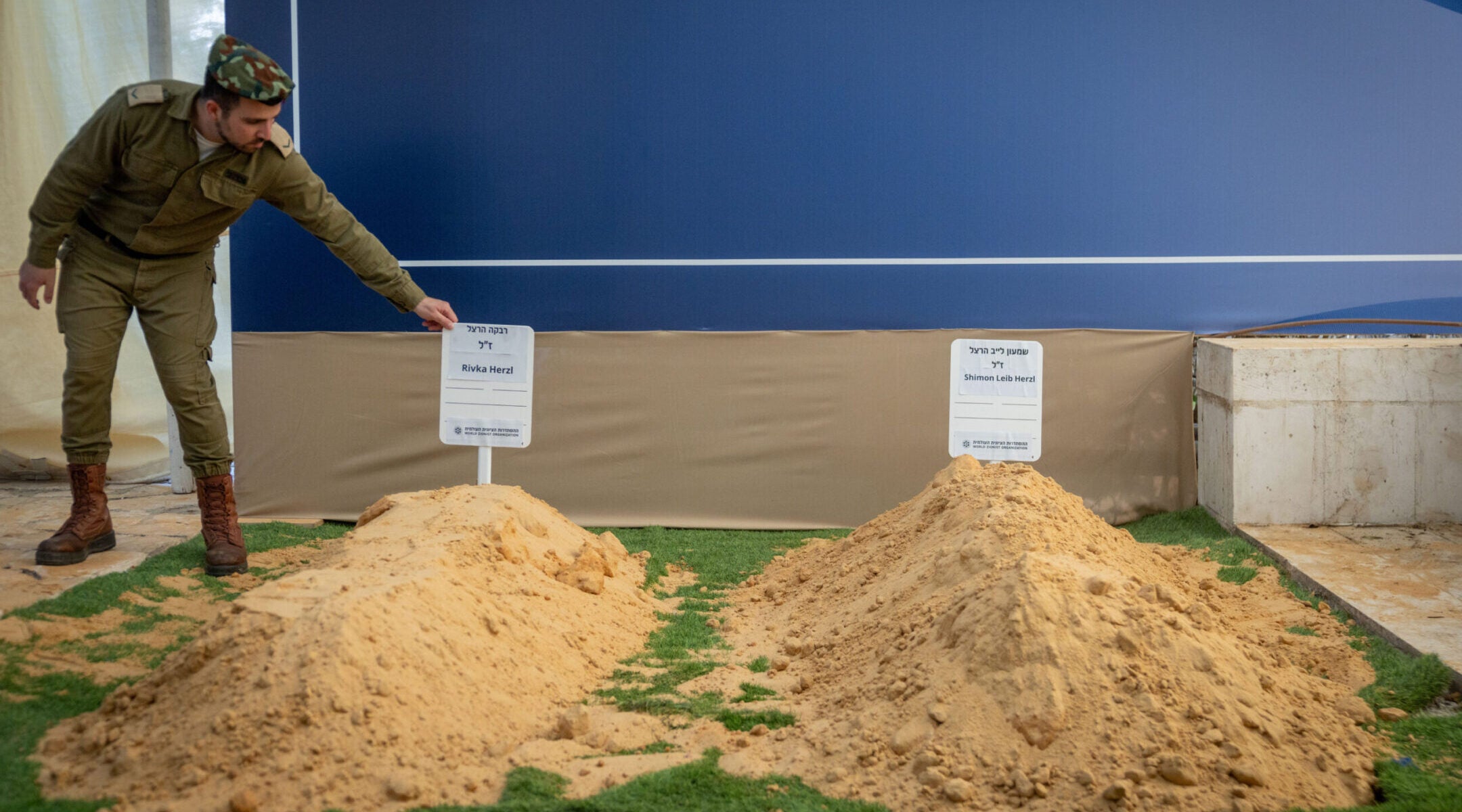
The graves of Shimon and Rivka Herzl, the grandparents of Theodor Herzl, are displayed in Jerusalem after their remains were brought from Belgrade, Aug. 5, 2026. (Chaim Goldberg/Flash 90)
Hess said Herzl mentioned his grandfather more than once in his diaries and letters. Herzl’s bris was held in Zemun.
Herzog made the same case from the podium, describing Shimon Leib as a man who was not a leader, who addressed no congresses and wrote no books the world read, but the gabbai who opened the synagogue door first and locked it last. “We know one thing,” Herzog said. “He carried those words home with him.”
The reburial is also an argument about who Herzl was.
The Herzl most people know is the assimilated Viennese journalist who found Jewish nationalism at the trial of Alfred Dreyfus, the French army general falsely convicted of treason in an antisemitic affair at the turn of the 20th century. Hess said that portrait is out of date.
“Calling Herzl an assimilated Jew is a mistake in many ways,” he said. Herzl was raised in a house where Jewish tradition was, in Hess’s words, alive and well. He was secular, but that was a way of holding the tradition, not leaving it.
He said Herzl’s bar mitzvah is proof. It was held at a synagogue in Budapest that was associated with the Hungarian Neolog movement, which permits music on Shabbat but seats men and women separately.
Hess traced the assimilation charge to the fight between haredi Orthodox Judaism and the Zionist movement in the 19th century, when calling Zionism assimilation was a way to fight it. “There is more than one political interest in calling Herzl an assimilated Jew,” he said.
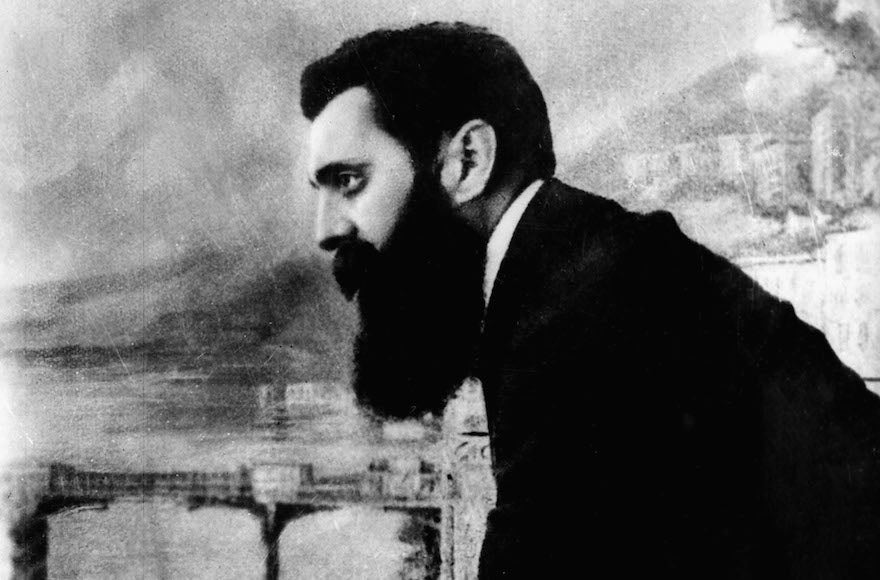
Theodore Herzl, the father of modern Zionism, leaning over the balcony of the Drei Konige Hotel during the first Zionist congress in Basel Switzerland, Aug. 29, 1897. (GPO via Getty Images)
Netanyahu made the argument explicitly, telling the crowd that the monument was not the point. “Our gaze turns to the foundations of the building,” he said. “Judaism as the basis of Zionism. The Torah and the entire Bible as the bedrock of identity. The chain of generations as an anchor of values and heritage.”
The Herzl family plot on Mount Herzl has been filling in for 77 years. Theodor Herzl was reinterred there in 1949. His parents and his sister Pauline were brought as well. The bodies of his two eldest children, Pauline and Hans, came from Bordeaux in 2006. The remains of his grandson Stephen Norman, who died by suicide in Washington in 1946, followed in 2007.
One member of the family is still missing. Trude, Herzl’s youngest daughter and Stephen Norman’s mother, died at Theresienstadt in 1943. Her remains were never recovered.
Hess said the circle closes anyway. “On Mount Herzl there is a plot that will now be complete,” he said.
The ceremony comes at a moment when Zionism is contested abroad and inside parts of the Jewish diaspora, a frame the WZO has embraced.
“Zionism is again being attacked from all sides,” Foyer said. “And the first answer to those attacks is within ourselves. Strengthening our Jewish identity will help us give answers, though not everyone who attacks is willing to get an answer.”
Foyer added, “You can look at the Herzl family as the story of a Jewish family in the diaspora in Europe: The old grandfather was Orthodox, somewhere in the Balkans, in Serbia. And then starts the traveling of the Jew, the wandering Jew. His kids moved to central Europe, and they maintained a connection with Judaism, but in a different way, more secular.”
Asked whether removing Jewish remains from Europe in 2026 says something about the future of Jewish life there, Foyer declined the premise.
“This is not our goal,” he said. “This is not the reason for it.” Then he added, “Maybe I’m too optimistic and too naive. I’m choosing to be.”
Reporting the stories that define our era. When history unfolds in real-time, the Jewish world turns to (JEWISH REVIEW). Your support ensures we can document the complexities of war and the resilience of Jewish communities with integrity.