

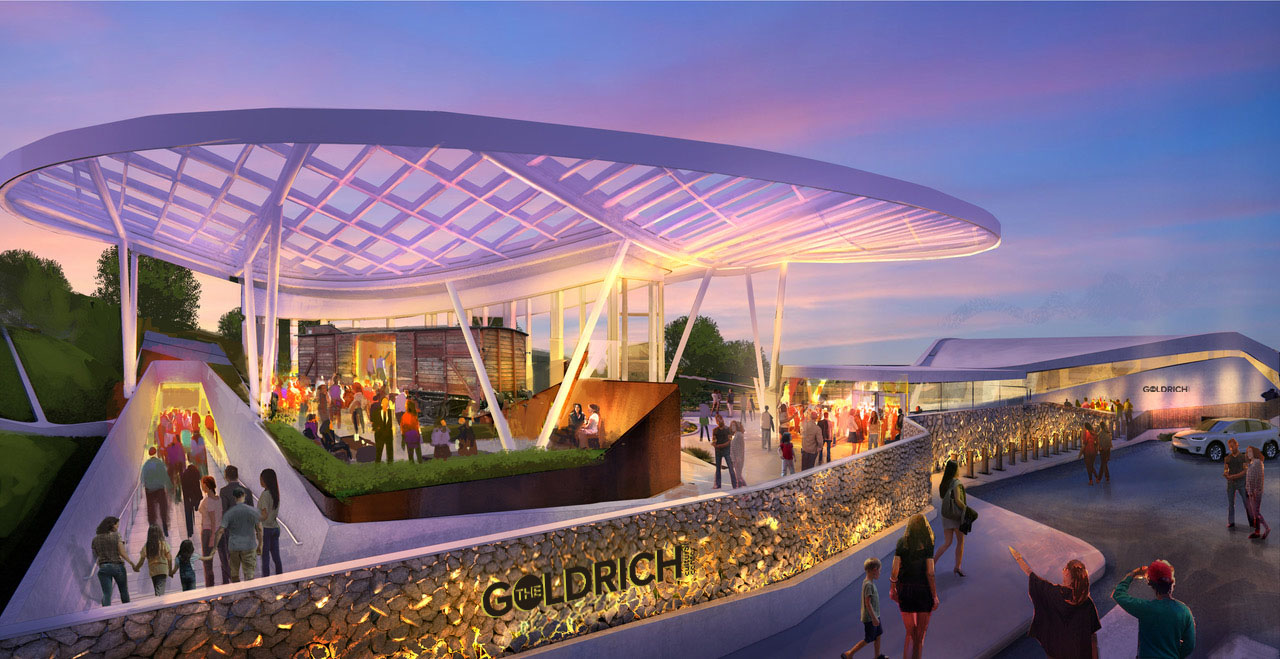
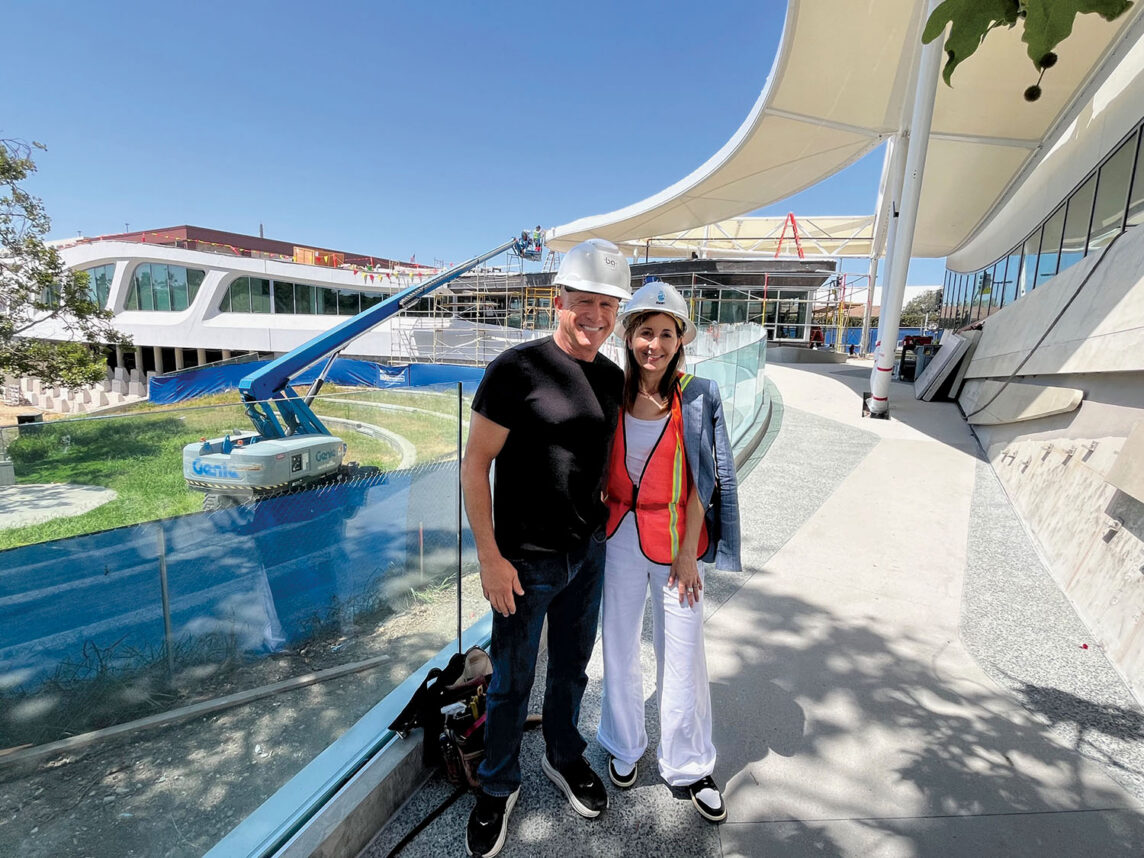
On a construction site in Pan Pacific Park, where exposed beams and unfinished pathways are rapidly giving way to a bold new vision, two descendants of Holocaust survivors stood side-by-side, looking at what will soon become the Goldrich Cultural Center, a major expansion of Holocaust Museum LA.
Overlooking the park and just steps from The Grove, the sprawling center sits at one of the most central and visible locations in Los Angeles. For CEO Beth Kean and renowned architect Hagy Belzberg, this building represents the realization of a shared vision: transforming memory into a living, evolving experience for future generations.
During a recent hard hat tour, as construction moved toward its June 14 opening, Kean and Belzberg guided The Journal through the 70,000-square-foot center — roughly double the size of the existing museum. The expanded campus will include multiple pavilions where visitors can explore the full arc of Holocaust history: the world that existed before, the horrors that unfolded during and the lasting consequences that continue to shape the present. More than 25,000 artifacts will be integrated into these spaces. “Most of the artifacts were donated by Holocaust survivors, liberators and their descendants,” Kean said.
One of the artifacts is an original Holocaust-era boxcar (cattle car), one of the few remaining in the world. Discovered near the Majdanek death camp, it once transported up to 200 people in a 250-square-foot space to concentration and extermination camps. “You’ve seen these cars in photographs, but when you stand in front of one, it stops you in your tracks,” Belzberg said. “We wanted to create a more intimate experience — to slow visitors down, guide them around it and allow them to gradually confront what’s inside.”
The Holocaust Museum was established in 1961 by Holocaust survivors who met in an English as a Second Language class at Hollywood High School and sought to commemorate the Holocaust and preserve its memory. They began collecting personal photographs, documents, artifacts and testimonies. Over the years, the museum moved between several locations until 2006, when Belzberg was selected to design a new building, which opened in 2010 in Pan Pacific Park.
Belzberg said that before the museum opened, they expected about 15,000 annual visitors, but attendance quickly grew to more than 100,000 each year, including 30,000 schoolchildren — far exceeding the capacity of the original space. In response, the Goldrich Cultural Center was conceived six years ago, with construction nearly completed.
The project was made possible after the City of Los Angeles allocated previously unused land within Pan Pacific Park for the expansion. No green park space was removed in the process. The state provided an initial $8.5 million grant to help launch funding for the expanded museum, which Kean said underscored its growing reach and impact. Additional support came from the building’s namesake, the late Jona Goldrich, a real estate developer and Holocaust survivor, as well as other donors. The total project cost is approximately $70 million.
Unlike the original subterranean structure, much of the expansion rises above ground, filled with natural light and open, welcoming spaces.
The project is already resonating beyond the museum itself. “People in the community are really excited,” Kean said. “We are changing the landscape of the street and the neighborhood.”
“Hagy and his team found a way to build above a flood control channel — something that also became a metaphor. We want this to be a landmark for hope, understanding and community,” she added.
In reimagining the campus, Belzberg aimed to create a fluid visitor experience that guides people seamlessly from one area to the next, while also allowing moments of pause and reflection, both indoors and in open-air spaces.
For Kean, the connection to the outside world is essential to the experience — and to the lesson it carries.
“You see life continuing outside, people walking, dogs running, families having picnics, kids playing soccer. During the Holocaust, while Jews were trapped in ghettos and camps, life went on outside the walls. That contrast is something we want visitors to feel and understand,” she said.
The center will also feature the S. Mark Taper Theater, a venue dedicated to cultural programming including music, live theater, film, lectures and public dialogue.
There is also an immersive theater where visitors will be able to engage with Holocaust survivors through advanced interactive hologram technology. Rather than watching a recorded testimony, guests can ask questions and receive real-time responses, creating a closer approximation of a live conversation. As the generation of survivors diminishes, this technology is designed to preserve not only their stories, but their immediacy and humanity, ensuring that future audiences can continue learning directly from those who lived through the Holocaust.
For both Belzberg and Kean, the project is deeply personal, rooted in family histories marked by loss and survival.
Belzberg’s father was just three years old when his mother fled Poland for what was then British-controlled Palestine. Much of his extended family was murdered in the Holocaust.
Kean’s grandparents were also Holocaust survivors from Poland; her grandmother endured two concentration camps, including Auschwitz, and had a number tattooed on her arm. Her grandfather was sent to forced labor camps.
“I grew up hearing these stories from a very young age,” Kean said. “But they didn’t tell them to dwell on the suffering — it was about teaching dignity, respect and the importance of educating future generations. We can’t be complacent or take things for granted. It’s about building empathy and a mindset where people truly care about one another.”
One of the artifacts in the museum’s collection is especially meaningful to her: a photograph of her grandfather as a young child in Poland, taken before World War II. Much of her family history was lost when he fled, leaving behind not only his home but also physical traces of his earlier life.
“A few years ago, a cousin in Mexico City found a photograph of my grandfather as a young boy, around eight years old, standing inside the great synagogue in his hometown.” The image shows him as part of a boys’ choir, alongside the synagogue’s rabbi and cantor. “It’s remarkable what you can learn from a single photograph,” Kean said. “It allows us to piece together a world that no longer exists.”
That idea is central to the museum’s approach. The first gallery focuses on Jewish life in Europe before the Holocaust, emphasizing the richness and complexity of communities that were later destroyed. “You have to understand what existed before to grasp the enormity of what was lost,” Kean said.
“It’s really important in today’s world to humanize this history and make it relatable,” she added. The museum, she said, is designed not for one audience but as part of a broader educational mission that extends beyond the Jewish community, asking how an event from a distant time and place can be made meaningful today — especially for visitors who bring their own histories and perspectives. The expansion, she added, allows the museum to deepen its storytelling through art, culture and programming for all ages.
With only weeks until opening day, the Israeli-born architect who moved to the U.S. as a child, is working seven days a week. Speaking about the project, he grows visibly emotional.
“Twenty years of my career have been dedicated to this — from the first museum till now,” Belzberg said. “It’s exactly why I became an architect.”
The grand opening will take place on June 14 and will be free to the public. Entrance for children 17 and under will always be free.
Holocaust Museum LA | 100 The Grove Dr., Los Angeles, CA 90036