

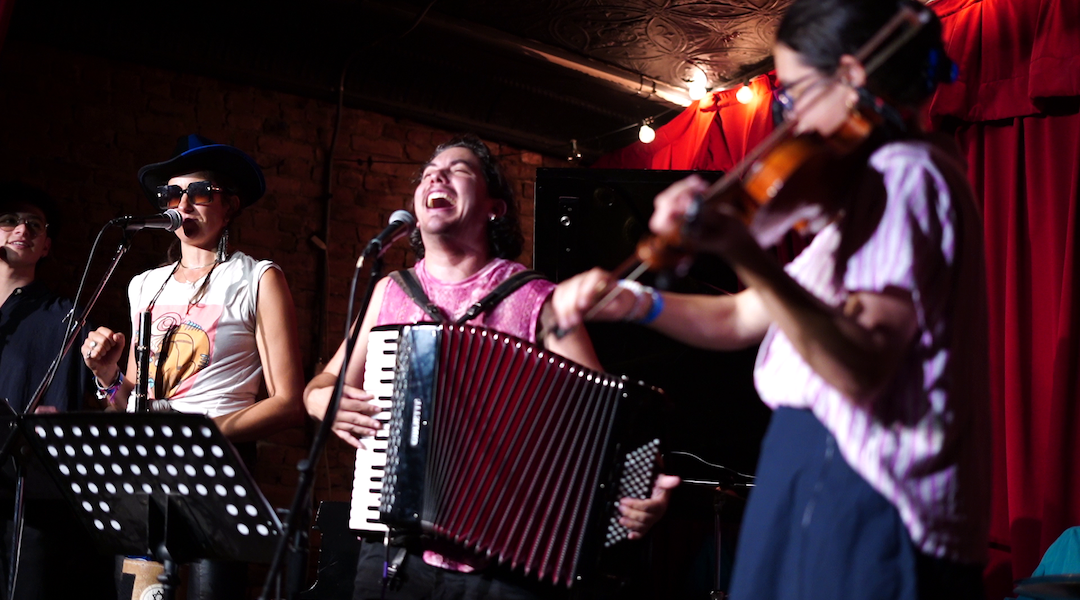
“I want to change the way I wear my shoes,” Brooklyn-based Yiddishist and musician Ira Khonen Temple sings on the first track on their debut album, “Strange Tongue/Mistame Loshn.”
“But I don’t wanna change the way I say ‘hello,’” Temple continues. “I wanna say it in my fruity voice and hear the birds around rejoice.”
Those lines in the song “change my shoes” contain coded poetry that members of the queer Yiddish community readily understand: In Yiddish, the term “feygele” — literally, “little bird” — is often used to describe a gay or effeminate man. Today, this term is being reclaimed by queer and trans Jews — including Temple. With “Strange Tongue,” the multi-instrumentalist “enters the growing ranks of people reclaiming Yiddish heritage and exploring its queer potentials,” according to the country music site Rainbow Rodeo.
The album “is queer because I’m queer,” Temple writes in the liner notes.
“It represents my experiences on both sides of the mekhitse, and my experiences of the mekhitse itself,” they continue, using the Yiddish term for the physical barrier used to separate men and women at an Orthodox synagogue. “There is no right side of the mekhitse for me. But also there is no wrong side.”
While this may be Temple’s first solo album, the musician has been a mainstay of the “Klezmer Shtetl” in Midwood, Brooklyn — arguably the world capital of the klezmer music scene. There, they co-founded the klezmer band Tsibele, and led the klezmer ensemble at the Brooklyn Conservatory of Music. Temple’s other credits include “Fiddler on the Roof in Yiddish,” where they played the accordion; the music director for playwright Paula Vogel’s “Indecent” in 2019 and, most recently, accordionist for Broadway’s “Cabaret at the Kit Kat Club.”
With “Strange Tongue,” Temple probes the various gendered experiences they have lived over their 40 years. It’s a journey that is both highly personal and deeply relatable to other queer and trans Jews.
“I have never identified as anything,” Temple said. “The journey of who someone is and where they come from matters. Gender is also how people stay safe and how they make friends. It can be expansive, but it also reflects a world of limitation.”
Describing what this means, Temple shared anecdotes of the places they’ve made music — before and after their transition.
Temple describes visiting a Budapest synagogue pre-transition and, not realizing that a gender divide was in effect, sat among the men and was offered a kippah. However, in the same breath, Temple describes making music as a butch woman with the Satmar Hasidic community — in a program for older women funded through the Brooklyn Music School.
“I developed a program of music they were familiar with and enjoyed. I would bike down Bedford Avenue in a pair of tear-off Adidas track pants and stop three blocks away and put a long skirt on over it. I’d tear off the pants and have leggings underneath the skirt,” Temple said. “I would walk in with a button-up and short hair and they kind of just had to deal with it, but I was definitely not the only butch woman there.”
Several songs on “Strange Tongue” reflect these gender-bent experiences. There are multiple Yiddish women’s folk songs like “Agunes lid” on the track “Fayer/Fire,” which describes a woman left in legal limbo after her husband refuses to give her a get, or Jewish divorce. “Ushpizn,” a Satmar song sung by men during Sukkot, strikes at an intense homosociality that some perceive in gender-segregated Orthodox spaces — a fascination for many in the queer and trans communities.
The most forwardly queer track on the album might be “Hot Mir Zikh/Queer Wedding Song,” which offers a tongue-in-cheek tableau of an almost mythologized queer wedding. It mentions neopronouns, “aunties throwing down,” “butches in their vests,” the Shekhina (the divine feminine) and family trauma.
“Strange Tongue” has a strong focus on vocal music, and much of the vocal work happened while Temple was at a crucial point in their transition, notably their voice changing. “I went to study with Ethel Raim [the founder of the Center for Traditional Music and Dance], and at the same time my voice was changing because I was starting testosterone — my voice changed every day,” Temple said, describing the vulnerable task of adjusting to and exploring this new, deeper voice.
Temple grew up going to a Conservative synagogue in Denver, but they wouldn’t be introduced to klezmer and Yiddish until attending a workshop by musician Jeff Warschauer during their time studying Arabic and modern Middle Eastern history at Columbia University.
“It felt like a homecoming to a home I didn’t know that much about,” Temple said. “It led to me immediately starting to learn [klezmer] tunes.”
Much ink has been spilled on the connections between queerness and Yiddishkeyt. Scholar Jeffrey Shandler notes various commonalities: “diasporism; rootless cosmopolitanism; a penchant for transgression, border-crossing, and being proudly, defiantly different; standing as a challenge to broader societies sense of ‘certitude and power.’”
For Temple, “there was a deep meaningfulness knowing I was entering a scene where there was queer royalty,” they said. Temple cites several queer mentors in the Yiddish and klezmer scenes, including Raim, artist and activist Jenny Romaine and two OG members of The Klezmatics, fiddler Alicia Svigals and vocalist Lorin Sklamberg.
Sklamberg helped Temple hone their vocals for the album, and also provided his own vocals to one of the tracks. “Working with Ira was a thrill — for being a part of the creation of new additions to contemporary Yiddish song repertoire and their refreshingly original takes on traditional material,” Sklamberg said. “Additionally, it was a rare privilege helping Ira navigate the vulnerable challenge of singing with what is essentially a new voice.”
Young queer Jews have found “Strange Tongue” empowering. “It sounds like my Jewish spaces,” said Bea, a 27-year-old accordionist and singer. “A mix of Yiddish and English, frum and veltlekh [religious and secular] — and all very queer.”
Raia, a 21-year-old Yiddishist in Western Massachusetts, agrees. “‘Strange Tongue’ lets me slip in after musicians like Ira, as noticed or unnoticed in my queerness and transness as I want to be,” they said.
Perhaps not surprisingly, this warms Temple’s heart.
“When younger queer and trans musicians tell me my music is meaningful to them it makes me feel so warm and proud,” Temple said. “That I produced something that can help people feel a kind of belonging that I didn’t feel as a younger person, which doesn’t always come easy to me! It makes me feel grounded, and shows me a clear need for this work — to spread that sense that we belong to this world and to each other.”
Ira Khonen Temple’s “Strange Tongue/Mistame-Loshn” is out now on Borscht Beat. Temple will next perform the album at Stone Circle Theater in Ridgewood, Queens, on Feb. 15. Get details here.