

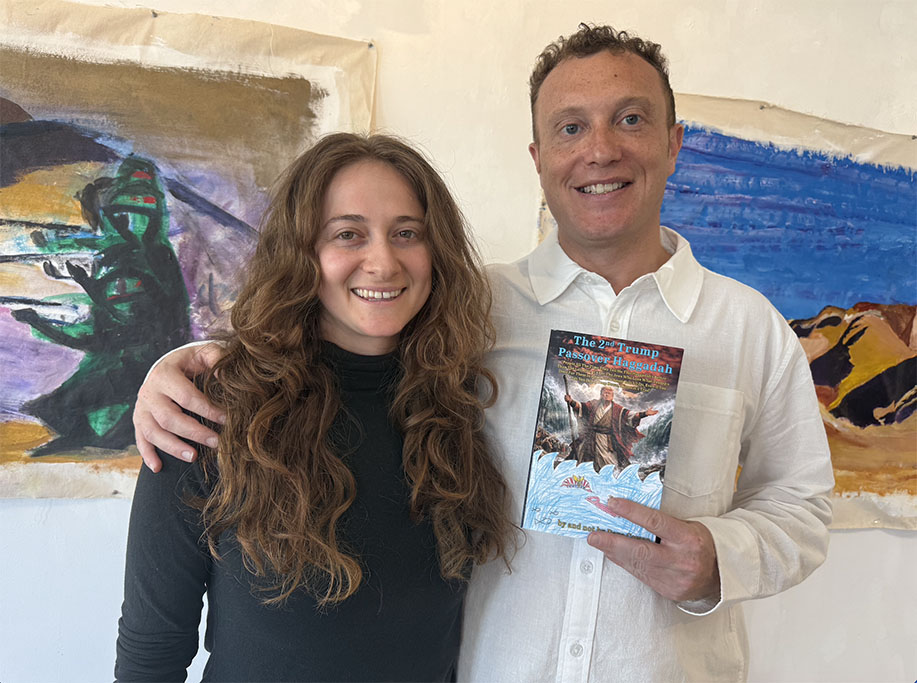
Dave Cowen’s Passover Seder is one his guests are unlikely to forget. This is not the traditional evening of long, formal passages, often written in an biblical or liturgical Hebrew that can feel distant and difficult to understand even by Hebrew speakers. Instead, it moves at a lively pace, loosens the traditional structure, and blends in playful, engaging readings — all while leaning into what many secretly look forward to anyway: the meal.
Cowen’s Haggadah is a sharp, irreverent work, written as a script in which familiar figures — including Donald Trump, Benjamin Netanyahu, and Marco Rubio — take on roles within the Seder itself. The result feels more like a fun table reading than a religious ritual. Guests are assigned parts and read directly from the Haggadah, turning the evening into an interactive, theatrical experience.
For the past eight years, Cowen has written a new Haggadah annually. It began in 2018 with “The Trump Passover Haggadah,” and he now returns with “The 2nd Trump Passover Haggadah.” The cover alone sets the tone: Donald Trump is cast as Moses, parting the Red Sea, and declares:
“People All The Time They Tell Me This Haggadah’s Better Than The Last One, It’s For The Jews Who Love What Trump’s Done For Them In Israel, And I Know You All Do, Even If You Say You Don’t, Deep Down, I Know It’s True.”
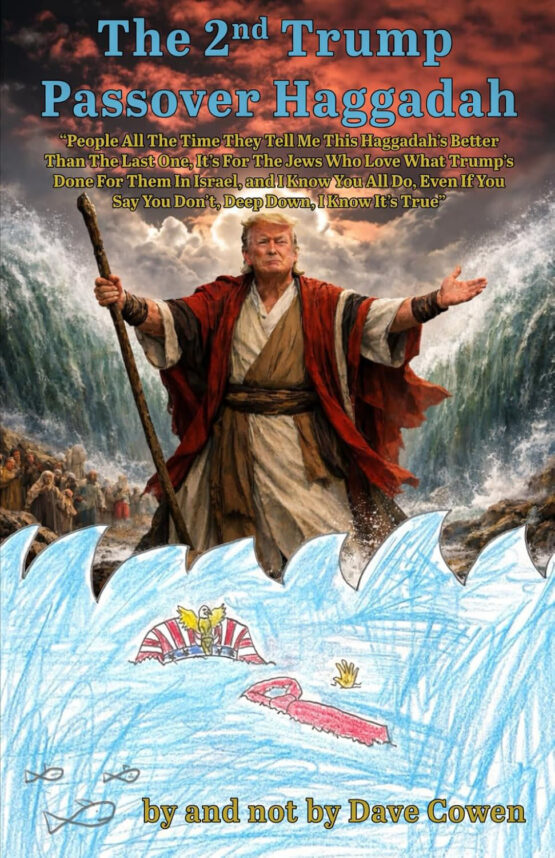
The tone is exaggerated and intentionally provocative, capturing Trump’s voice with over-the-top bravado and placing him in absurd, fictional scenarios that intertwine politics with religious tradition.
Cowen reserves a more traditional Seder for the first night, which he celebrates with his family.
Cowen adds another layer through AI-generated, comic-style illustrations. One such image shows Trump reimagined with peyot, a white beard and a black hat, seated at a Shabbat table, saying: “I said no calls on Shabbat — and I mean no calls on Shabbat unless it’s Mashiach now!”
A few things have changed since Cowen first published his Haggadah. The first is that he no longer hates Trump, especially after all he has done for Israel.
“Honestly in his first term I wrote the book with fear and anger, and I really hated him. It was quite left wing and very anti-Trump,” admitted Cowen. “I was younger and a little more immature, but after Oct. 7, as a Jewish person, I also like – to a certain extent – what Trump had done to help Israel. It’s not completely black or white.”
Honestly in his first term I wrote the book with fear and anger, and I really hated him. It was quite left wing and very anti-Trump … but after Oct. 7, as a Jewish person, I also like – to a certain extent – what Trump had done to help Israel. It’s not completely black or white.”
The second is more personal: his father passed away in 2019, prompting him to reflect and connect more deeply to his spirituality. He has grown more observant and deepened his connection to Judaism.
“Before, I had a lazy relationship with God, now I have a more direct relationship with God. Studying Kabbalah and going to shul has opened me up to spirituality in a way I never experienced before.”
And there was one more thing – he met his girlfriend, Leora Tofler, with whom he traveled to Israel after years of resisting, in part because he had heard unfavorable things about the country.
“When I finally went in December 2025, it really opened me up to understanding how important it is to be Zionist at this time,” he said. “We were in Tel Aviv-Jaffa and there were bands of Palestinians and Jews playing together. It’s not an apartheid state at all. It’s a beautiful place. People don’t really understand that.”
The first Haggadah sold over 10,000 copies and even caught the attention of conservative commentator Charlie Kirk, who tweeted about it — unaware at the time that it was written from a left-leaning perspective. In part thanks to that exposure, many readers likely discovered the book and hurried to purchase it as gifts for Passover. Some even ordered 10 copies to read during the Seder night. One can only imagine their surprise once they began reading it.
“The reaction of readers was pretty split,” said Cowen. “Some really liked it and thought it’s just hilarious, and some people were like this is disrespectful to the president or to Passover.”
After Kirk’s tragic death, Cowen expressed his condolences, emphasizing that he now writes from the center and from the heart, and highlighting his commitment to bridging divides, as reflected in his graphic novel, “An Imperfect Union,” about a couple, America and the gun debate.
Cowen’s Passover Seder is also part of “36 Days of Emunah,” a program he created with Tofler, running from Purim to Passover. The initiative combines Tofler’s art exhibition at Beverlywood’s Ivan Gallery, a pop-up of Cowen’s parody Haggadahs and a series of community events centered around the theme of faith, resilience and trust.
Past Seders have taken on similarly unconventional themes. One he co-created with Dan Lerman — “’The Office’ Haggadah: An Unofficial Scranton Seder” — was hosted in Lerman’s backyard and brought a sitcom twist to the tradition. Another featured “Puff Puff Passover,” with a multi-course, cannabis-infused meal prepared by chef Danielle Steckler.
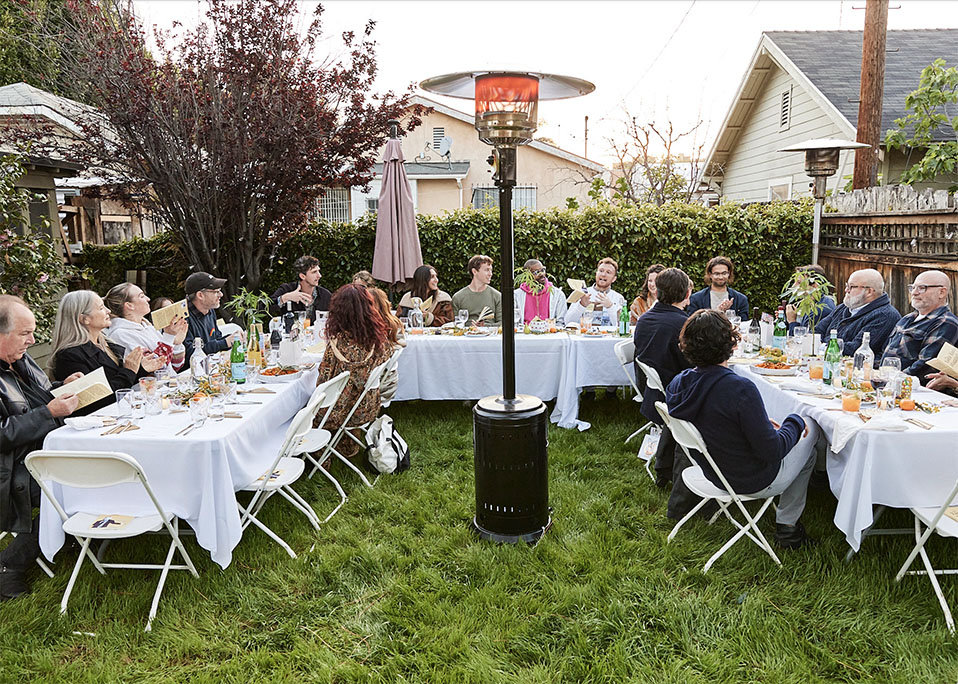
“We had 50 people that year. People were laughing throughout the Seder, it was a riot,” Cowen recalled.
This year’s Seder returns to a more traditional culinary approach, with kosher food, wine and Cowen’s latest Haggadah at the center — but the spirit remains the same: creating a space where people can engage with tradition in a way that feels relevant, thought-provoking and, above all, fun.
The 2nd Trump Passover Comedy Seder will take place on Thursday, April 2nd, 2026 at 8 pm. Cost: $100. Please RSVP at Partiful or contact Dave Cowen directly at (323) 929-9926 or [email protected]