
BOCA RATON, Fla. – Over a bagel with cream cheese and lox, Ron, a Jewish South Florida attorney, admitted that he hasn’t quite figured out his ballot.
Seated at Flakowitz Bagel Inn, a New York-style Jewish deli nestled in a Boca Raton parking lot, Ron — who declined to share his last name to protect his privacy — said he tends to go with moderate Democrats.
And that’s making the U.S. Senate race a real puzzler.
“I’m really torn,” said Ron, a Boynton Beach resident.
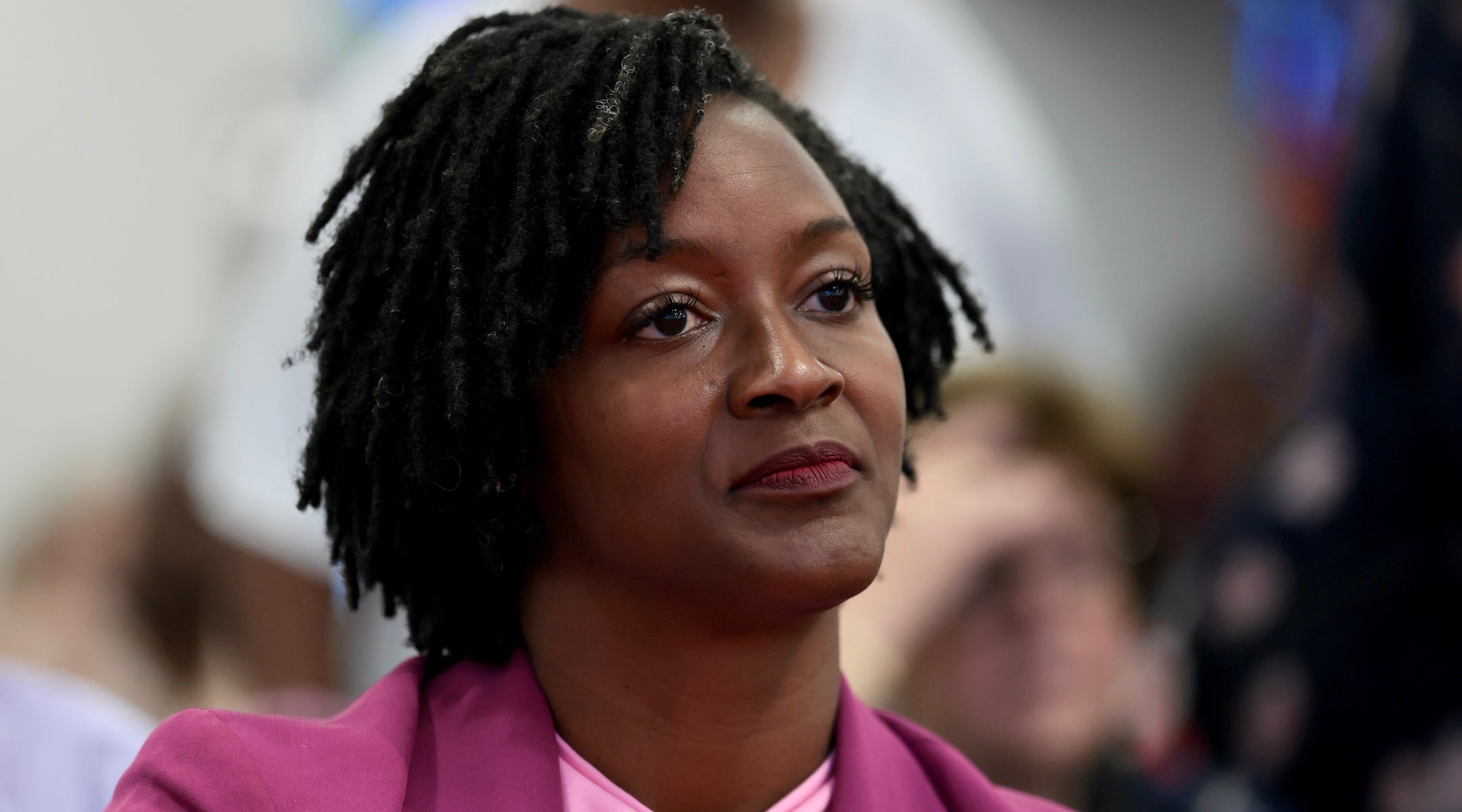
He has no intention of voting for Ashley Moody, the Donald Trump-backed Republican who was appointed by Gov. Ron DeSantis to replace Marco Rubio last year when Rubio became secretary of state. But he also is unsettled by some of the stances taken by Angie Nixon, the left-wing challenger who hopes to be Florida’s first Democratic U.S. senator in eight years.
“For example, Israel is important for me, and I suspect that she’s not in that direction. So that’s a problem for me,” Ron said between bites. He added that he is considering not voting in the race at all, but conceded that “not voting is as much as giving a vote.”
Nixon, who was first elected to the Florida House in 2020, accuses Israel of committing a genocide in Gaza and has said that she opposes sending U.S. military aid or selling weapons to Israel “at this moment.” In November 2023, she introduced a statewide bill advocating for “de-escalation and cease-fire in the state of Israel and occupied Palestine,” which was defeated 104-2 in the Florida House.
In August she soundly won the Democratic nomination with a progressive platform focused on universal healthcare and free childcare.
Next week, Nixon — who is trailing between 4 and 6 percentage points in the latest polls — finds out whether her Israel stance affects her performance among the state’s substantial Jewish minority. (A 2021 study found that there are approximately 665,000 Jewish adults in Florida, the third-largest Jewish electorate nationally.)
Some attendees at a recent Boca Raton congressional candidates’ forum, which featured Democratic Rep. Jared Moskowitz and GOP challenger Scott Singer, expressed reservations about Nixon, who was not endorsed by the Democratic Socialists of America but became a member of the left-wing political organization earlier this year.
In the Senate race, “I’m going to vote Republican,” said Peter Davidson, a sales rep and a member of Congregation B’nai Israel, the Reform temple in Boca Raton that hosted the forum. He said that he is an independent who sometimes votes for Democrats, such as the staunchly pro-Israel Moskowitz. But he added, “Right now, the Democrats are not friends of the Jewish people in general. Jared Moskowitz is an exception.”
Marsha SanFilippo said she plans to vote for Nixon because she is “not comfortable with Ashley Moody.” She added, however, that Nixon “would not necessarily have been my choice of candidate because I don’t know if she is going to be able to win” in a Florida general election.
Leaders in the Florida Democratic Party’s Jewish Caucus, which had endorsed Nixon’s opponent in the primary, Alex Vindman, have started to come around on Nixon. Vindman, who is Jewish and pro-Israel, has endorsed Nixon.
Former state legislator Rick Stark, president of the Jewish caucus, told the Jewish Telegraphic Agency that he will “probably close my eyes and vote for her.”
“I can’t do the alternative unfortunately,” he said, saying he is counting on Democrats to flip Congress and the U.S. Senate.
Mitchell Mallett, president of the Sarasota-Manatee Democratic Party Jewish Caucus, wrote in the Times of Israel last week that Nixon “will be a friend to both the Jewish community and the State of Israel,” and noted that she has “largely stopped making Israel an issue in her campaign” since the primary. He also referred to a meeting between Nixon and about 70 people at a private home, during which she spoke about the historical relationship between Black and Jewish Americans, and said he felt they had “found common ground in the shared experiences of our ancestors.” Nixon would be Florida’s first ever Black U.S. Senator, if elected.
The race between Nixon and Moody is a special election, meaning another election will be held in 2028 for a full, six-year term.
“If Angie Nixon turns on Israel, we can do what the DSA does: we can primary Angie,” Mallett wrote.
Meanwhile, a number of progressive Jewish Floridians have pointed to Nixon’s Israel stance as one of their reasons for supporting her.
Donna Nevel, a member leader of the anti-Zionist group Jewish Voice for Peace’s South Florida chapter, told (JEWISH REVIEW) that Nixon “cares deeply” about the Jewish and Muslim communities and combating all forms of hate.
“What I love is that it’s not just rhetoric for her, it’s like — that’s who she is,” Nevel said, adding that Nixon speaks to Jewish constituents “from so many different perspectives” and is able to connect with voters despite disagreements they may have over Israel. Nevel said she witnessed at least one voter tell Nixon that she won her over, despite differences on Israel, following a private event at a Coral Gables home that also featured Vermont Rep. Becca Balint, who is Jewish.
According to Stark, the former state legislator, Nixon’s outreach to the Jewish community has been “very good” since the primary. His assessment came two months after Vindman’s election night event in August, where Stark said that Nixon’s “outreach to the Jewish community has not been good.”

Stark told (JEWISH REVIEW) that he and a handful of others in the Florida Democratic Party Jewish Caucus met with her privately in September, which he described as a positive interaction. He said that they were “upfront” with Nixon about her Israel stance and wanted to “see what we can do to moderate” some of her positions to win more of the Jewish vote.
“If she had moved over just a little bit of an iota and was stronger on Israel’s right to exist, and refrained from the rhetoric about genocide, apartheid, I think she would do a lot better,” he said.
Nixon’s coalition of supporters now includes former President Barack Obama and a number of high-profile progressives in Congress. Vermont Sen. Bernie Sanders traveled to Florida for a series of campaign rallies with her in October.
James Fishback, the far-right politician who lost the Republican gubernatorial primary, made headlines when he said he would be attending one of those rallies and was photographed with Nixon supporters there. Nixon said that Fishback was welcome to attend but “just can’t be bigoted.” Afterwards, Fishback wrote that he disagrees with much of Nixon’s platform, but that “her opposition to data centers, private equity buying homes, and taxpayer money to Israel is popular and sound.”
At Flakowitz, however, Nixon’s stance on Israel seemed to be a sticking point for lunchgoers, who mostly shared their thoughts anonymously.
“It’s terrible,” said one woman about the state of politics writ large, adding that she feels the only politician she can trust is Moskowitz.
Boca resident Don DePaola, who is of Italian descent and not Jewish, said that he loves Israel and the city’s Jewish community. As for how he’s voting: “Republican, down the line.”
For Ron, the decision was not so easy.
“I just don’t know what I’m going to do about that race yet,” he said.
A Season of Big Decisions. From the Knesset campaign to American midterms, Jewish communities are weighing what comes next. Help (JEWISH REVIEW) keep delivering the deeper context.