

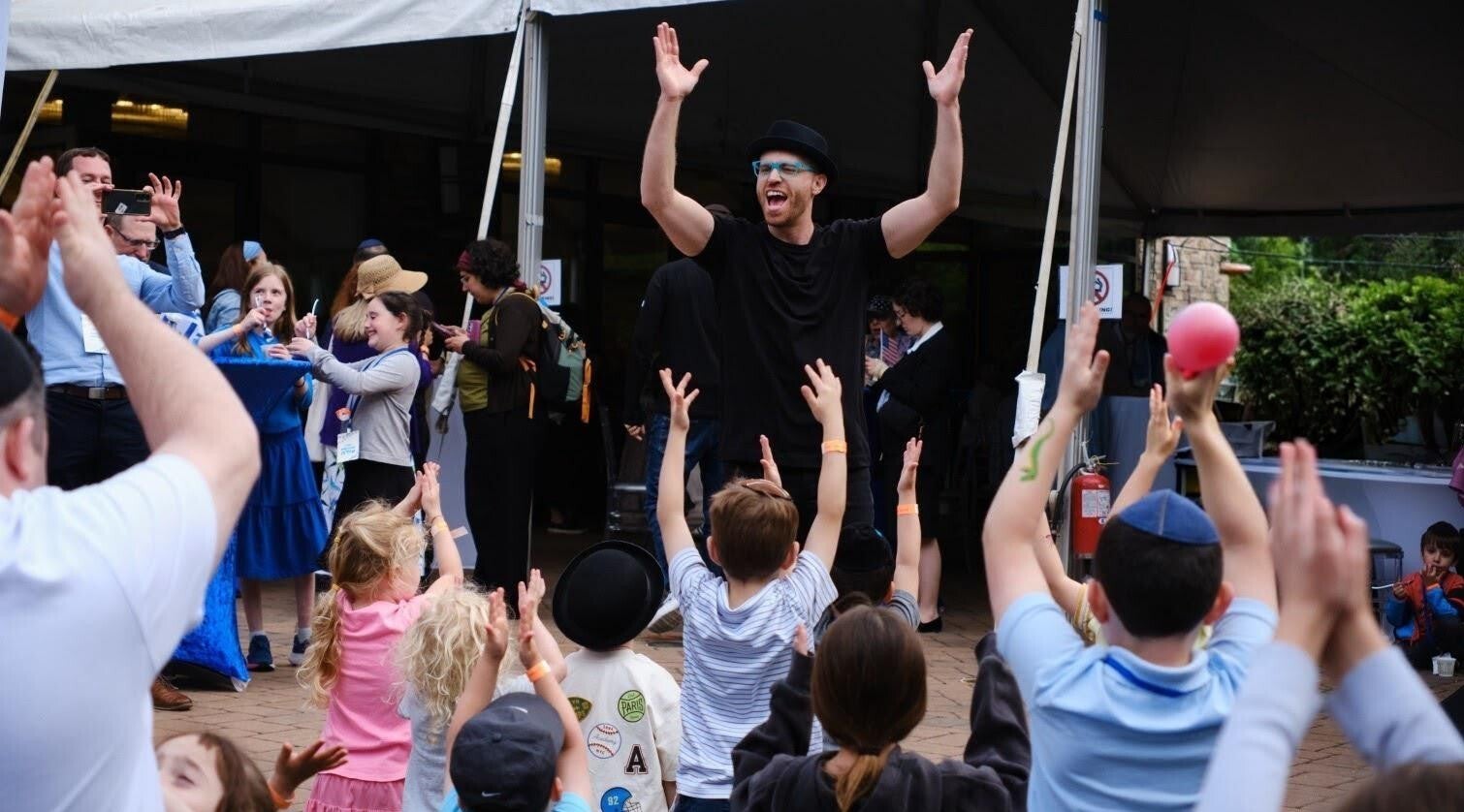
At first glance, the recent celebration outside a northern New Jersey synagogue looked a lot like a bar or bat mitzvah party. Dance music blared from the speakers, many of the men wore kippahs and there was enough food coming off the grills to feed all of the guests and then some.
After a few minutes, however, it became clear that this wasn’t a typical Jewish coming-of-age party. The loud, upbeat music was mainly in Hebrew. Crowds of kids joyfully slid down the bouncy slide, while others waited patiently for balloon animals and cartoon portraits. Blue-and-white banners billowed in the breeze.
The 450 partygoers, mostly from the New York area, had gathered on the beautiful, warm evening to fete their upcoming move to Israel. The Celebrate Aliyah party was held on June 1 and was sponsored by Nefesh B’Nefesh, an organization that facilitates people moving to Israel from North America, together with Israel’s Ministry of Aliyah and Integration, The Jewish Agency for Israel, Keren Kayemeth LeIsrael and Jewish National Fund-USA.
“It’s very special for the community, friends and family to celebrate aliyah,” Rabbi Yehoshua Fass, the co-founder and executive director of Nefesh B’Nefesh, said, a few minutes after Tony Gelbart, Nefesh B’Nefesh’s other co-founder, got up and danced alongside DJ Raphi, an Israeli content creator and beat-boxer. “It’s also special for the families making aliyah.”
This summer, more than 2,300 North American Jews plan to move to Israel, about a 15% increase from the past few years, according to Nefesh B’Nefesh officials. (A similar party with 200 attendees was held in Toronto the following day.)
Summer is the peak season for North American Jews — particularly families — to make a permanent move to Israel. There are numerous reasons for this: the summertime break allows for a longer adjustment time than other seasons, it provides an easier educational transition for kids starting new schools, and people can become familiar with their new surroundings before marking Rosh Hashanah and Yom Kippur, the holiest days on the Jewish calendar.
Binny S., a therapist who lives in Teaneck, New Jersey, who asked that his last name not be used for privacy reasons, was at the party with his wife and three children. He and his family intend to move to Carmei Gat, a new neighborhood in the southern Israeli town of Kiryat Gat, in August. “It’s right after the kids finish camp and before their school starts,” said Binny, whose children range in age from 2 to 8.
The reason for making aliyah is simple, he said: “We wanted to be where our people are.”
Partygoers Stan and Karen Fireman are planning to move to Israel this summer, in part to join two of their children and 12 of their grandchildren. (Matt Capowski)
Nefesh B’Nefesh has helped over 100,000 North Americans make aliyah since it was founded in 2002. In recent years, the organization has stepped up its efforts to help immigrants have a “soft landing” in Israel, Fass said. In addition to offering assistance navigating Israeli government bureaucracy, the organization provides services such as job counseling, retraining and help with resettlement and housing. Nefesh B’Nefesh also provides personal aliyah advisors who assist new immigrants both before they leave North America and after they arrive in the Jewish state.
“It’s a different world. It’s a different move,” Fass said. “We want people to thrive, not just survive.”
Tova Wagner, a genetic counselor who also lives in Teaneck, is looking forward to thriving in Israel. She and her husband Efrem, a rabbi and psychologist, and their four children, are planning to move there this summer.
The Wagners had previously spent a year in Israel; Tova recalls how nurtured she felt during the pregnancy and birth of her oldest child, who is now 6. Staff in medical offices made appointments as easy as possible, she said, and “people from all walks of life brought us food.”
She and her husband both have siblings already living in Israel. Plus, she added, “we love the country and the brotherhood.”
Of course, even with family living nearby, moving to a new country poses challenges, such as learning a new language and experiencing different cultural mores. As Binny put it, “I’m excited, but terrified.”
Thanks to modern technology, some of the people making aliyah this summer will be able to transfer their jobs. Binny, for example, will continue to counsel his American patients remotely while he works to build up his Israeli practice. Darren Edelstein, a Long Island resident who’s making aliyah over the summer with his wife, five children and their dog, will keep his job as an in-house lawyer.
Furthermore, Israeli institutions are doing more to help new immigrants acclimate to Israeli society. In addition to receiving free group flights to Israel — which the Israeli government provides — new immigrants receive free Hebrew classes, as well as explanations about how the different educational streams in Israel work, said Deganit Sankar-Lange, the director-general of Israel’s Ministry of Aliyah and Integration. In addition, some Israeli universities now offer bachelor’s and master’s degree programs in English.
As a result, North American olim “see Israel as a place for equal opportunity,” she said.
Before these new immigrants board their flights to Israel, there’s a celebration to be had on these shores.
“We hold these events both to celebrate the olim who are making aliyah and to inspire other members of the community to potentially consider aliyah themselves,” Yael Katsman, vice president of communications at Nefesh B’Nefesh, said. “Their primary purpose is to give olim the opportunity to connect with one another, build relationships, network and support each other as they plan for their upcoming aliyah.”

Darren Edelstein, in blue, is planning to move to Israel this summer with his wife Elisheva (far left) and their children. Darren’s longtime friend Elchanan Ogorek, in green, and some of his kids joined Goldstein’s family at a recent event in New Jersey to celebrate North American Jews who are making aliyah. (Matt Capowski)
At the party in New Jersey, many of the activities were geared toward young families. At one point, two dozen children, along with some of their parents, got up and danced together. In between some of his stylized moves, DJ Raphi led the dancers in a rousing chant of “Am Yisrael Chai.”
Not everyone at the event had kids in tow. Andy Piper, a 39-year-old physician assistant from Reno, Nevada, who wore Israeli blue-and-white sneakers with a Jewish star on them, was visiting Israel last year during the first Iran war. He said he was impressed by the relentless spirit Israelis demonstrated, despite the regular warning sirens.
“We’d be at the beach or the bar, and then we’d go to the shelter,” said Piper, who added that after the emergency lifted, “we’d go out like nothing happened.”
Piper, who will live in Tel Aviv, is moving to Israel as part of the International Medical Aliyah Program, which aims to bring 2,000 physicians and other health care professionals to Israel by 2029 to address a shortage of medical providers.
For some soon-to-be immigrants, a move to Israel has been a long time coming. Stan and Karen Fireman, who currently live in Monsey, New York, plan to move to the Jerusalem suburb of Ramat Beit Shemesh over the summer.
Karen has wanted to move to Israel for several decades, but it’s taken that long to convince her husband. In the meantime, they raised six children in Ohio, where they worked as therapists at the Cleveland Clinic.
Karen’s persistence eventually paid off: Stan said he is looking forward to living where the events of biblical Jewish history took place. It also helps that two of their children — and 12 of their grandchildren — already live in Israel.
“The bottom line is that Israel is where I think we should all be,” he said.
Reporting the stories that define our era. When history unfolds in real-time, the Jewish world turns to (JEWISH REVIEW). Your support ensures we can document the complexities of war and the resilience of Jewish communities with integrity.