
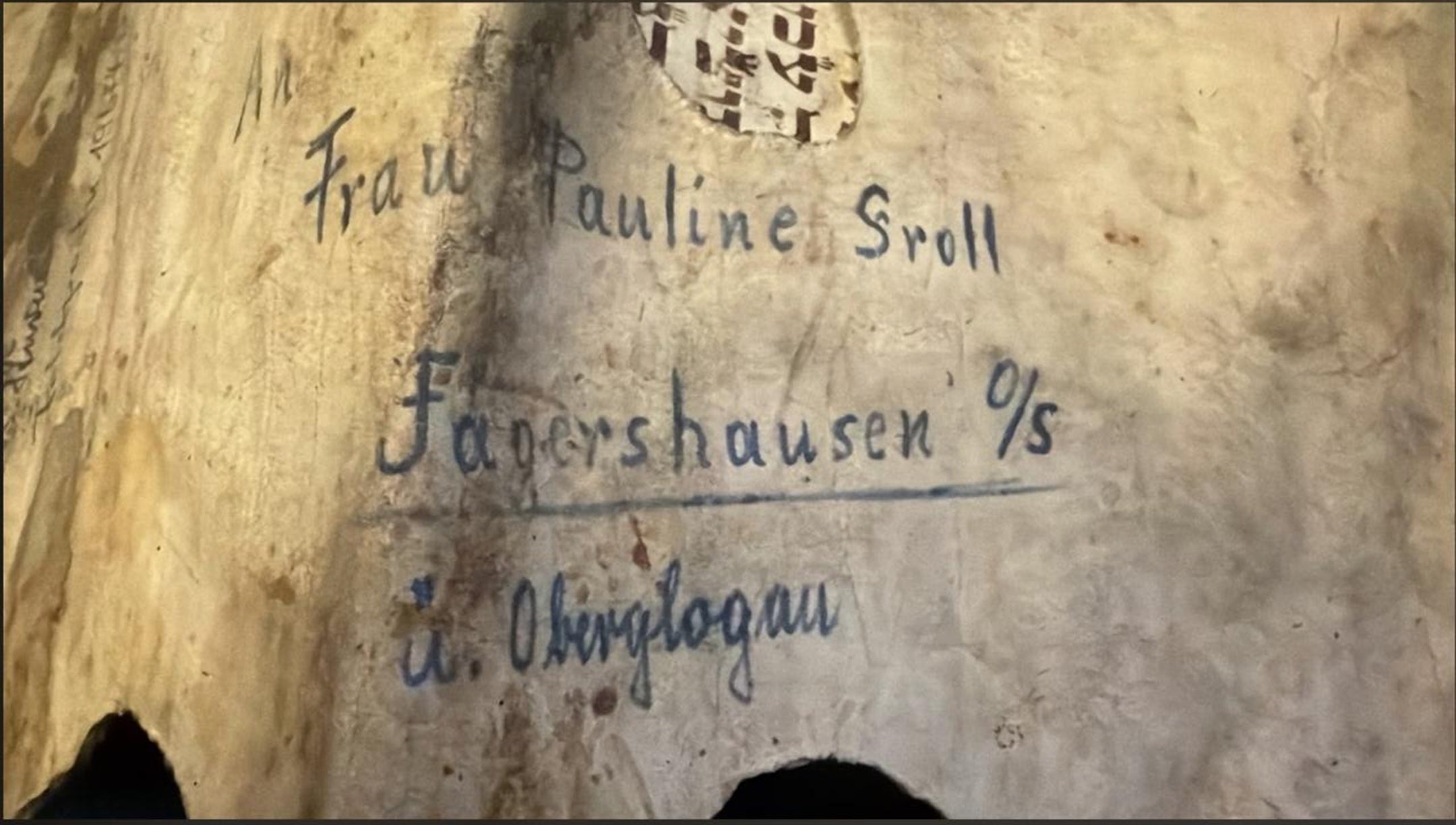
A Torah scroll fragment believed to have been used as parcel paper by Nazi SS soldiers is expected to be donated to a US Holocaust remembrance organization after a Norwegian auction house listed it for sale last week, sparking an outcry.
A spokesperson for Israel’s Foreign Ministry told JR that Foreign Minister Gideon Sa’ar had directed the ministry and Israel’s embassy in Norway to intervene to prevent the sale of “a sacred manuscript looted by the Nazis.”
“Thanks to the embassy’s efforts, the auction was canceled and the parchment will be donated to a Holocaust remembrance organization in the United States,” the spokesperson said.
The Torah fragment is expected to go to Remember Us The Holocaust (RUTH), a San Diego Holocaust remembrance organization working to establish a permanent museum. In a statement sent to JR, RUTH said it had worked over 48 hours to “secure the fragment for preservation” and Holocaust education.
The organization also enlisted Adolfo Roitman, the former curator of the Dead Sea Scrolls and head of the Shrine of the Book at the Israel Museum in Jerusalem, to advise on its “appropriate treatment and respectful exhibition,” the statement said.
Moisés Salinas Fleitman, RUTH’s executive director, told JR that the donation had been confirmed by email last Tuesday but had not yet been finalized. He said there was “no expert confirmation as of yet of the provenance of the scroll,” and that the consignor had told RUTH the parchment was “found on a public market in Poland” over three decades ago. RUTH had not yet inspected the fragment or any evidence supporting that account, he added.
Salinas Fleitman said his understanding was that the fragment had been withdrawn from the auction, but RUTH could not confirm what had happened amid conflicting news reports. The organization also declined to identify the person in possession of the fragment, citing its policy of protecting anonymous donors. RUTH’s procedures for verifying authenticity and legitimate provenance take time, the organization said, adding that the organization would not accept the fragment unless both could be established.
The controversy began when the fragment was put up for auction Oct.18 by Oslo-based Valkyrie Historical Auctions, an online auction house specializing in Third Reich memorabilia.
The handwritten calfskin parchment, estimated to fetch between $1,500 and $2,000, was advertised as a “sad and powerful symbol” of the destruction of European Jewish life.
Valkyrie identifies its president as Norbert Podlesny, a historian and author of a trilogy on the Holocaust. The auction house says its items are examined by experts and carry a lifetime guarantee of authenticity. Neither Valkyrie nor Podlesny responded to repeated inquiries from JR.
The auction house’s original listing explicitly described it as having been plundered by SS soldiers during the Holocaust, an account its representative subsequently disputed in comments to a Norwegian newspaper. The parchment was also described as having been used to wrap a package sent to Germany.
The Valkyrie website recorded a winning bid of $8,500 on the Torah fragment, more than four times the upper estimate for the parchment.
Video footage of the live auction reviewed by JR shows bidding on the fragment proceeding, with offers rising incrementally. The footage does not establish who placed the bids or whether a transaction was ultimately completed.
Conflicting accounts have left it unclear whether the fragment was formally withdrawn, purchased by the auction house itself or simply withheld from the winning bidder.
Other lots in the same auction included a death certificate for a Polish prisoner at Dachau, a book from the scientific library at Auschwitz, and a dress bearing a yellow Star of David marked “JUIF.”
The controversy went public after the Foreign Ministry condemned the planned sale in a post on X headed “A Nazi celebration in Oslo.”
The ministry also criticized Norway’s proposal to end dedicated funding for school trips to former Nazi concentration camps, with the funding instead transferred to general local government allocations.
“Auctions of sacred texts looted by the Nazis: IN. Visits to extermination camps: OUT,” the ministry wrote.
Gideon Taylor, president of the World Jewish Restitution Organization (WJRO), said that the auction house had taken steps to remove the fragment from public sale but added that those measures “in no way” resolved the issue.
“There are many unanswered questions,” Taylor told JR.
He urged Valkyrie to identify the seller, explain how the fragment had been acquired, disclose what provenance information accompanied it and undertake further research into its history. He also questioned why the auction house had agreed to sell the parchment despite its original description as Nazi-looted property.
“There is a profound contradiction in recognizing an object as a symbol of the Holocaust while treating it as something to be bought and sold,” he said.
He said the case exposed a “lack of historical awareness” of how the systematic plunder of Jewish property, both private and communal, formed part of the Nazis’ campaign to annihilate European Jewry.
“This is not simply an antique or a historical curiosity. It is a sacred Jewish object that represents a community’s religious life and the devastating destruction of that life during the Holocaust,” he added.
WJRO has called on the Norwegian government to launch an investigation into the auction house’s handling of the fragment, Taylor said, adding that similar questions had arisen concerning other objects previously sold by it.
Taylor also called for “a coordinated international effort” to tackle the trade in sacred Jewish objects looted during the Holocaust and still held by private collectors.
“This is not about private collections, this is about the memory of the Jewish people,” he said.
Norway is among 35 countries that have endorsed the 2024 Best Practices for the Washington Conference Principles on Nazi-Confiscated Art. The nonbinding guidelines cover Holocaust-looted religious and communal property, including sacred scrolls, manuscripts and synagogue objects, and recommend returning objects determined to have belonged to Jewish communities to successor communities or institutions. They do not automatically require restitution of an item offered through a private auction.
The dispute follows other controversies over the sale and ownership of Holocaust-era artifacts. Last November, a German auction house canceled a planned sale of more than 600 concentration camp-related objects, including prisoners’ correspondence, identification documents and a yellow Star of David, following protests from Holocaust survivors and Jewish organizations.
Earlier this year, Poland returned 91 Jewish religious objects to Greece, decades after they were seized by the Nazis from synagogues in Thessaloniki. WJRO helped coordinate their restitution following years of research and negotiations.
A Season of Big Decisions. From the Knesset campaign to American midterms, Jewish communities are weighing what comes next. Help JR keep delivering the deeper context.