

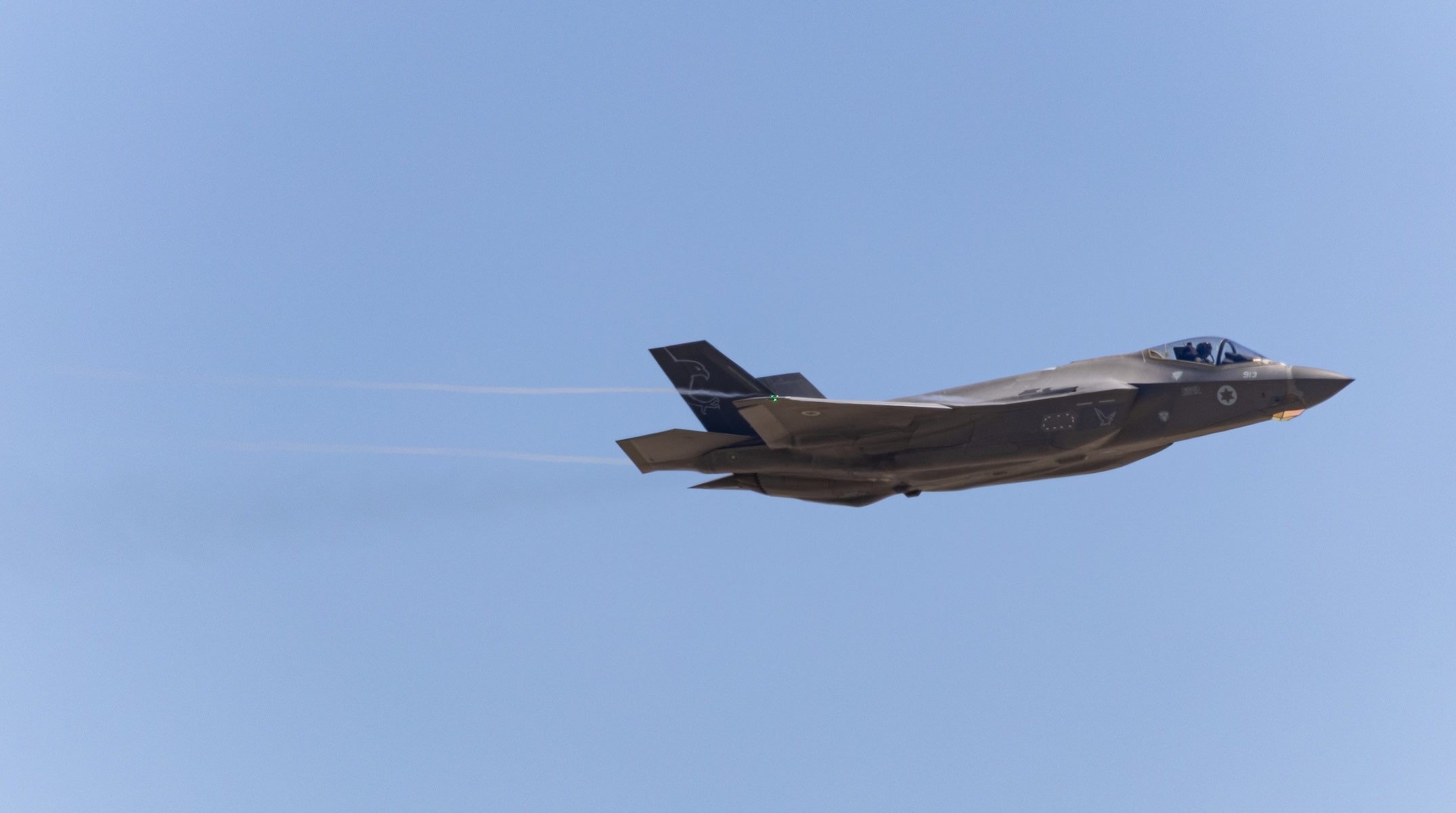
The State Department has approved a possible $24.3 billion sale of 48 F-35 fighter jets to Saudi Arabia — a move that would make the kingdom the second Middle Eastern country after Israel to have the world’s most powerful combat aircraft.
“This proposed sale will support the foreign policy and national security objectives of the United States by improving the security of a major non-NATO ally,” the department said in a statement.
Israel wants the sale attached to a normalization deal with Saudi Arabia, but that doesn’t appear to be on the horizon. However, there is a small chance that Congress could keep the sale from happening.
When President Donald Trump first confirmed that he was considering the sale last November, Israeli officials told Axios that while they don’t oppose the sale itself, they wanted it “to be subject to Saudi normalization with Israel.”
Although Israeli Prime Minister Benjamin Netanyahu reportedly brushed off the deal’s significance last fall, a security source at the time warned on CNN that the possibility of Saudi Arabia acquiring “the same capabilities” as Israel was “very concerning.”
The prime minister was more vocal in his opposition to a July announcement from Trump that he was weighing selling the advanced jets to Turkey as well, telling CNN that Turkish President Recep Tayyip Erdogan is “not exactly a model ally of the United States.”
Israel has already purchased 50 F-35 jets, in two procurement rounds that occurred in 2016 and in 2017, according to the Israeli Defense Ministry. However, local media reports indicate that two of the 50 have yet to arrive, meaning that just 48 are on the ground – the same number of planes that the State Department has approved for Saudi Arabia’s potential purchase.
Israel would have many more F-35s than Saudi Arabia for the time being, because its Defense Ministry announced in 2024 that it would be procuring 25 more of the planes, slated to begin arriving in 2028. Earlier this year, the Defense Ministry revealed that it would be procuring yet another squadron of the jets, although the quantity remained unclear.
Congressional approval is not assured; wariness of the Saudi regime, stemming in part from the state-sanctioned 2018 murder of a U.S.-based journalist in Turkey, crosses party lines.
The U.S. Arms Export Control Act requires the executive branch of the government to notify Congress regarding major defense equipment sales to most countries. Congress can then deem a country ineligible to participate in a sale through a joint resolution. The president can then veto the resolution, which Congress would need a two-thirds supermajority to override.
Additionally, U.S. law requires the president to ensure that Israel maintains “a qualitative military edge over military threats” when considering arms sales to other Middle Eastern countries. Israel, per the law, must be able “to counter and defeat any credible conventional military threat” from both other nations and “non-state actors.”
“The proposed sale of this equipment and support will not alter the military balance in the region,” the State Department said on Thursday. It called Saudi Arabia “a force for political stability and economic progress in the Gulf region,” adding that the sale would help “deter current and future threats by strengthening its homeland defense.”
The department maintained that not only would the sale improve Saudi Arabia’s defense capabilities, but it would also boost “interoperability” with both U.S. forces and other players from NATO and the region.
As for the potential deal’s logistics, Saudi Arabia has requested 48 of Lockheed Martin’s F-35 Lightning II Joint Strike Fighter Jets, as well as 49 Pratt & Whitney engines, according to the State Department.
The kingdom is also seeking to acquire other non-major defense equipment, such as cryptographic devices, precision navigation, secure communications, simple key loaders and support for electronic warfare databases, maintenance and personnel training.
Producing and delivering these planes can take many years.
Meanwhile, just a day before Trump’s announcement, The New York Times surfaced intelligence concerns that China could acquire F-35 technology by spying on Saudi Arabia or through its partnerships with the kingdom.
U.S. House Rep. Raja Krishnamoorthi, a Democrat from Illinois, warned in a statement on X that “Beijing has spent decades stealing American intellectual property” and that this deal could “help them do it.”
“Our own intelligence community is warning that it could put the crown jewels of American military technology within reach of the Chinese Communist Party,” Krishnamoorthi added.
The Biden administration reportedly ended a past F-35 deal with the United Arab Emirates — secured by the first Trump administration — due to similar concerns about the country’s connections to China, as well as to Russia.
As the Year Turns, Support the Journalism You Trust. JR covers the stories shaping Jewish life around the world — with the depth this moment calls for. As you reflect on the year ahead, consider a gift that keeps independent Jewish journalism strong.