

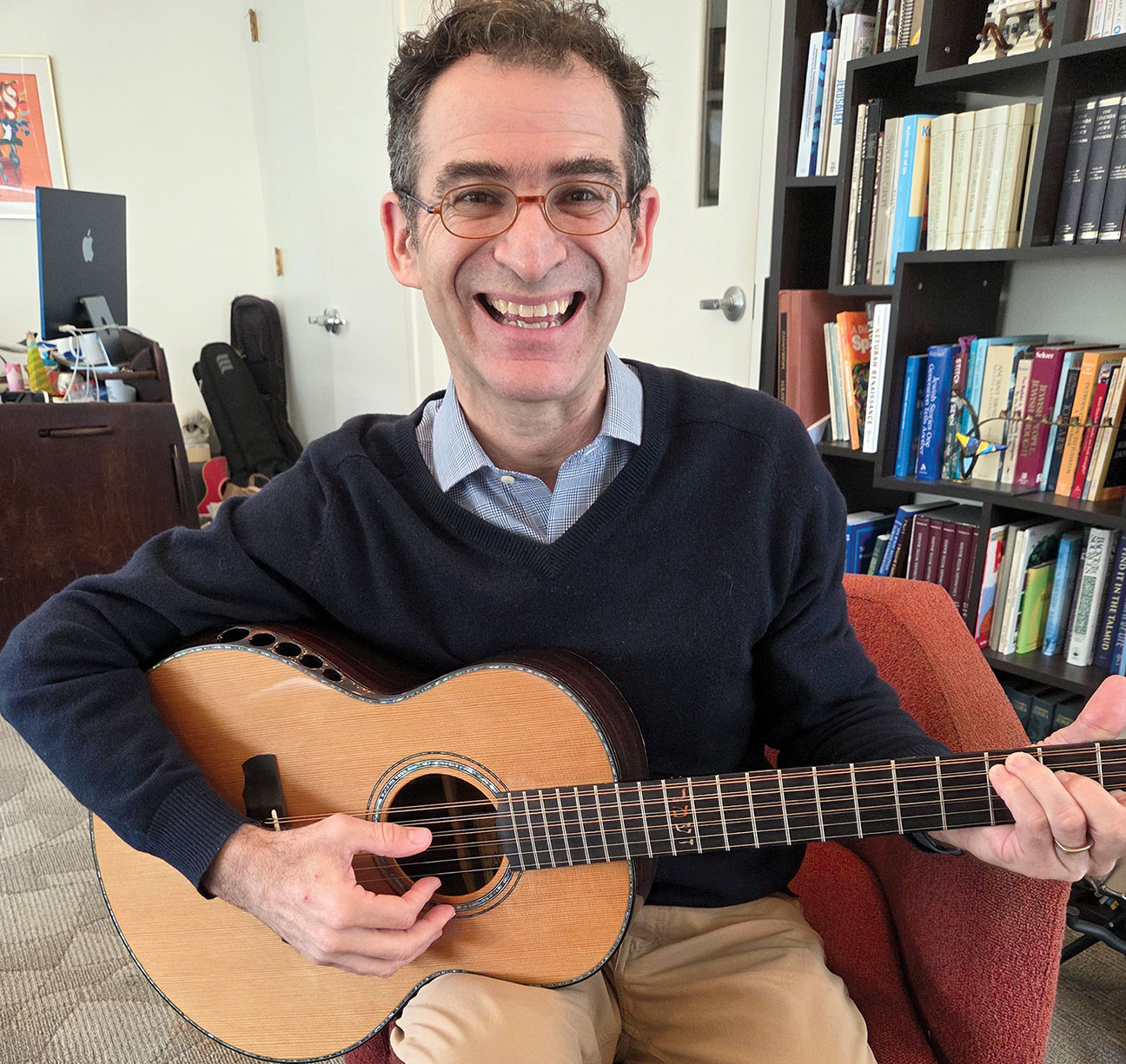
According to Rabbi Zach Shapiro, Spiritual Leader of Temple Akiba in Century City and a lifelong musician, the way Reform and Conservative congregations pray underwent a seismic change in the 1970s. That’s when Debbie Friedman, the hugely popular Jewish musician who died in 2011, “began to transform the way we pray.”
The change, he told The Journal, started in camp. Then synagogues realized that the rabbi, the cantor and the choir were active, but the congregation was just sitting there. “Now, when you go into a synagogue, you won’t see an organ anymore. You’ll see a piano, guitars, other kinds of instruments that might form a band. But the encouragement of congregants to open their souls and to actively allow their voices to lift — that has made a big difference. “When we sing,” he said, “it’s as though we pray twice.”
There never was a question that combining music and Judaism would drive his rabbinate. “I always knew they would be intertwined,” he said. “Around the time I was a rabbinic student, it was almost expected that students come in playing guitar. We grew up in that generation. It’s a real asset that I am able to lead musically.
“But as I said earlier, I know my limitations.” One example: when he came to Temple Akiba in 2006, “we had a very dedicated lay cantor who led us once a month and helped us with the High Holy Days, Gilbert Phillips, who now is in Cleveland.”
Rabbi Shapiro lauded him as a “formidable, wonderful presence. But we also recognized that he was limited. He could read music and lead music, but he wasn’t trained in teaching cantillation. As soon as I got here, we began to bring on Lonee Frailich, who was just about to enter cantorial school. She began to intern for us and eventually became our first fulltime cantor. She has taught all of our children how to chant from the Torah.”
Rabbi Shapiro said Cantor Frailich “has infused this place with a love of music. Now we have junior choirs and junior-junior choirs, intergenerational choirs.” This, he said, is part of his project “to bring music into every aspect of the congregation, to help with prayer, to help with Akiba’s youth program and to make sure people were actively loving Jewish music – both the classics as well as everything that is contemporary, a mix of all of that.”
And with that has come innovative musical services – Beatles Shabbat, Simon and Garfunkel Shabbat, Reggae Shabbat, Broadway Shabbat and Nefesh Mountain making multiple appearances. “We care about having a budget to bring in people who can help us,” said Rabbi Shapiro.
When he was younger, “it was the music of Debbie Friedman that inspired him. “One of the crowning moments in my rabbinate was when I left University Synagogue, we had a tribute evening with Debbie Friedman as our guest artist. As a surprise added guest, Theodore Bikel was there — may their memories be a blessing. To share a bimah with both of these luminaries was really wonderful.” Friedman’s music had a major influence in how he writes his music, he said, “along with ‘Rabbis’ Paul Simon and Art Garfunkel. They influenced my folk music style.”
And the way he looks at music has transitioned. “My musical repertoire has broadened,” he said. “A big part of it is that my husband, Ron Galperin, is a Renaissance man. He’s given me an appreciation for (certain) music I did not have before I met him.” Something that not many people know about Ron is that he is from a rabbinic and cantorial dynasty. “His father, his grandfather, his great-grandfather – going back to the giant, Rabbi Levi Yitzchak of Berditchev,” who lived from 1740-1809.
His husband, he said, is the kind of person “who can go into a synagogue anywhere in the world, pick up either a siddur or a machzor and lead the davening. And he does it with a voice where one might think he was going back to 19th-century Europe, the time of the great hazzans.” Active in the community for three decades, Galperin is currently interim director of the American Jewish Committee/Los Angeles.
The rabbi had news for his new employer when Akiba hired him in 2006. “The community thought they were going to get a two-for-one,” he said. “They thought they were going to get a rabbi and a cantor together. I said ‘No way.’ We would kill each other if we worked together all of the time.” But a few times a year, when they get a chance to lead services together, it “really is beautiful.”
Looking back at the start of his two decades leading Akiba, “Ron was very much of a cornerstone for me.” It was a golden time for the couple. “Not long after I began, Ron became the elected controller of Los Angeles. In that time period, we gave birth to beautiful twins. While Shapiro is at temple Friday nights, Galperin is home with the kids until they are old enough to be here more often.” The twins are now six and a half. With a smile, Shapiro noted that “we have a long journey in front of us.”
Bringing his thoughts into the present, he said that when he walks into Temple Akiba, “I am the luckiest rabbi in the world. I love the community I serve, the staff I serve. We are in a congregation bursting at the seams because Culver City is transforming. I am so fortunate. I feel as if we are on the precipice of growing stronger, more committed.”