
When Mickey Gitzin arrived in New York last month with two young daughters and a few winter coats hastily packed in Israel, he was stepping into a role that once would have seemed improbable for the organization he now leads.
Gitzin, 44, was named interim president and CEO of the New Israel Fund in December, as its longtime CEO, Daniel Sokatch, begins a year-long sabbatical. Gitzin takes over at an organization that funds progressive Jewish and Arab organizations in Israel that are often at odds with the Israeli government. As a result, it has been vilified by Israel’s right and their allies in the United States as dangerously radical, even traitorous.
And yet today, as Israel is led by its most right-wing government ever and anti-Zionism is growing on the American left, NIF finds itself in a different, if no less precarious, position: defending a space in the Jewish mainstream that is fiercely critical of Israeli policy while affirming a version of Zionism that aligns with democratic equality.
“NIF was always in the forefront when it came to the liberal progressive ideas that were later on absorbed by the mainstream,” said Gitzin, the first Israeli to lead the organization, in a Zoom interview. “We are not there to be the mainstream. We’re there to push the mainstream, but in order to push the mainstream, you need to be in touch with the mainstream and not give up on it, which is a very, very fine line.”
That position leaves NIF open to criticism from both sides. To some on the American left, Zionism of any stripe is incompatible with democracy and human rights for Palestinians and other minorities. In many parts of the Jewish center, NIF’s grantees reveal political and social ills in Israel they’d rather not see, and definitely do not want broadcast to the rest of an already hostile world.
Yet Gitzin argues that NIF reflects where many American Jews actually are: horrified by Hamas’ Oct. 7 attack, devastated by the destruction in Gaza, and alienated by a discourse that demands total allegiance to one narrative or another.
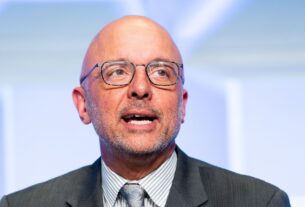
“We’re there to push the mainstream, but in order to push the mainstream, you need to be in touch with the mainstream,” said Mickey Gitzin, the interim CEO of the New Israel Fund. (Courtesy NIF)
“People want to act in ways that fit with their values,” he said. “I think that we have a very powerful story to tell, that the story of Israel is being able to care about the state of Israel and fight for it and care about the notion of equality for Jews and Palestinians.”
Born in Israel to immigrants from the former Soviet Union, Gitzin grew up in Azor, a working-class development town. His first rebellion, he said, was against the politics of his right-leaning parents. His political awakening came late, sharpened by his service as an intelligence officer in the Israel Defense Forces, where he worked on Palestinian affairs during the Camp David negotiations and the Second Intifada.
That “allowed me to understand the complexity of the relationship between Israelis and Palestinians, the role that Israel plays, and the missed opportunities all through the way,” he said.
Later, as a Jewish Agency emissary in South Bend, Indiana, Gitzin encountered an American Jewish world that unsettled his assumptions about liberal politics and Jewish observance, which among many secular Israelis are often seen as incompatible. “I was able to jump between the communities happily, something that I’ve never been able to do in Israel,” he said.
Returning to Israel, he founded an organization focused on religious freedom that later became an NIF grantee. Gitzin had found his institutional home. Eight years ago he became executive director of NIF’s Israel office — years that coincided with some of the fiercest attacks the organization had ever faced.
Though more intense, those attacks were not new. Since the 1980s, NIF has been accused by critics of undermining Israel by funding human rights groups that promoted anti-Israel positions. In 2010, the right-wing organization Im Tirtzu said NIF grantees were helping hostile groups abroad build their case against the Jewish state. Those grantees included B’Tselem, a human rights group, who said they merely reported human rights violations and left others to draw their own conclusions.
NIF responded at the time that politically charged groups like B’Tselem represent only a fraction of their grantees. It pointed to other grantees, including the Association for Civil Rights, the pro-democracy group Mehazkim, the civil-society coalition Citizens HQ and the Israel Religious Action Center, a public policy arm of the Reform movement.
More recently, the criticism came not just from right-wing NGOs but from the prime minister’s office. In 2018, Netanyahu blamed NIF for thwarting his plan to deport African asylum seekers. That same year, he accused NIF of weakening Israel by opposing the nation-state law that prioritized Jewish national identity over equal citizenship for non-Jewish Israelis.
“I think it was very confusing for the organization,” said Gitzin. “We’re do-gooders, and all of a sudden we found ourselves in such an attack.”
The organization’s response, he said, was to retool and stop ducking each individual attack or trying to convince critics that NIF’s mission was as a non-ideological supporter of “civil society” or “social justice.”
Instead, NIF has clarified that it stands for democracy, peace, building Palestinian civil society, Jewish-Arab partnership and protecting human rights. Other issues, like economic justice and religious pluralism, are less of a priority now, said Gitzin, who described the process as “being pushed out of the closet.”
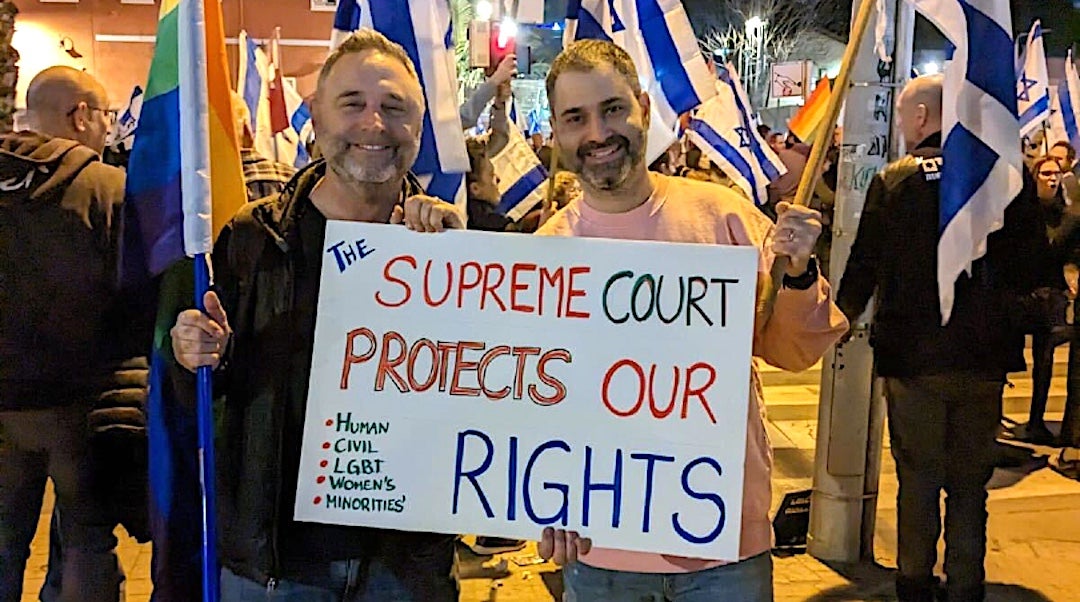
“As someone who came out of the closet, personally, as a gay person, I know it’s really, really difficult to be pushed out of the closet,” he said. “And then when you’re out it’s the most powerful feeling that you can know.”
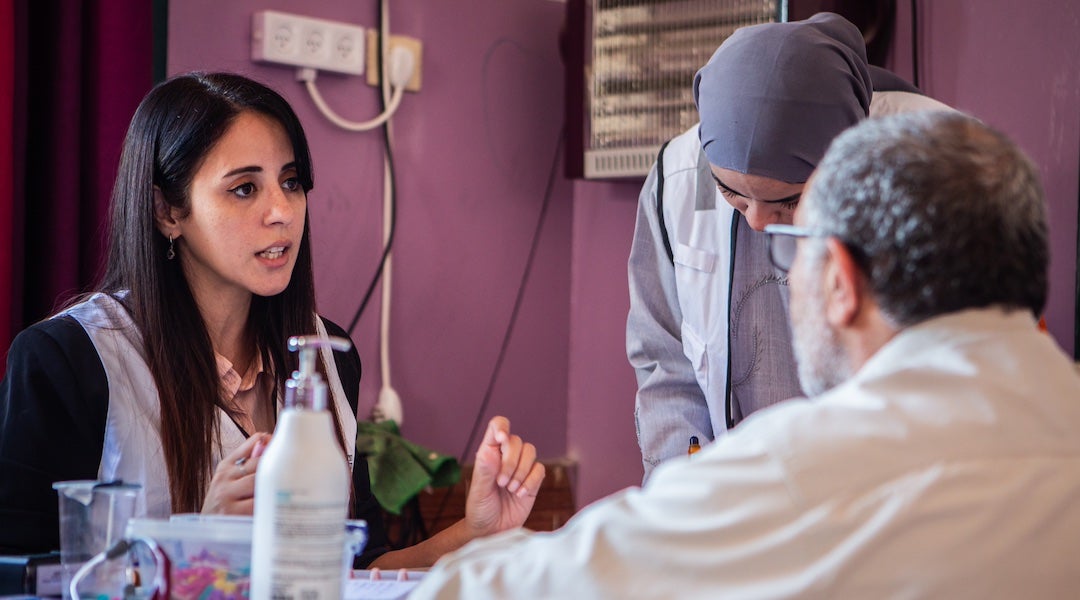
A physician volunteering for the mobile medical clinic run by NIF-grantee Physicians for Human Rights-Israel treats Palestinian patients in the West Bank. (Mati Milstein for NIF)
As a result of this clarity, he said, their support in Israel grew. Donations from within Israel also surged after Netanyahu’s attacks, Gitzin said, as liberal Israelis came to see NIF as part of a broader struggle to defend democratic institutions.
According to NIF, since 2023 — and especially in the aftermath of Oct. 7 — NIF’s donor base has increased by more than 7,000, from roughly 14,000 donors to more than 21,000 through 2024. Its annual budget in 2025 was $28.5 million, a figure that does not include additional funds it stewards through donor-advised gifts and family foundations.
In 2025, NIF distributed more than $12.8 million in core grants to 97 grantees, and spent an additional $3.7 million on strategic capacity-building and issue advocacy in Israel.
NIF employs 112 staff members, with 42 based in the United States and 70 in Israel.
Gitzin boasts that NIF was one of the first organizations to respond to the Oct. 7 attacks, finding hotels for people who were evacuated from Ofakim and other villages. NIF also raised more than $3 million for a humanitarian campaign to aid Gazan civilians.
In Israel, NIF has expanded its work in the West Bank, funding not only legal advocacy but “protective presence,” supporting Israelis and Palestinians who show up as observers and demonstrators at Palestinian communities threatened by settler violence. Gitzin describes the campaign to push Palestinians out of Area C, the fully Israeli-controlled territory in the West Bank, as systematic and state-enabled.
“These are not mistakes,” he said. “It’s a policy.”
He worries about the tens of thousands of Israelis who have left the country since Oct. 7, suspecting many are the kind of liberal democrats who agree with NIF’s agenda. And he warns about the rise of what he and others call “Kahanism,” a hyper-nationalist Zionism associated with the late Meir Kahane, the American rabbi who at one time was shunned even by the Israeli right for being too radical.
Such Kahane acolytes as the far-right senior ministers Bezalel Smotrich and Itamar Ben-Gvir, Gitzin said, make it increasingly obvious that “the attack against Israel and democracy comes from the settlement enterprise and ultra-nationalist settlers,” alongside “populist leadership like Netanyahu” and forces that “can’t live with the notion of equality.”
Asked whether liberal Zionism still has a future in Israel, Gitzin argued that the political landscape is shifting in ways that create new — if limited — opportunities. While the traditional left remains a small minority, he said, “the definition of what’s left or not left is changing,” especially since Oct. 7 and, before then, the government’s judicial overhaul proposal that triggered massive pro-democracy demonstrations.
“There is a space to influence, where more people are searching for answers. There’s definitely a growing camp of people who are not pleased with the current government and who identify as liberal democrats,” he said. “Our job is to reach out to them and try to bring them closer to where I sit.”
Liberal Zionists, he acknowledged, “will never be a majority.” But drawing a lesson from their ideological opponents, he noted that settlers were never a majority, yet learned how to exert their influence. That, he said, is a model for Jews and Arabs who believe Israel needs “a different vision than the one represented by this government.”
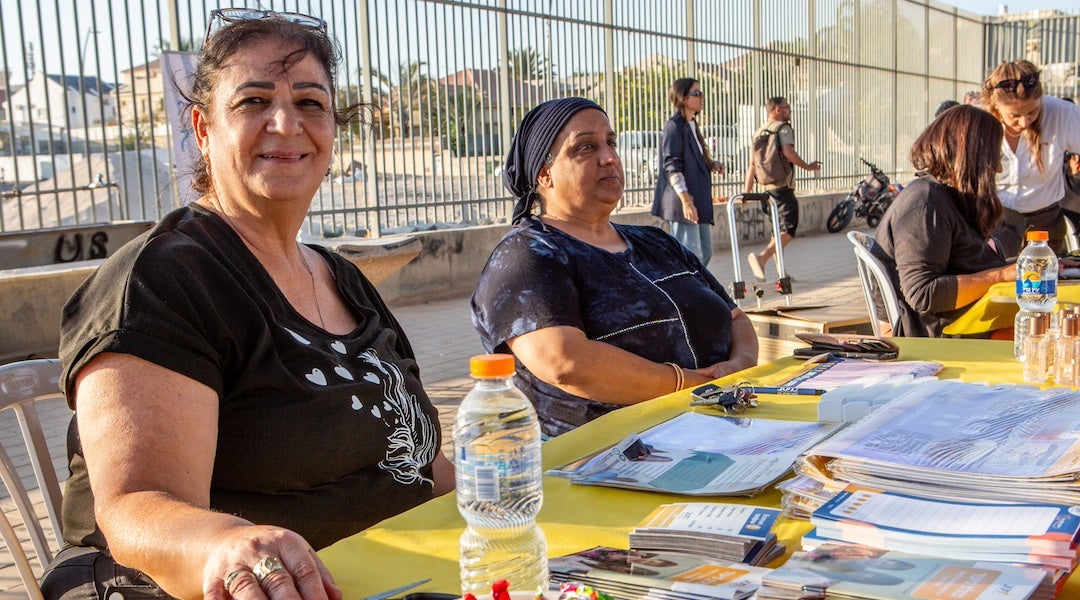
NIF-grantee Tzedek Centers participates in a citizens’ rights fair in the southern Israeli development town of Ofakim in October 2025. (Mati Milstein for NIF)
Reinforcing that vision in the United States means building bridges and setting boundaries. Gitzin said NIF staff and grantees include Jewish and Palestinian citizens of Israel, Zionists and non-Zionists. In the Israeli context, “non-Zionist” means those who do not actively support or advocate for a Jewish state, but also do not actively seek the end of Israel. NIF has several red lines: It will not support groups that advocate violence, racism or affiliation with the movement to boycott, divest from or sanction Israel, or BDS. In addition, “we don’t support those who actively oppose the notion of a homeland of the Jewish people,” he said.
“We are a space in which Zionist and non-Zionists can live together and work together, as long as we share ideas like equality, partnership, peace-seeking and so on,” he said. Outside of that space are those, on both the right and the left, who offer “from the river to the sea” solutions of exclusive Jewish or exclusive Palestinian domination in Israel proper, Gaza and the West Bank.
As interim CEO, Gitzin is still finding his footing in a new country and a new role. But he brings with him a sensibility shaped by Israel’s contradictions — and by the conviction that walking away, whether from Zionism or from liberal democracy, is not an option.
“Israel is giving me, personally, with my family story, an opportunity that no other country would have ever given me. I’m not throwing it away,” he said. “Despite my extreme criticism of current policies, I’m not willing to give it away. It’s too dear to my heart.”