
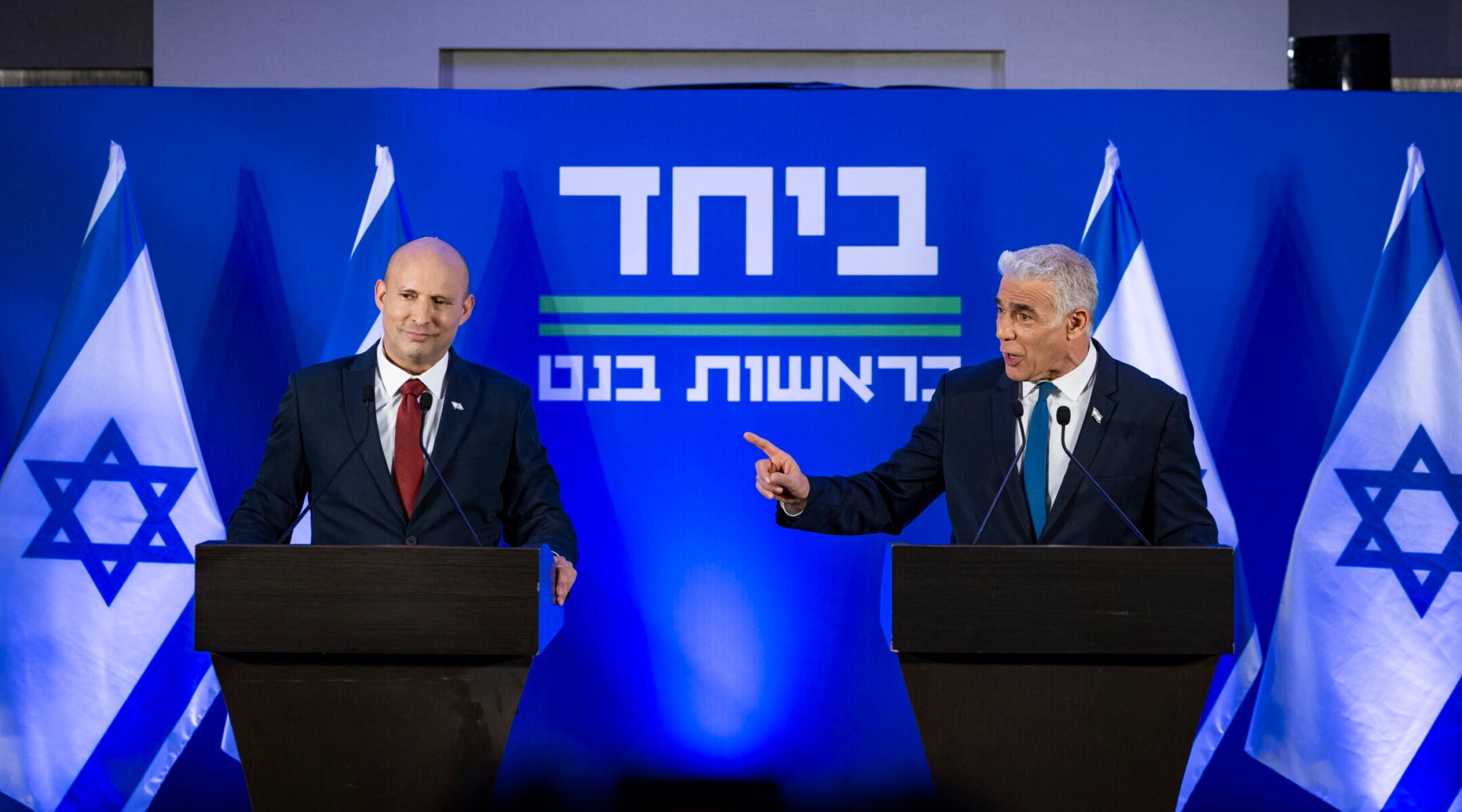
Yair Lapid and Naftali Bennett teamed up once before to unseat Israeli Prime Minister Benjamin Netanyahu, striking an unusual power-sharing deal after Israel’s 2021 election that briefly ousted Netanyahu from power.
Now, the two men are going even further in seeking to repeat their feat. Lapid and Bennett announced on Sunday that they would run in this year’s election in a shared party called Yachad, or Together.
“Our unity is a message to the entire people of Israel: The era of division is over. The era of correction has arrived,” Bennett said at a press conference announcing the collaboration.
The two men are betting that Israelis will see their coming together as an antidote to the polarization that has deepened under Netanyahu, who was reelected in late 2022 after an 18-month interlude in which Bennett was prime minister for a year and Lapid for six months. They hope that Lapid’s centrist supporters and Bennett’s center-right backers can overlook policy differences, which they acknowledged, for the greater good of the country.
Their announcement invigorated some Israelis on Sunday who believe it is essential to unseat Netanyahu, who has been prime minister for about 14 of the last 17 years and who is facing both criminal prosecution and calls to reckon with the security failures that led to Hamas’ Oct. 7, 2023, attack on Israel. Many of them are willing to make compromises on policy nuances to achieve that goal.
But the union also ignited scorn on the right, as even some who might prefer to see Netanyahu unseated said they could no longer support Bennett if he is working with Lapid, whom they perceive as left-wing. Both Netanyahu and his far-right coalition partners posted on social media suggesting that Yachad would partner with Arab parties or even do the bidding of the Palestinian Authority’s Mahmoud Abbas. Itamar Ben-Gvir, the national security minister, posted an AI-generated image of Abbas presiding at a wedding of Lapid and Bennett, whom he called “an extreme leftist.”
Neither Bennett nor Lapid has prioritized resolving the Israeli-Palestinian conflict or supported the creation of a Palestinian state. Their 2021 coalition included an Israeli Arab party.
Current polls show that the two men alone would not garner enough votes to be able to form a coalition on their own this year. But they could negotiate to add other parties to reach a governing majority either before or after the election, which must be held before the end of October. Gadi Eisenkot, a former army chief of staff who launched his own party last year, reportedly called for a three-way union earlier this year.
Their union in some ways resembles the pre-election alliance-building conducted by Peter Magyar in Hungary, who recently unseated Netanyahu’s ally Viktor Orban there. Many Israeli critics of the current government see the election in Hungary as a template for what could happen in Israel.
In the lead-up to the Yachad announcement, Bennett in particular announced some personal policy shifts that could make him more palatable to centrist and non-Orthodox voters. He said that he would now support same-sex unions in Israel and back public transportation operating on Shabbat.
Passover may be over, but your chance to support independent Jewish journalism isn’t. Help (JEWISH REVIEW) keep reporting the stories that define our era.