
Sweden’s center-left coalition has overturned Prime Minister Ulf Kristersson’s right-wing government after a nail-biter election, blocking a far-right party with neo-Nazi roots from its bid to join a cabinet for the first time.
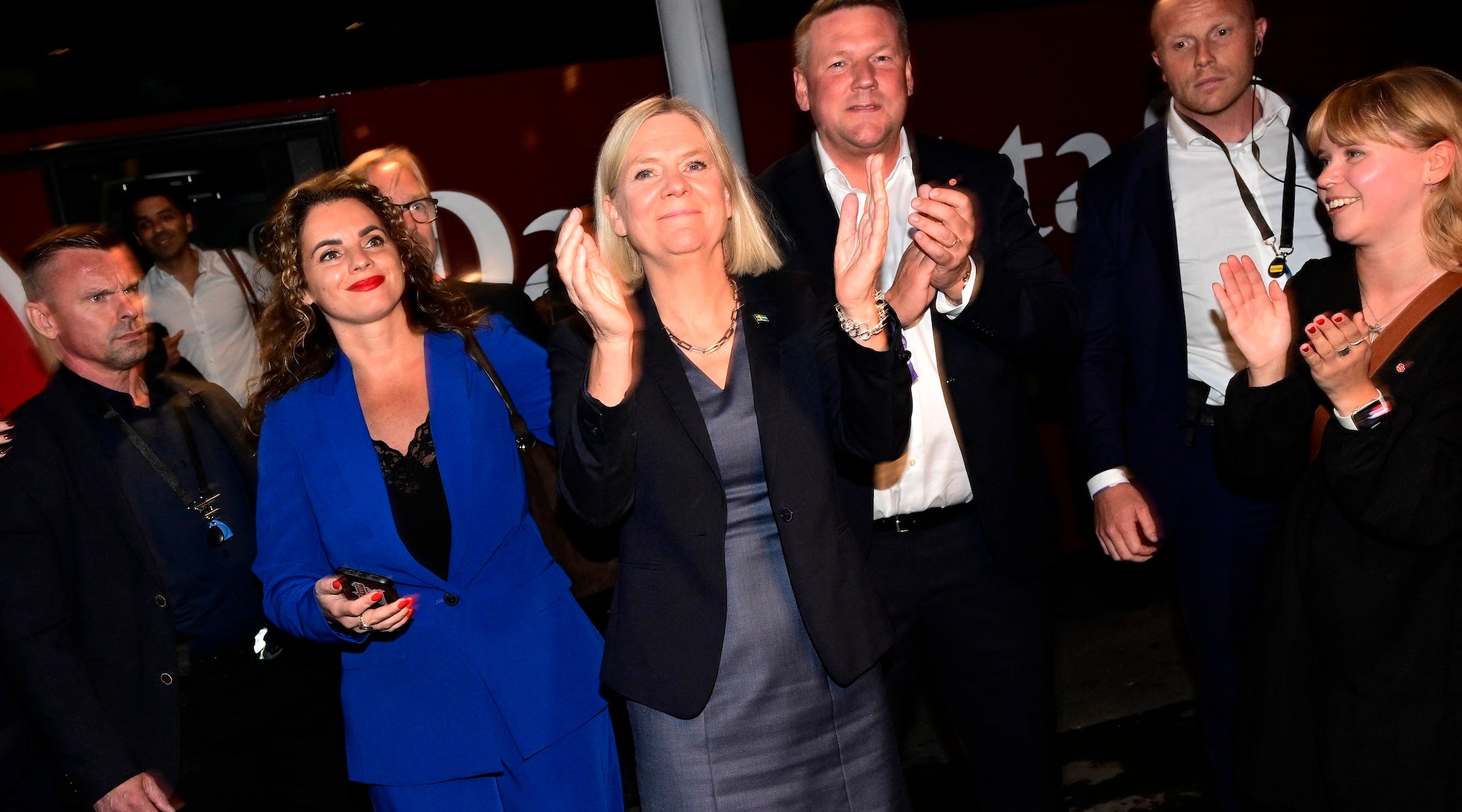
Kristersson resigned on Thursday after the public broadcaster SVT called Sweden’s general election for the center-left bloc, led by former prime minister Magdalena Andersson, whose Social Democrats ruled Sweden for most of the 20th century.
The alliance of four left-leaning parties won by just 50,359 votes, reaching 176 seats in parliament, while Kristersson’s coalition had 173 seats. The preliminary results are expected to be finalized by the Swedish Election Authority this weekend.
Kristersson had promised key ministerial posts to the Sweden Democrats, a far-right, anti-immigrant party whose early members were tied to neo-Nazi groups at its founding in the 1980s. In this election, they saw their first drop in support since they entered parliament in 2010. Among conservative parties, Kristersson’s Moderates won 19.8% of the vote, the Sweden Democrats 17.5%, the Christian Democrats 6.2% and the Liberals 5.3%.
Now, the Social Democrats face the challenge of cobbling together a government. Despite finishing with a plurality, the Social Democrats had their worst performance in decades, with 28% of the vote. They will seek to form a government through support from the Left Party with 8.4% of the vote, the Centre Party with 7% and the Green Party with 6.1%.
All the parties in Sweden’s parliament say they oppose antisemitism. But the Centre Party has said that it won’t team up with the Left Party after dozens of its candidates were removed from electoral lists this year for circulating antisemitic conspiracy theories, praising terror leaders and promoting homophobia online.
Aron Verständig, who chairs the Official Council of Swedish Jewish Communities, watched closely as the election’s razor-thin margins came down to a government that needed to rely either on the Left or the Sweden Democrats for a majority. “Either one of them,” he said, was a “concern.”
Debates about antisemitism loomed large throughout the election season, despite the country’s small population of Jews, who number about 20,000 in a country of more than 10 million people. Politicians on all sides repeatedly sought to position themselves as the best defenders against antisemitism, Verständig told the Jewish Telegraphic Agency.
Verständig said that while he appreciated gestures of solidarity with the Jewish community, he worried that politicians hurling accusations of antisemitism against each other could reduce Jews to a weapon of political debate.
“I’m a bit divided on the issue,” he said. “Of course, it’s good that our situation is discussed and people are interested in what happens to the Jews here in Sweden — but on the other hand, there’s a risk that we are becoming a tool.”
Simona Mohamsson, Sweden’s minister for education and integration — who is of Palestinian and Lebanese descent — wore a Star of David during a televised debate last month. A member of the center-right Liberals, Mohamsson said she wore the symbol “for the children who do not dare to in today’s Sweden.” She criticized members of the Left Party for “flirting with extremists.”
Meanwhile, Jimmie Åkesson, the leader of the far-right Sweden Democrats, posed with the book “@Stoltjude,” or “Proud Jew,” in a video last month while he spoke about “fighting Islamism.” The book was created by the Jewish Youth Association (JUS) in Sweden, which responded by decrying Åkesson on social media.
“Jimmie Åkesson is using our book, and thus the Jewish minority, in his rhetoric against Islam,” JUS said. “This is not something we stand behind. Stop using Jews as political battering rams to demonize other minorities.”
The Sweden Democrats have said they disavow their past neo-Nazi ties and expressions of antisemitism. Their leaders focused this election on ramping up measures against crime and migration, proposing to strip citizenship from some naturalized immigrants. The party has gained support from some Jewish voters by declaring itself “Sweden’s most pro-Israel party,” according to Verständig. Israel’s Minister of Diaspora Affairs, Amichai Chikli, has met with the Sweden Democrats amid his efforts to build alliances with Europe’s far-right parties.
The nationalist party influenced policy under Kristersson’s government, which has relied on their support in parliament since 2022. But because of its past links to white supremacist groups, the party has not been given any ministries — until this election, when Kristersson said they would join the cabinet if the right-wing alliance won.
The Left Party slightly increased its vote share from 2022, despite a campaign season dogged by controversy. Thirty-three Left Party candidates were booted from electoral lists this year after Swedish media revealed their past social media posts, which amplified antisemitic conspiracy theories that Jews sacrifice white children and control the world economy, media and academia, along with Holocaust denial and rhetoric that Hitler was “right” about the Jews. Members also shared posts celebrating Hamas leaders, praising Russian President Vladimir Putin and calling Stockholm’s Pride parade a “pedophile march.”
A government led by the Social Democrats would restore center-left rule to Sweden, which has transformed from one of Europe’s most welcoming countries for refugees a decade ago to one of its most restrictive. The Sweden Democrats helped steer a drastic overhaul of Swedish migration policy under Kristersson’s government.
The Sweden Democrats’ loss of power bucks a trend across the rest of Europe, where far-right, anti-immigrant parties are gaining ground in Germany, France, Italy, Britain and elsewhere.
Andersson has said the Social Democrats are “way stricter on migration and on crime” than they were in the past, and a left-leaning coalition is not likely to revive open-door policies. The party has instead focused on strengthening public healthcare and schools, protecting the environment and bolstering Sweden’s welfare system.
As the Year Turns, Support the Journalism You Trust. JR covers the stories shaping Jewish life around the world — with the depth this moment calls for. As you reflect on the year ahead, consider a gift that keeps independent Jewish journalism strong.