

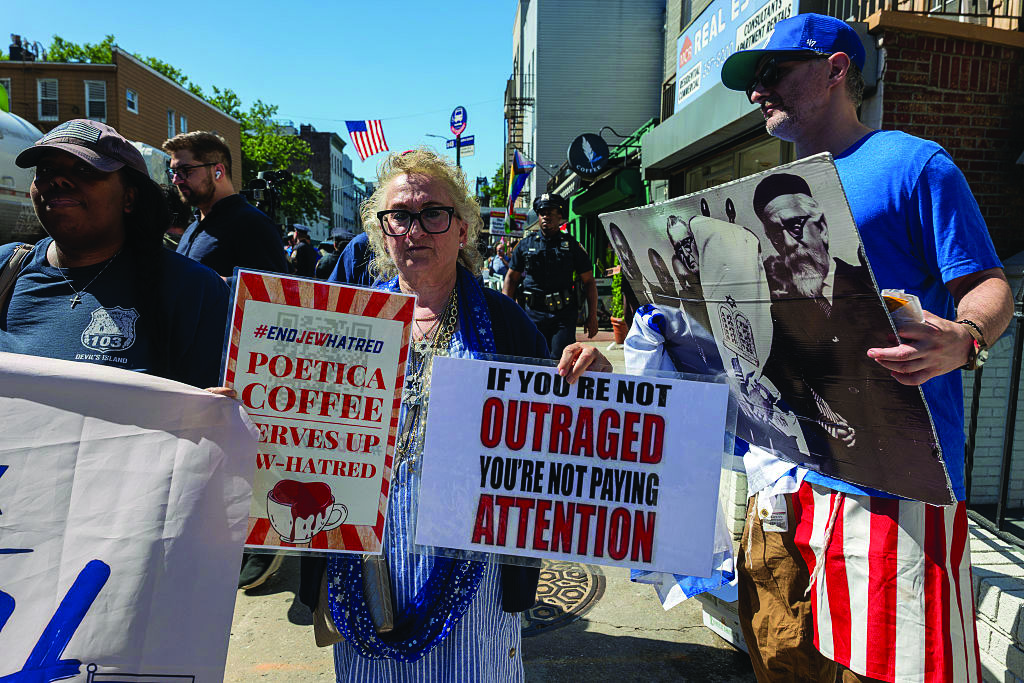
Poetica Coffee, a Brooklyn café, promises anyone who walks through its door “unconditional dignity.” Not as a customer and not as a transaction, the website explains, but as someone who arrived and deserves to be welcomed.
Recently the same business posted a photograph of Rep. Dan Goldman, who had stopped in for a coffee, and announced that it does not serve “genocide enablers.” Staff would have turned him away, the post said, had they recognized him in time. For good measure, it speculated that his money was “probably coming from AIPAC.”
The controversy matters not because of one congressman or one café. It matters because of the gap between those two statements—and because the people who wrote the second one clearly saw no contradiction with the first. That confidence is the real story.
For nearly three years since October 7th, the Jewish community’s attention has focused on elite institutions: presidents, provosts, trustees, editorial boards, elected officials. Those battles matter. Universities should protect Jewish students, public officials should condemn antisemitism, and institutions should enforce their own rules. But even when they do, a deeper problem remains. Antisemitism is no longer something many Jews encounter only from activists with megaphones or radicals occupying campus buildings. It is becoming socially acceptable among ordinary people in ordinary places.
That is what makes the Poetica incident worth more than a news cycle. The owners did not merely criticize Goldman; politicians are criticized every day. They publicly celebrated the idea that someone who supports Israel was unworthy of service, and they did so while presenting their business as a model of inclusion. The casual reference to money “probably coming from AIPAC” is especially revealing. That is not a policy disagreement about Gaza. It is the oldest insinuation about Jewish money resurfacing almost reflexively in a place that imagines itself progressive.
For years, Jewish organizations have measured progress through elite signals. Has the president spoken? Has the board acted? Has the governor issued a statement? Has the company adopted a policy? These questions are valid and carry weight, but they tell us surprisingly little about the culture beneath them. A university president can condemn antisemitism while Jewish students are quietly ostracized by their peers. A mayor can issue a supportive statement while local businesses signal that Zionists are unwelcome. A corporation can celebrate inclusion while employees quietly learn which identities are protected and which beliefs place a person outside the circle of acceptable opinion. The gap between official rhetoric and social reality has become impossible to ignore.
The gap between official rhetoric and social reality has become impossible to ignore.
What many Jews increasingly encounter is not formal discrimination but social exclusion. They are not denied admission to institutions, but they are told they do not belong in particular communities. They are not silenced by authorities, but they are shunned by peers. And they are not excluded for being Jewish in the old sense. They are excluded for being Zionists, a category that happens to include the overwhelming majority of American Jews. That distinction is presented as morally decisive. In practice it rarely is.
The effect is often the same: A Jewish student, professor, neighbor, or congressman discovers that support for the existence of the world’s only Jewish state is enough to place him beyond the bounds of polite society.
That is not political disagreement. It is social stigmatization, harassment and exclusion, and it is becoming normalized. Many people who would never tolerate the exclusion of a Muslim, a Black American, a gay neighbor, or an immigrant have convinced themselves that excluding Zionists is not only acceptable but also virtuous. The language of inclusion has been repurposed to justify exclusion; the language of tolerance has become a rationale for intolerance. The contradiction is obvious and increasingly ignored.
This is why elite responses, however necessary, are not enough. A congressional hearing cannot fix a culture. A university policy cannot repair a social norm. A presidential statement cannot persuade millions of people that their neighbors deserve dignity even when they disagree.
The challenge facing American Jews is not only institutional but cultural, and it lives not just in faculty lounges and encampments but in coffee shops, community groups, workplaces, and ordinary social circles. That is the uncomfortable part, because institutions can change rules far faster than people change attitudes.
Poetica later deleted its account, saying it had received threats. Threats are wrong, and they are also beside the point; they do not make the original boast any less revealing.
Goldman’s response is worth lingering over. He recalled that a barista had let his seven-year-old daughter use the restroom without buying anything. He bought a coffee in return and later said he hoped she would still receive her tip. Whatever one thinks of his politics, it was a response grounded in ordinary reciprocity rather than retaliation.
Whatever one thinks of his politics, it was a response grounded in ordinary reciprocity rather than retaliation.
That is the whole tension in miniature. The young woman behind the counter extended the ordinary decency that holds a society together. The owners chose, deliberately and publicly, to advertise exclusion as a virtue. The first instinct is quiet and deeply civic. The second now expects applause.
The struggle against antisemitism will not be won solely in courtrooms, boardrooms, or university offices. It will be won, or lost, in the everyday spaces where people decide who belongs: the coffee shops, the community groups, the professional networks, the social circles. The most revealing incidents are often the smallest ones. They show what people are willing to say when they believe the room agrees. By the time organizations acknowledge a problem, the culture beneath them may already have shifted to a place from which it may be difficult to come back from.
Samuel J. Abrams is a Professor of Politics at Sarah Lawrence College and a Nonresident Senior Fellow at the American Enterprise Institute.