
When the Jewish Brigade appears today in Italian public debate, it is rarely about the British Army unit, formed largely by Jewish volunteers from Mandatory Palestine, that was sent to fight in Italy in the final months of the Second World War.
The Jewish Brigade has become a screen onto which other conflicts are projected: Zionism and anti-Zionism, antisemitism, Israel and Palestine, the meaning of antifascism and the ownership of public memory.
This is why recent tensions in Milan and Rome during Italy’s Liberation Day commemorations were not simply disputes about flags or parades. They were symptoms of a deeper problem: the difficulty of allowing history to remain history, while also recognising that memory is always political.
On April 25, Italy celebrates its liberation from Nazi occupation and fascist rule. It is the most important civil holiday of the Italian Republic, a foundational moment in the country’s democratic identity. But precisely because it is so symbolic, it has always been a stage on which the political tensions of the present are acted out.
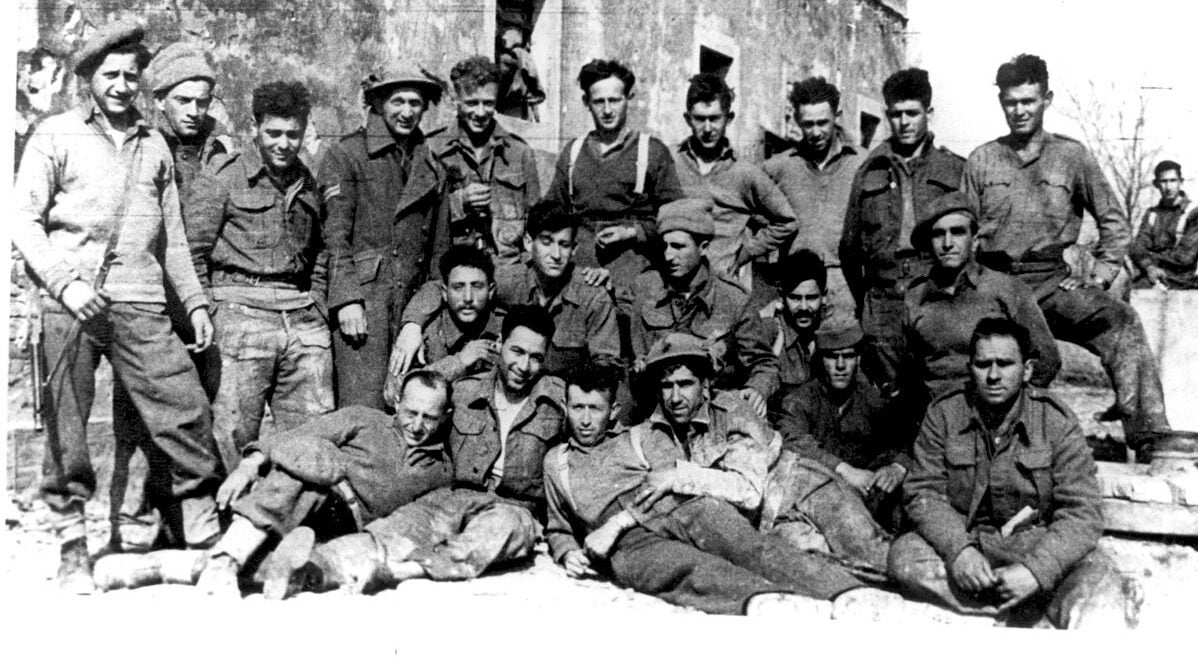
The Jewish Brigade occupies a peculiar place in this story. Militarily, its contribution to the Allied campaign in Italy was limited. The Brigade arrived late at the front, in early 1945, and fought for only a short time. Its soldiers were deployed in Romagna, north of Ravenna, along the Lamone, and later near Riolo Terme and the Senio river. About 50 of its soldiers died.
Yet to measure the Brigade only by military impact is to misunderstand its historical significance. Its importance was symbolic, political and psychological. These were Jews in uniform, fighting under a flag marked by the Star of David, against the army of the regime that had attempted to annihilate European Jewry. For many of the volunteers, especially those who were committed Zionists, service in Italy represented more than participation in the Allied war effort. It was a form of Jewish self-assertion, and a claim to political dignity before the world.
This is one reason the Brigade mattered then. It also helps explain why it matters now.
After the war, the memory of the Jewish Brigade did not immediately become central to Italian public memory. For decades it remained relatively marginal, preserved above all within parts of the Jewish community and in the recollections of veterans. Its later rediscovery, especially from the 1990s and 2000s, coincided with new struggles over the meaning of April 25. Some Italian Jewish communities began to bring the Brigade’s flag into Liberation Day commemorations to remind the public that Jews had not only been victims of fascism and Nazism. They had also been combatants, liberators and political actors.
That reminder was, and remains, historically legitimate. Italian Jews belong fully to the history of the Resistance and to the history of the Republic that emerged from the defeat of fascism. The Jews of Mandatory Palestine who served in the Jewish Brigade also belong to the history of Italy’s liberation, however brief their time at the front. They fought in Italy, against German forces, alongside other Allied soldiers and alongside the reborn Italian army. To deny their place in that history is not a neutral act of historical correction. It is an exclusion.
A contingent remembering the Jewish Brigade, which fought in World War II, marches during Italy’s 80th Liberation Day commemoration in Milan, Italy, on April 25, 2025. The next year, pro-Palestinian activists forced Jewish groups out of the Liberation Day procession. (Alessandro Bremec/NurPhoto via Getty Images).
At the same time, it is clear that the Brigade has become controversial not only because of what it did in 1945, but because of what its flag is understood to mean today. The flag of the Jewish Brigade is virtually identical to the later flag of the State of Israel. For some, this makes it a proud symbol of Jewish resistance to Nazism and of the Jewish contribution to liberation. For others, especially in the context of the Israeli-Palestinian conflict, it is read primarily as a symbol of Israel and therefore as a political provocation.
This is the heart of the problem. The dispute is often presented as a debate about history, but it is in fact a debate about the present. People argue about the Brigade because they are really arguing about the legitimacy of Zionism, about whether anti-Zionism can become antisemitism, about whether Israel should be understood as a national project or an imperial one, and about what antifascism should mean today. These questions generate fierce disagreements, and April 25 gives them a highly charged public stage.
There are two competing visions of Liberation Day. One sees April 25 primarily as a historically defined Italian commemoration: the day on which the country remembers those who fought between 1943 and 1945 to free Italy from Nazi-fascism. In this interpretation, the Jewish Brigade clearly has a place, because it took part in that struggle. Palestinian flags, by contrast, are harder to place within that specific historical frame, not because Palestinians were fascists, but because they were not participants in the liberation of Italy.
The other vision is more dynamic and internationalist. It sees April 25 not only as the commemoration of a past event, but as an annual reaffirmation of resistance to oppression in the present. In this interpretation, the presence of Palestinian flags, Ukrainian flags, Iranian dissidents or other contemporary causes can be understood as part of a broader antifascist language. April 25 becomes not only the memory of Italy’s liberation, but a ritual of solidarity with those who resist domination elsewhere.
The Jewish Brigade forces us to confront this tension. It belongs to the historical April 25 because it helped liberate Italy. It also belongs to the broader moral history of antifascism because it embodied Jewish armed resistance to Nazism. But its memory is now inseparable from the unresolved political and psychological impact of the Israeli-Palestinian conflict on Italian, and indeed international, public life.
This does not mean that every criticism of Israel is antisemitic. It is not. Nor does it mean that Jewish history should be used to silence Palestinian suffering. It should not. But it does mean that excluding Jews from an antifascist march, insulting people carrying the symbols of the Jewish Brigade, or treating Jewish participation in Liberation Day as illegitimate is a profound historical and moral failure. Antifascism without Jews is not antifascism. An April 25 in which Jews are tolerated only if they hide the symbols they decide to choose is not a healthy democratic ritual.
The answer is not to turn the Jewish Brigade into a weapon in today’s political battles. Nor is it to erase it in the name of avoiding controversy. The answer is to recover the complexity of its history. The Brigade was a military unit, but also a symbol. Its soldiers were liberators in Italy, survivors or relatives of victims of European catastrophe, Zionists of different kinds and human beings who often carried grief, hope and a desire for revenge. Their story links the Holocaust, the Second World War, the end of empire, the birth of Israel and the politics of memory in postwar Italy.
That is why the Jewish Brigade matters today. It reminds us that history cannot be reduced to slogans, that memory can both illuminate and distort, and that democratic societies must make room for complexity and uncomfortable truths.
Reporting the stories that define our era. When history unfolds in real-time, the Jewish world turns to JR. Your support ensures we can document the complexities of war and the resilience of Jewish communities with integrity.

teaches modern European history at Nottingham Trent University in England. He is the author of “Soldiers, Angels, and Avengers: A History of the Jewish Brigade” (2026).
The views and opinions expressed in this article are those of the author and do not necessarily reflect the views of JR or its parent company, 70 Faces Media.