
In 1976, deep in New York City’s fiscal crisis, the artist Mierle Laderman Ukeles read a review of her conceptual work in the Village Voice. In his review, critic David Bourdon made a radical suggestion inspired by Ukeles’ thesis: What if municipal work, like the Sanitation Department, were conceptual art? Could it get funded by grants, instead of by the city?
Ukeles presented the idea to Sanitation Department commissioner Anthony T. Vaccarello, who invited her to create art for 10,000 sanitation workers. The job would be unpaid. And, it turns out, she would keep it for nearly 50 years and counting.
Now 86, Ukeles is the subject of the documentary film “Maintenance Artist” directed by Jewish filmmaker Toby Perl Freilich, which made its New York theatrical release last week at the IFC Theater in Greenwich Village.
The title refers to Ukeles’ 1969 manifesto, which declared that the everyday activities often relegated to women — cooking, cleaning, changing diapers — were “maintenance art.”
But the movie spans all of Ukeles’ career, looking at her role as the artist-in-residence at the New York City Sanitation Department to her early activism on behalf of Tanzanian independence. The throughline, Ukeles says, has been a belief — rooted in her Jewish identity — that people are more than the roles that society assigns to them.
“As a Jew, I was in love with the notion of freedom,” Ukeles said in an interview. “This message of art as freedom, I felt that’s what I’m about. That’s what I’m for.”
As artist-in-residence, Ukeles plans, stages, and records public works of performance and conceptual art that recognizes the workers of the Sanitation Department. After the piece’s initial staging, photos from the performance might be shown at a museum or gallery.
Despite having been coined New York’s “trash artist” because of her Sanitation Department role, Ukeles does not actually dig in dumpsters or landfills to create her work. But much of her art has mined something else: her Jewish values, as the daughter of an Orthodox rabbi who herself has divided time between New York and Israel.
Some of her pieces have included conceptual and interactive works focusing on Jewish themes and traditions, such as the creation story and the mikvah, or ritual bath.
A 2010 interactive piece “Birthing Tikkun Olam,” for example, invited onlookers to reflect in an installation of glass mirrors, then make a “covenant” to repair the world. Their responses were collected and exchanged for a mirror in the piece, which she staged at the Yeshiva University Museum.
“The site of the art is going to move out into the world, and with it, the acts that you will do,” Ukeles told the university’s newspaper at the time.
Though Ukeles does not consider herself a Jewish artist, because she prefers to avoid being categorized as such, she observes Shabbat — even turning down a stint in the Peace Corps and Friday-night gallery openings to maintain her observance. She lives in Israel, where she advises art students at the Bezalel Academy Academy of Art and Design and attends a “partnership” minyan that aims to widen women’s participation in Orthodox Judaism.
“I have many deep beliefs in great Jewish ideas and commitments,” Ukeles said.
For Freilich, the daughter of Polish Holocaust survivors and a descendant of Hasidic dynasties who is herself an observant Jew, Ukeles’ identity was core to why she became so transfixed by the artist that she decided to make a movie about her.
“Her reading of Jewish texts, her reading of Jewish philosophy, of Judaism was profoundly moving to me because it emphasized things like, ‘we’re all created in God’s image’ and and we’re all equally deserving of respect and honor, or that the, the profane is the pathway to the sacred,” Freilich said. “And these are deep, deep kinds of concepts in Judaism that a lot of people aren’t really that familiar with.”
That first piece with DSNY, titled “Touch Sanitation Performance,” spoke to Freilich, who was inspired by a visit to the 2016 retrospective of Ukeles’ work at the Queens Museum.
“I was completely, really blown away,” said Freilich, whose previous documentary works have covered broad swaths of Jewish history, from the partisans of World War II to kibbutz life in Israel.
Ukeles’ works, funded by grants, endowments, fellowships, and commissions, have taken shape in every possible art medium — including performance art and landscape art.
Initially experimenting with paint, she got into trouble while at the Pratt Institute for creating a bulbous multimedia piece with cheesecloth and debris. The school’s administration found it provocative. Her mentor, the abstract expressionist Robert Richenburg, defended Ukeles’ work and ultimately resigned from the school, rather than change his teaching methods at the administration’s request.
“It was a very, very difficult time in my life,” Ukeles said. “I was shocked.”
That controversial piece, titled “Second Binding,” is currently hanging in New York’s Jewish Museum.
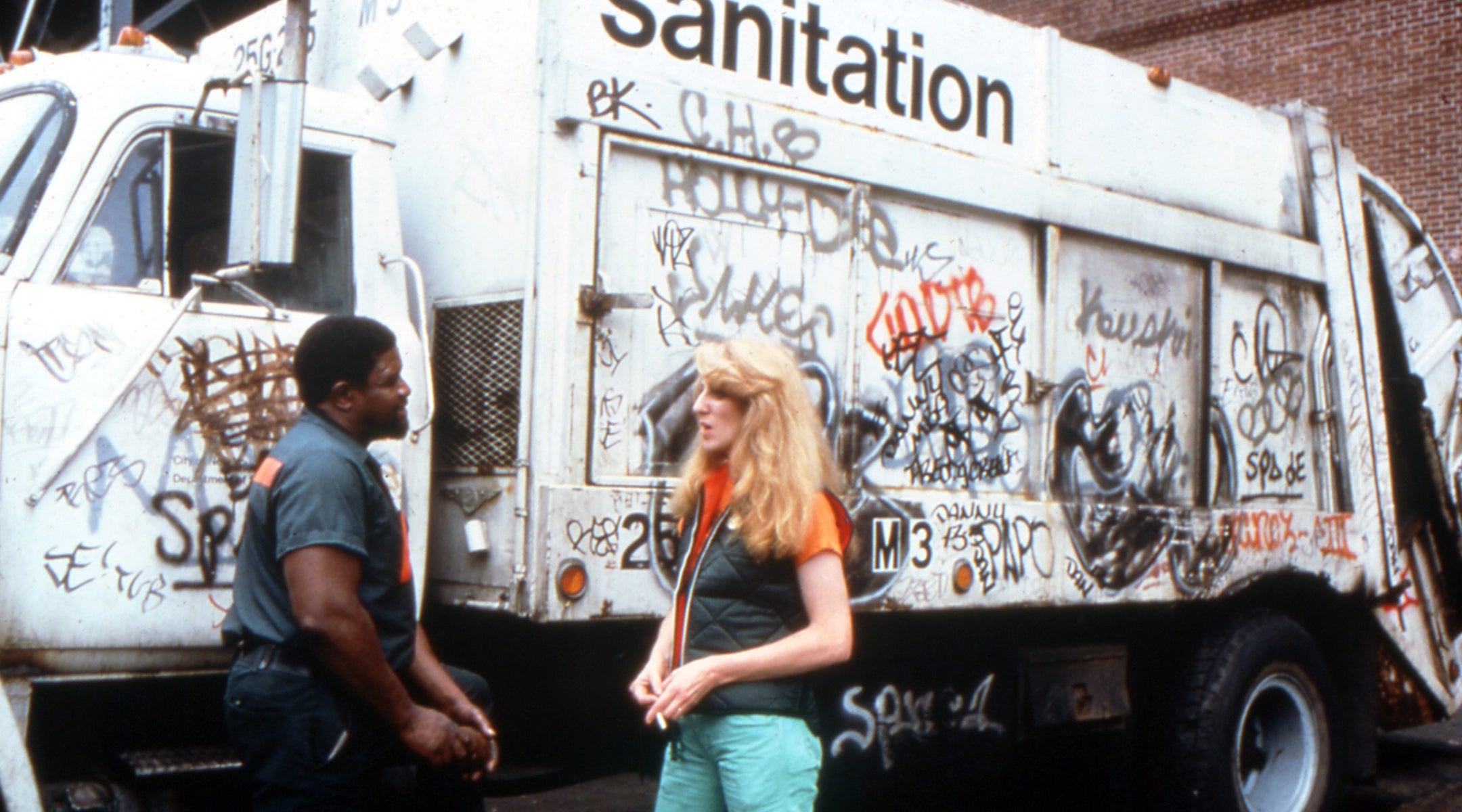
Ukeles’ work with the Sanitation Department is perhaps best known for a year-long project from 1979 to 1980, where she sought to shake all 8,500 department workers’ hands. It was documented in a series of photographs.
“They were looked down upon,” Ukeles said. “Not race, not religious, not ethnic, but as a kind of class of maintenance workers and names that people were called.”
Coming up on her 49th year with the New York Sanitation Department, Laderman still has project ideas for the city. She has two projects at Fresh Kills Landfill on Staten Island — formerly the largest landfill in the world. One of those projects is an ongoing conversion of the landfill into a public park, set to be completed in 2036. The other project is an overlook above the park.
“I now call it ‘intergenerational,’ because it’ll probably take other people to pick it up,” Ukeles said.
“There’s a Jewish source of that notion that the earth is sacred and that we have to redeem the earth when it’s been degraded,” she added. “I don’t know if it will ever finish.”
Passover may be over, but your chance to support independent Jewish journalism isn’t. Help (JR) keep reporting the stories that define our era.