

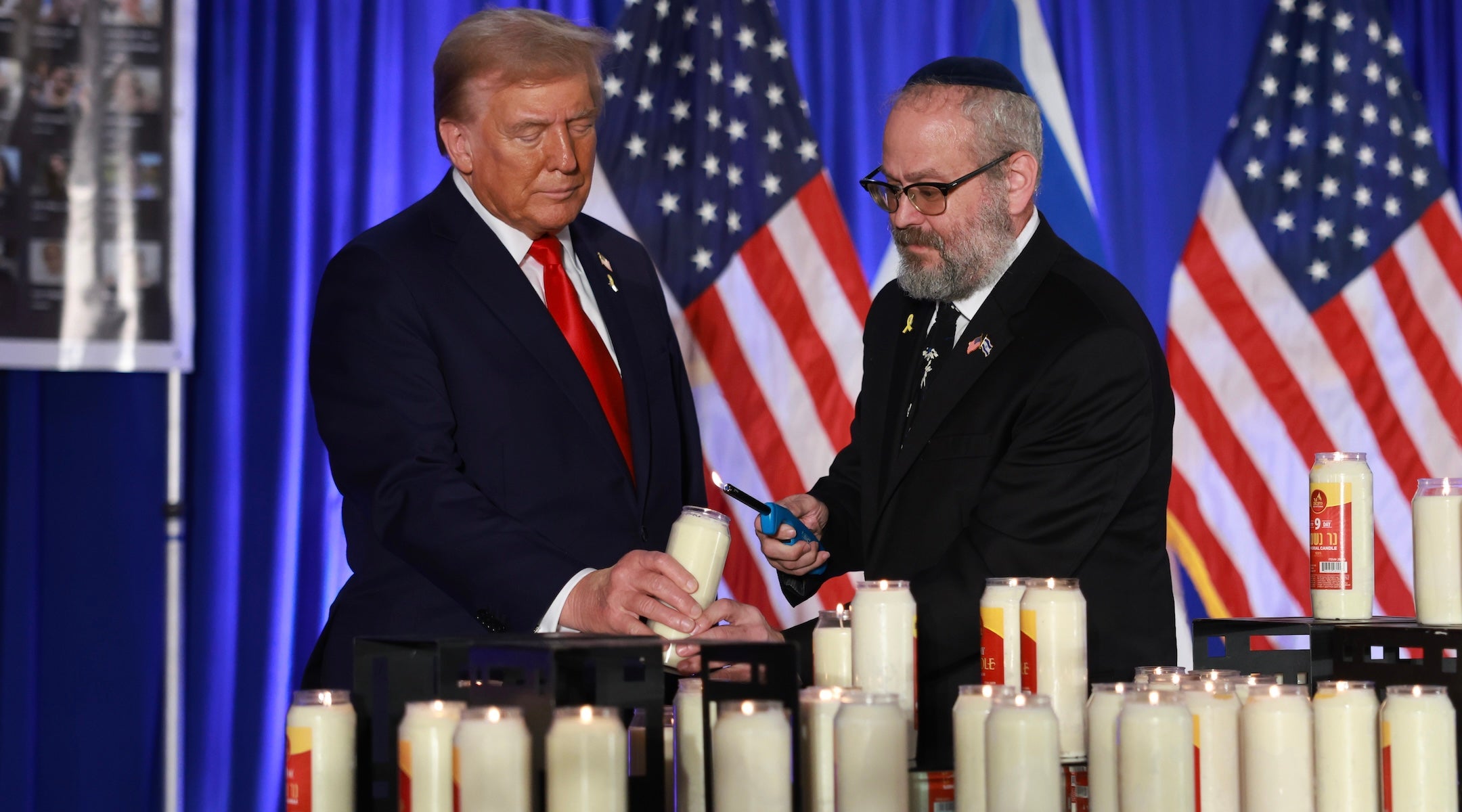
For months, Rabbi Yehuda Kaploun, the Trump administration’s special envoy to monitor and combat antisemitism, has worked to fold the State Department’s Holocaust envoy office into his own, a congressional source told the Jewish Telegraphic Agency.
That effort would absorb the State Department’s Office of the Special Envoy for Holocaust Issues, which oversees U.S. policy on Holocaust-era restitution, education and remembrance, into Kaploun’s office, which focuses on combating contemporary antisemitism around the world, according to the source, who asked for anonymity because they were not authorized to speak on behalf of the member of Congress they work for.
If approved by the State Department, the proposal would mark a significant reorganization of the State Department’s approach to antisemitism and Holocaust issues at a time when antisemitism has surged globally, Holocaust distortion is growing and the number of living Holocaust survivors is rapidly declining.
As Kaploun has waged his campaign within the State Department, news of the effort has also reached Jewish leaders and diplomats, exposing a divide over whether the offices’ overlapping missions warrant a merger for efficiency’s sake, or whether eliminating a dedicated Holocaust envoy could harm the government’s focus on survivors.
A legislative effort is now underway to block the move. On Wednesday, Rep. Jerry Nadler, a Jewish New York Democrat, submitted an amendment to the House Rules Committee seeking to prohibit the State Department from using federal funds to “eliminate, consolidate, or downsize” the Office of the Special Envoy for Holocaust Issues, or SEHI, without congressional authorization.
In a statement, Nadler described the proposal as a “vain attempt to consolidate power by Yehuda Kaploun,” who he said had joined the Trump administration in treating antisemitism as a partisan issue and falsely accusing Democrats of not caring about stopping antisemitism.
“The Trump Administration’s plan to eliminate the only position in the US Government solely devoted to fighting for Holocaust survivors is abominable,” Nadler said. “If supporting Holocaust victims and their families was a priority to this Administration, they would seek further opportunities to support SEHI, not to eliminate it.”
The committee has not yet decided whether to advance the measure, which Illinois Democratic Rep. Brad Schneider has also joined. Kaploun did not respond to numerous requests for comment from the Jewish Telegraphic Agency.
The move comes ahead of the planned departure of the current special envoy for Holocaust issues, Ellen Germain, in the coming months. No replacement has been named to fill the role, prompting a host of prominent Jewish groups, including the Anti-Defamation League and the American Jewish Committee, to sign onto a letter calling on Secretary of State Marco Rubio to fill the impending vacancy.
Ellen Germain, U.S. special envoy on Holocaust issues, listens during a panel before a screening of “The U.S. and the Holocaust” at the United Nations in New York, Feb. 9, 2023. (John Lamparski/Getty Images)
“[W]e write to urge you to make an appointment soon of a senior diplomat in order to demonstrate the prioritization that the United States ascribes to preserving the uniqueness of the Holocaust through this special office, and to ensure that its critical work continues,” said the letter, which is dated April 28.
Many of the groups that signed the letter did not respond to requests for comment about the potential changes to the position.
Robert Williams, the CEO of the University of Southern California Shoah Foundation and advisor to the International Holocaust Remembrance Alliance, told (JEWISH REVIEW) that he first heard of the potential merger roughly five months ago.
He said he believed that “merging these offices right now could lead to decreased effectiveness at a moment when we need them to be as effective, if not even more so, than they’ve been historically,” even as he said he was a proponent of efficiency.
“I worry that a merger from a mission standpoint could have greater implications on the Holocaust education, remembrance and research side, because it brings with it the risk of seeing the lessons and work of the Holocaust reduced just to the fight against antisemitism,” Williams said.
Williams said he had written two letters to Rubio in March and May outlining his “hope that we could maintain two strong offices in state rather than try to hybridize them into one.”
Those letters were not the only outreach directed at Rubio over Kaploun’s initiative.
Support for the merger came in the form of a letter to Rubio on June 10 from a host of Jewish groups, including the Combat Antisemitism Movement, the Union of Orthodox Jewish Congregations of America, the World Jewish Congress and Chabad-Lubavitch World Headquarters.
In the letter, which was also signed by Trump’s first-term antisemitism envoy Elan S. Carr, the signatories offered their support to the effort of “formalizing this unified mission under the leadership of Ambassador Rabbi Yehuda Kaploun.” Kaploun was confirmed in December.
“Fragmenting our diplomatic response across two distinct offices dilutes administrative efficiency, risks duplicative efforts, and underutilizes vital Department resources at a time when maximum strategic impact is required,” the letter said. “Consolidating these mandates into a single, cohesive entity will streamline U.S. foreign policy implementation.”
Rubio’s office did not immediately respond to a (JEWISH REVIEW) request for comment about the multiple letters he has received on the topic.
Karen Paikin Barall, who served as the deputy special envoy to monitor and combat antisemitism when the office was first created under President George W. Bush’s administration in 2004, also signed the letter of support for consolidating the positions.
Paikin Barall said that discussions about “how best to coordinate Holocaust issues and antisemitism monitoring” dated back to the creation of the office.
“We already had seen that there was some duplication and some issues, and had started to have the conversation about merging these two offices,” Paikin Barall, who is the chief policy officer of the Louis D. Brandeis Center for Human Rights Under Law, told (JEWISH REVIEW). “It’s not even partisan. It’s been decades of trying to get these two to be under one agency.”
Paikin Barall said she had been told that there was “no budget cut being proposed” alongside the merger of the two offices, and that the move dovetailed with broader efforts by the Trump administration to “streamline how government works” — a move that she said would benefit the global Jewish community.
However, Menachem Rosensaft, a longtime advocate for Holocaust remembrance and a founding chairperson of the International Network of Children of Jewish Holocaust Survivors, said he had been watching the effort unfold from a distance “with very serious concern.”
“I don’t see any reason to merge them other than potentially to increase one person’s fiefdom,” Rosensaft said. “I know that this will result in less confidence by survivors and their families in the support they’re getting from the State Department.”
He added, “The Holocaust-era office — its ability, its effectiveness over the years – has been precisely in the fact that it is not headed by a political appointee.”
Former U.S. Treasury official Stuart E. Eizenstat, who once served as chairman of the United States Holocaust Memorial Museum Council and is special negotiator for the Claims Conference, told (JEWISH REVIEW) in a statement that “given the tsunami of antisemitism around the world, it is vital that the U.S. Department of State remains deeply engaged on this issue, and having a dedicated and strong advocate, such as Rabbi Kaploun, within the Department, to combat antisemitism is essential.”
“At the same time, the work on behalf of Holocaust survivors is not finished,” Eizenstat continued. “With the survivor community rapidly dwindling and yet their needs growing, having an office focused solely on Holocaust remembrance, fighting wrongs and critical survivor care is crucial.”
Kevin Rachlin, the vice president of government relations for the Nexus Project, a group dedicated to combating antisemitism, told (JEWISH REVIEW) that the advance toward a potential merger marked “yet another attempt by the administration to cut government offices and roles without thinking through the ramifications or the consequences,” adding that the two offices have “fundamentally different roles.”
“Folding one office into the other does not streamline the government’s work,” Rachlin said. “It diminishes the vital and distinct importance of the Special Envoy for Holocaust Issues — and dishonors the survivors and communities that role was created to serve.”
Rachlin added that his group hoped that Congress “exercises its oversight authority and accurately probes into why this is happening.”
Reporting the stories that define our era. When history unfolds in real-time, the Jewish world turns to (JEWISH REVIEW). Your support ensures we can document the complexities of war and the resilience of Jewish communities with integrity.