
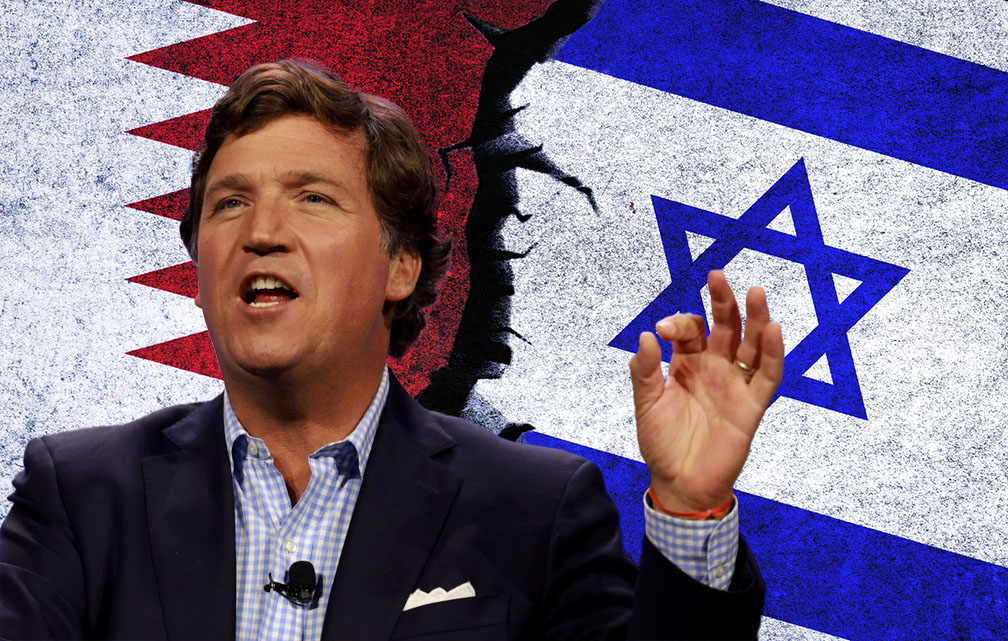
Antisemitism has often been described as a “virus of the brain,” and there is no better example of its effects on critical thinking than Tucker Carlson’s bizarre assertion that Qatar—a transactional dictatorship—is the U.S.’s “greatest ally.” At the same time, Israel is a “one-way street” with no tangible benefits.
This assessment fails on every strategic and moral ground. Former Secretary of State Alexander Haig called Israel “the largest, most battle-tested and cost-effective U.S. aircraft carrier” at a critical geographic location, and retired U.S. Air Force Intelligence head General George Keegan declared that “Israel is worth five CIAs.” By contrast, while Qatar plays host to a U.S. military base, the country has consistently played a dangerous double game — officially aligned with the United States while secretly supporting actors and narratives opposed to it.
While Qatar plays host to a U.S. military base, the country has consistently played a dangerous double game — officially aligned with the United States while secretly supporting actors and narratives opposed to it.
This duplicity was made painfully clear on December 13: After an ISIS attack killed American soldiers, President Trump publicly blamed them, but Qatar’s official condemnation intentionally left out any mention of ISIS. That silence was no diplomatic mistake; it matched a long-standing pattern, identified by senior American generals as far back as 2014, showing financial links between Qatar-based networks and ISIS-affiliated groups.
The betrayal goes back to the roots of modern terror. In 1996, U.S. officials told the Qatari emir that the FBI was coming to arrest Khalid Sheikh Mohammed (KSM)—the future mastermind of the 9/11 attacks. When American agents arrived, KSM was gone. Later reports confirmed a Qatari government minister, a member of the ruling Al Thani family, had sheltered him. This fundamental breach of trust still defines their relationship.
Beyond operational sabotage, Qatar leverages its vast wealth to undermine U.S. interests through media and influence. Its global media network, including Al Jazeera, consistently promotes strongly anti-American narratives and depicts U.S. counterterrorism efforts as aggression. More subtly, Qatar has gained intellectual property and strategic footholds in sensitive U.S. sectors such as nuclear and national security research in Texas. At the same time, significant Qatari funding of American universities has been linked to environments where radicalization can grow under the guise of academic freedom. Overall, this is not a series of mistakes but a deliberate strategy to weaken the United States from within while maintaining the façade of an alliance.
In an era of Great Power competition, Israel is firmly in the American-led bloc and is indispensable in pushing harmful actors from the region. Since the 1979 Islamic Revolution, Iran has waged a proxy war on American soldiers, diplomats, and civilians. The Iranian regime was inaugurated in a blatantly illegal anti-American act of holding Americans hostage in the U.S. Embassy in Tehran. Throughout the 1980s and 1990s, Iranian-backed terrorist groups killed hundreds of American soldiers stationed in Lebanon and Saudi Arabia. According to the Pentagon, Iran is responsible for the deaths of at least 608 American troops in Iraq between 2003 and 2011. Only recently, Iran attempted to assassinate President Trump. Iran also props up America’s rivals – China and Russia – supplying weapons for Putin’s war in Ukraine while selling oil to China in violation of U.S. sanctions.
In an era of Great Power competition, Israel is firmly in the American-led bloc and is indispensable in pushing harmful actors from the region.
Since Hamas, an Iranian proxy, launched an invasion of Israel on October 7, 2023, Israel has been steadily degrading the capabilities of the Iranian axis. A 12-day operation in June 2025 saw Israel successfully eliminate Iranian military leaders, nuclear scientists, and ballistic missile capabilities, delivering a decisive blow to America’s chief regional enemy. This invaluable intelligence and military capability is a strategic bulwark that no other partner provides.
Moreover, Israel has pioneered innovative security technologies used by the U.S. to protect critical infrastructure, citizens, and troops, including multi-layered missile defense systems and advanced counter-drone technologies, many of which are jointly developed. The two countries also work closely on emerging threats: the U.S. and Israel have jointly developed anti-tunnel technology for nearly a decade to address complex challenges from Gaza to the U.S.-Mexico border, and they expand collaboration on Artificial Intelligence to compete with adversaries like China and Russia. Additionally, the IDF’s Cyber Defense Directorate and the U.S. Cyber Command hold annual joint exercises, highlighting the essential cooperation in cybersecurity against rogue states. Beyond security, the U.S.-Israel relationship is an economic powerhouse, supporting over 255,000 American jobs, with all future U.S. security assistance to Israel required to be spent within America, and over $22.4 billion in Israeli foreign direct investment in the U.S. in 2023.
Given Carlson’s recent adulation of Putin and Hamas, it’s not surprising that he shows admiration for an Islamist dictatorship that consistently stirs unrest in the Middle East. Patriotic Americans, whose critical thinking is not compromised by the “brain virus” of antisemitism, recognize that Israel is an indispensable strategic ally essential to keeping the United States safe, secure, and prosperous.
Dr. Ariel Admoni is an expert on Qatar at the Jerusalem Institute for Strategy and Security (JISS). Avraham Shalev is a senior fellow at the Kohelet Policy Forum focusing on international public law.