
This article was produced as part of (JR)’s Teen Journalism Fellowship, a program that works with Jewish teens around the world to report on issues that affect their lives.
I grew up speaking Russian to my family — at home, on the streets in Brooklyn and Manhattan, and at the Italian grocery store in Tottenville, Staten Island. It was never an issue until the Russia-Ukraine conflict escalated in 2022. That’s when the language I knew as my mother tongue became political.
When I spoke Russian, some people threw judgmental looks and choice words my way, assuming my allegiance to Russia. They didn’t know my Ukrainian-Jewish background as the child of Odesan immigrants (while Odessa is the Russian spelling, Odesa is officially used in Ukraine). Slavic people judged my choice of Russian; others would assume I must be Russian.
My language became the marker of my identity; otherwise I was seen as a nondescript white person. This prompted me to seriously consider what my mixed ethno-cultural background meant to me. As someone one quarter Jewish, three-fourths Slavic, but fully shaped by Ukraine, who really was I, and how could I express all of it at once?
I think back to my parents describing Soviet antisemitism, particularly harsh in the 1980s, when they grew up in Soviet Ukraine. Though they learned both Russian and Ukrainian, able to partially connect to the region’s heritage, they lived under systemic discrimination that limited religious cultural expression. They celebrated with a secular “New Year’s” tree and exchanged gifts, prohibited from any further religious celebration by the government. My mother’s Jewish family could not light Hanukkah candles, and my father’s Eastern Orthodox relatives could not celebrate Christmas. Judaism was passed down through family recipes such as mini-matzah ball soup and latkes, mannerisms and stories told in kitchens thick with the smell of borscht.
Similarly, the Soviet Union suppressed Ukrainian identity, and Russia now does the same with Ukrainian speakers inside the territory it controls. Since 2019, Ukraine has emphasized reclaiming its culture, passing a language law mandating Ukrainian in the public sector. There is growing societal emphasis on the use of Ukrainian as a way of reinforcing national identity amid the war launched by Russia in 2022. Before the full-scale invasion, most Ukrainians were bilingual and Russian remained widely used in cities like Odesa and Kharkiv, not as a marker of loyalty to Russia but simply as a legacy of Soviet policy and urban life. My elderly relatives in Odesa tell us they struggle with the linguistic shift, while others feel empowered by the new cultural attitudes.
Many Jews in Ukraine are reclaiming an identity as “Ukrainian Jews,” blending language, religion and nationality into shared Ukrainian-Jewish solidarity, such as those from Kyiv’s Simcha Chabad Jewish community. In March, members celebrated their third Purim since Russia’s invasion by connecting the story of Esther to Ukraine’s struggle with Russia. This turn towards greater Ukrainian connection has been especially prevalent among younger Slavic Jews, who now speak more Ukrainian and hold all events in the language, shared members of the community.
Students attend the Ukraine Action Summit on Capitol Hill, lobbying for legislation in support of Ukraine, Oct. 28, 2025. (American Coalition for Ukraine)
I was always someone of Slavic descent in America, but now feel that I am both an American and a Slavic Jew. After my parents immigrated to the U.S. in 1992, they aimed to teach me and my younger sister Eve Russian, Ukrainian and English. I grew up mostly indifferent to their educational efforts, achieving accented Russian fluency and even less in Ukrainian, until 2022, when the Russia-Ukraine war led me to realize how language creates voice and belonging. That spring, I set out to create the Slavic Culture Club, a space for students at my Manhattan public school to explore Slavic identity and community.
My school, Hunter College High School, on the Upper East Side of Manhattan, had many cultural groups — Jewish, Black, East and South Asian groups and more — but I never heard of one space dedicated to Slavic heritage. Many Jewish students from Eastern Europe told me that they had no place to connect both sides of their background, and other Slavic classmates told me that they felt Slavic culture was not “anything special” to learn about.
I asked my Polish ninth-grade math teacher about spaces at the school where our cultures could be celebrated. She said there was a small group of Slavic students who got together occasionally to watch English-subtitled films. With her support, I rechartered the club, expanding its purpose to cultural learning and dialogue.
A fellow member, Georgian-Jewish student Natalie Viderman, 17, said that she often felt “like [her] two sides were in conflict with each other, given that Slavic culture attempted to erase Judaism,” referring to the Soviet Union’s religious persecution. She said food was one way that Slavic/Eastern European Jews could merge their identities.
To capitalize on this element, I filled the Slavic Culture Club’s table with blini, syrniki and compote at the 2022 fall club fair.. Those unfamiliar with the dishes, and those for whom the food called up intense nostalgia, enjoyed the treats. Some joined the club originally for the promise of snacks at every meeting, but then stayed for the conversation. Others came immediately excited to talk about the cultural history of these and other dishes.
Over three years, from two members, we’ve grown to 20+ meeting biweekly across grades. Through Slavic-Jewish foods, games and the conversations they sparked, the SCC has come to provide more than entertainment. My sister Eve, a freshman, said that the SCC made her think about “passed-down recipes and family traditions, both Jewish and Slavic.” She explained how “making a cultural recipe we had had since forever tied us to our ancestors, almost like sharing a conversation without words.”
With Russian and Ukrainian soldiers opposed and many Jews divided, we focused on commonalities — food, games, holidays — creating a space apart from global tensions. Members explored cross-cultural experiences without pressure to pick sides.
Viderman said she valued being able to “interact with more cultures” and that she was able to express both of her identities. During club meetings, she learned a lot about others’ cultural heritage through the conversations we’d have about Slavic movies, such as the Christmas Eve classic, “Noch’ pered rozhdestvom.”
Tenth grader Anna Vasylenko, who joined because she simply wanted to “have fun together, play cards and eat snacks,” loved getting competitive over Durak, a card game popular across many post-Soviet states, and teaching each other the words used for the game, in different languages: trump suit, козырь, козир.
Others came for the informational discussion; we discussed holidays like Orthodox Christmas, which one member shared made them “feel closer to others in learning about it,” even though the holiday wasn’t part of their religion.
“I signed up for a safe place to learn something new and yet close to my cultural identity,” said tenth grader Viktoriia Pletneva.
Our focus remains cultural connection — no one has to be Slavic to appreciate Slavic history and language.
It’s inspiring for me to see students teach each other Ukrainian, rediscover recipes, learn about holidays, and laugh through card games. Making associations on the blackboard for the letters of the Cyrillic alphabet, laughing over the house-shaped д, bonds together equally clueless freshmen and seniors.
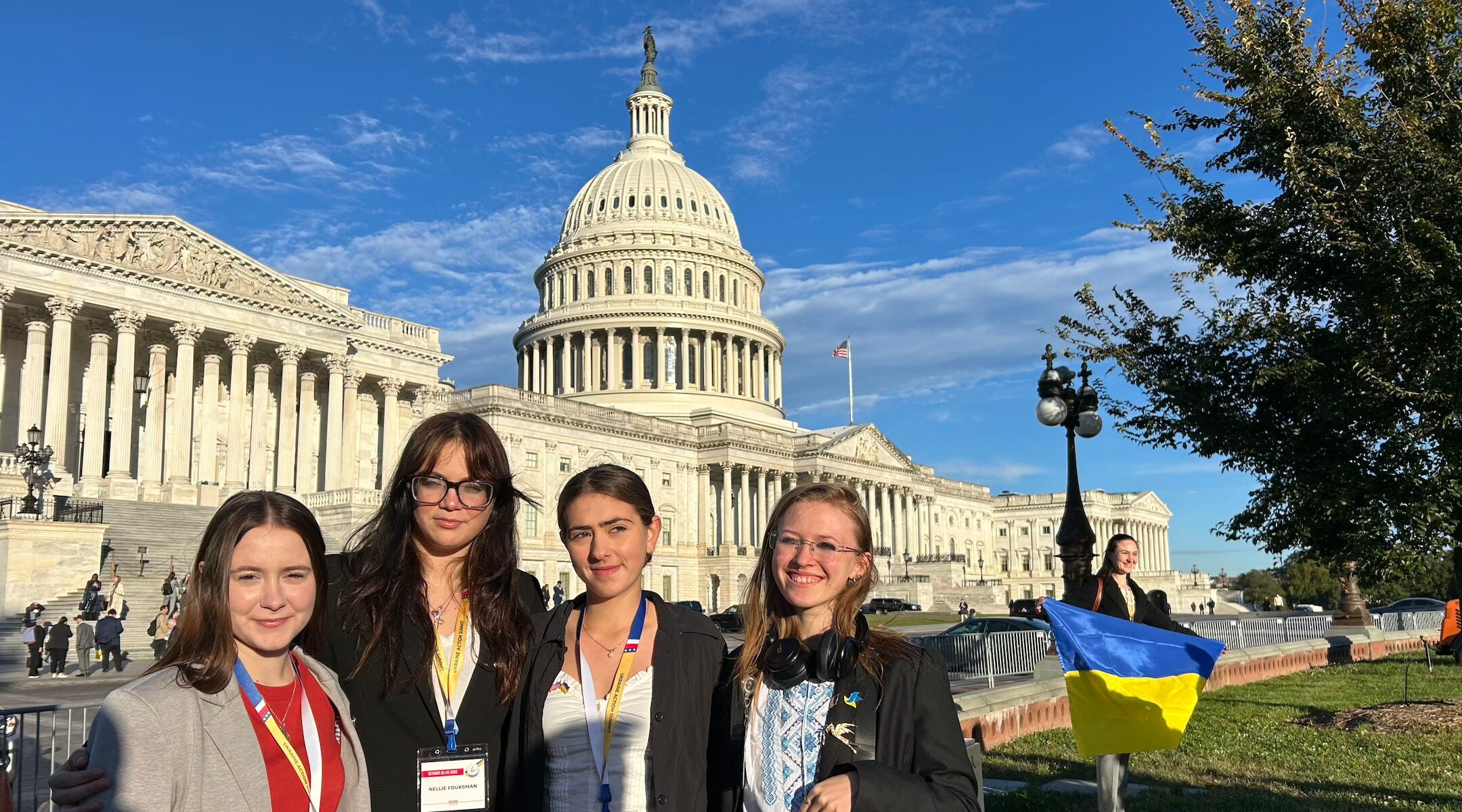
Nellie Fouksman, Leah Mordehai, Sabine Brook and Yaraslava K visit Capitol Hill in support of a bipartisan resolution calling for the return of abducted Ukrainian children and accountability for those responsible, Washington, D.C ., Oct. 28.2025. (American Coalition for Ukraine)
As the Russo-Ukrainian war divides Slavs by sub-group solidarity, with Slavic Jewish populations internally displaced or pushed to flee Ukraine, creating this space feels vital: fostering diverse voices pushes back against histories of cyclic oppression.
Seeing the impact of open conversation, I began to wonder whether writing could achieve the same—or even more. That curiosity led me to Slavic Voice 4 Ukraine, an international newspaper and advocacy project founded in August 2025 by Leah Mordehai and Nellie Fouksman in San Francisco,. Their mission “to inform and inspire through storytelling, journalism, and art” mirrored what I had been trying to build locally. I joined as the New York regional dDirector, connecting Slavic Culture Club members to a wider network of writers and artists exploring identity under war.
Published pieces on Slavic Voice 4 Ukraine, such as “Mama, I’m All Grown Up” by Caroline Kaytan and “The Rising Smoke of Ukraine” by Juliana Milevsky, capture what it means to love a homeland under fire and to carry inherited pride through war. Others, like “Life Passport” by Daniel Troshin and “From Latvia to My Kitchen: NSLI-Y’s Culinary Lessons” by Shira Avidan, explore how Slavic culture endures across the diaspora. My own article, “I am Multi-Cultural,” traces how reclaiming my Slavic-Jewish heritage led me to build the diverse community I needed but didn’t have.
When I write for the blog, I don’t feel I have to choose between my backgrounds. My Jewishness gives my Slavicness meaning; my Slavicness gives my Judaism memory. In Slavic Voice 4 Ukraine, I see a generation coming together that lights both menorahs and New Year’s trees, embracing the fullness of what we’ve inherited.
The views and opinions expressed in this article are those of the author and do not necessarily reflect the views of (JR) or its parent company, 70 Faces Media.