
“If you are looking for a black–and-white narrative, you might want to take up checkers,” Thomas Friedman wrote this week in The New York Times. He was referring to the Middle East in general, which he called “a complicated, kaleidoscopic region where religion, oil, tribal politics and great power politics interweave in every major story.”
The war against Iran is no exception. If anything, it’s even messier and more complicated.
Above all, it’s unpredictable. No one really knows what will happen. The future is more unclear than one of Persian poet Rumi’s “unseen poems.”
Given all this uncertainty, it’s tempting to just sit back humbly and say, “let’s see what happens.”
But something major has already happened.
An evil and powerful regime that has destabilized the world for nearly half a century has been significantly weakened.
This story of a theocratic monster in decline should not get lost in the fog of a messy war.
“The Islamic Republic of Iran has been the biggest imperialist power in the region since 1979, cultivating proxies to control four Arab states — Syria, Lebanon, Iraq and Yemen — and undermining liberal reformers in all four by promoting sectarian divisions,” Friedman wrote.
It turns out that the Hamas invasion of Israel on Oct. 7, 2023, changed everything.
Within two years, Hamas and Hezbollah were decimated, Syria imploded and the Houthis were neutralized. The once-mighty Islamic Republic, by losing its proxies, lost its mystique, not to mention its imperial power.
But that was just the beginning.
For the first time, the war came to Iran.
A joint attack from Israel and the U.S. in June 2025 severely damaged Iran’s nuclear facilities and air defenses, further undermining the regime’s prestige. Meanwhile, with sanctions still in place, a sinking economy added its own dark cloud.
All of that came before last week’s devastating strikes from the U.S. and Israel, including the stunning assassination of Supreme leader Ayatollah Ali Khamenei and scores of other top military leaders.
Aware that its fearsome reputation has crumbled and it is now in survival mode, Iran is hoping that the hundreds of missiles and drones it is launching against Israel, American bases and Gulf countries will regain some of its honor and help it survive.
A wounded Iran will fight to the death.
But even if the regime does not fall, Steven Erlinger writes, “this massive attack [from U.S. and Israel] is likely to have strategic consequences in the Middle East comparable to the collapse of the Soviet Union.”
Let that land.
No matter what happens going forward, something as earth-shattering as the fall of the Soviet Union has already happened in the Middle East.
For those of us who have been yearning for the liberation of the Iranian people, anything short of a new regime with Western values will not satisfy us. An Islamic Republic 2.0 that is defanged and can no longer wreak havoc is an upgrade for the world. But if it continues to oppress its people, it won’t be an upgrade for Iranians.
That said, we can’t let that disappointment blind us to the fact that the world’s biggest sponsor of terror has lost its power to terrorize the world.
A nation that for decades has proudly trumpeted “Death to America” and “Death to Israel” is now worried about its own death.
A nation that threatened to destroy Israel with nuclear weapons is now worried about its own destruction.
Regardless of where this complicated war goes, an evil empire will no longer have the luxury of throwing its theocratic weight around.
Instead, it will be awash in secular worries.
Worry about its spiraling economy, about finding new leadership, about its global loss of status, about maintaining cohesion in its security forces, about a population that has reached a breaking point.
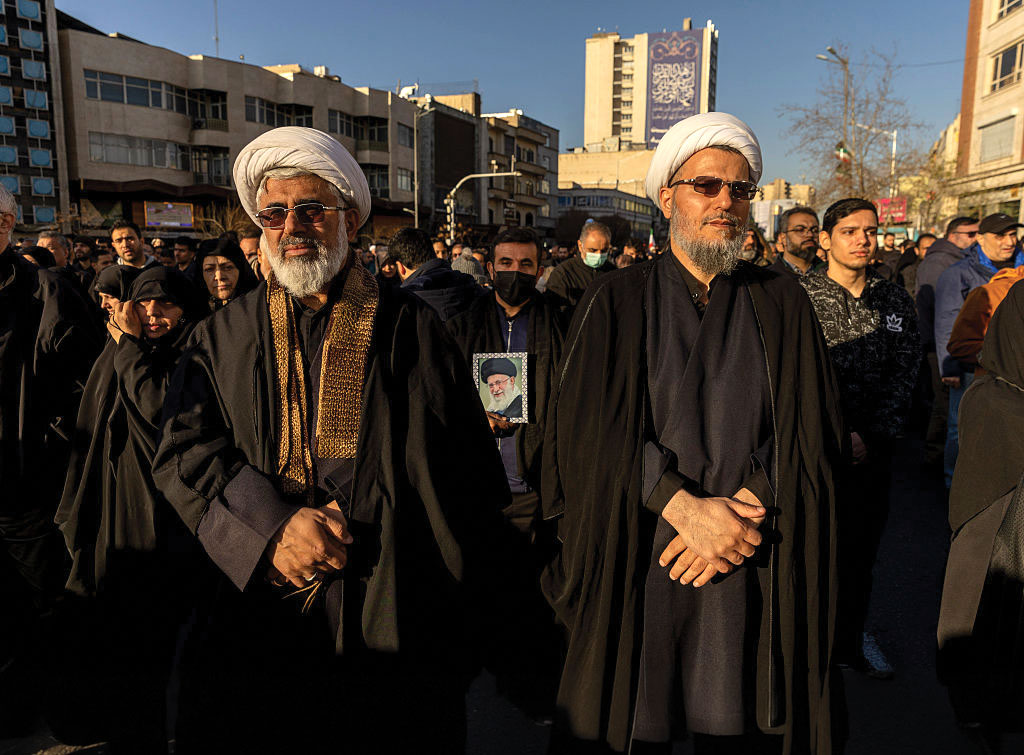
Since 1979, the arrogant mullahs of Iran have been spreading their toxic poison and getting away with it.
This week, as we commemorate the failure of another Persian named Haman to destroy the Jews 2,500 years ago, these arrogant mullahs are getting a taste of their own medicine.
It’s not as good as a new regime with Western values, but for a black-and-white outcome, it’s not a bad start.