

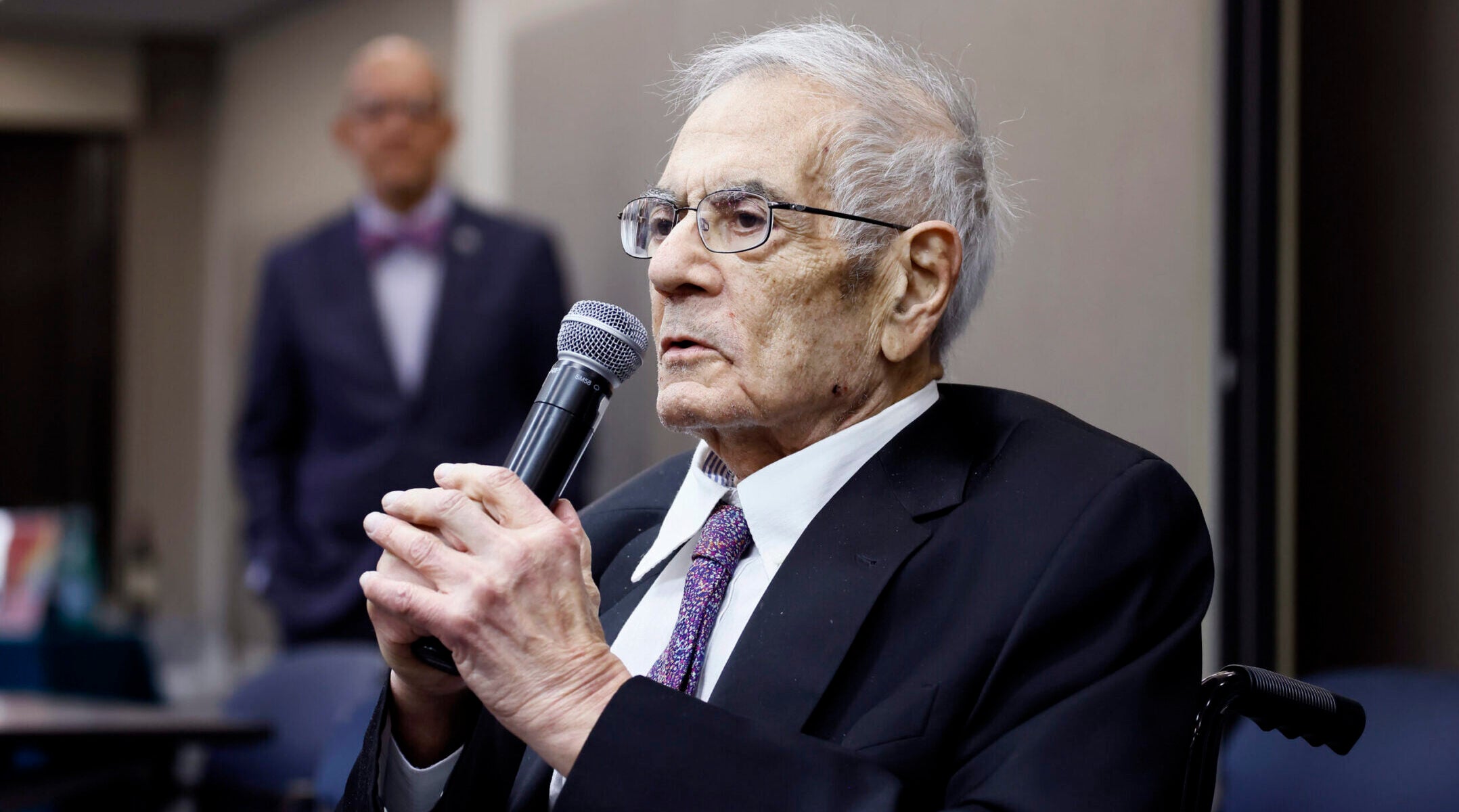
Barney Frank, for years the progressive conscience of his party who died on Tuesday night, had one last piece of advice for Democrats as he entered hospice care earlier this month: Repudiate litmus tests – except for Israel.
The United States should cut off weapons sales to Israel as long as Prime Minister Benjamin Netanyahu does not relieve Palestinian suffering, Frank told the Jewish Telegraphic Agency this month, using his imminent death to state bluntly what he believed other Democrats could not.
“It’s what the Democrats should be doing, it’s what America should be doing, and it should be what the Democrats are advocating, is giving an ultimatum that [Netanyahu] either changes things substantially in Gaza and the West Bank, or we cut off any aid,” the onetime congressional powerhouse said in a May 8 phone call from his home in Ogunquit, Maine.
“I’ve been talking about the importance of repudiating positions from the left and from the far left, but the Israel one is almost 180 degrees” different, he said. “It’s the one area where we are not doing enough in terms of making our position clear.”
Jewish lawmakers criticizing Netanyahu’s Israel was extraordinary a decade or so ago but has become commonplace. Frank’s plea, however, came from a lawmaker who grew up in a Zionist household and who was throughout a decades-long career in the U.S. House of Representatives solidly pro-Israel, albeit with occasional deviations from the pro-Israel lobby’s orthodoxy.
In one of his final interviews, he acknowledged being heartbroken by Israel under Netanyahu, recalling his family’s support for the struggle to shuck off the British mandate and create a Jewish state.
“We had a ‘boycott Britain’ bumper sticker on our car,” he said. His older sister, Ann Lewis, brought the family into the Zionist fold after a summer at a Habonim camp. “During my congressional career, I was very supportive, emotionally as well as politically and for a while earlier in this century, I volunteered and traveled at the request of Hillel to a couple of college campuses to defend Judaism and Israel.”
That would be hard to do in the current moment, he said. “I guess I held on longer than I should have to, ‘Well, we can work with them, etc’,” he said. “But it’s become clear to me, particularly due to what they’re allowing to happen in the West Bank, that it is important morally and politically to repudiate the policy of supporting Israel’s military activity.”
Rep. Barney Frank speaks to a Harvard Students for Israel rally in Harvard Yard, Oct. 23, 2000. The Harvard Society of Arab Students stood silently in protest, holding signs with the names of Palestinian and Israeli victims of recent violence. (Jim Davis/The Boston Globe via Getty Images)
From the home he shared with his husband in Ogunquit, Frank in his final days took calls from the media well ahead of the scheduled publication of his book, “The Hard Path to Unity.”
He freely admitted he was doing a virtual publicity tour because his survival until the September launch date was unlikely. He knew he was leveraging his decline to be heard, and he didn’t mind that at all.
“Frankly, if I weren’t dying, people wouldn’t be paying as much attention,” Frank told The New York Times earlier this month.
His message in many of those conversations: Don’t make or break viable Democratic candidates on issues like transgender rights or Medicare for all.
“The key to liberal democracy being able to come back is to get rid of the perception, that we have allowed to grow, that the entire Democratic Party is committed to a series of very drastic social reconstructions that go beyond the politically acceptable,” he told the Times.
Asked at the outset of his interview with (JEWISH REVIEW) if that advice extends to the pressure from some of the Democratic base on candidates to pledge to cut assistance to Israel, he offered a vigorous “almost the opposite” because of his conviction that the party should be more vocal in its opposition to the current Israeli government.
Frank was a fighter during his congressional career from 1981 to 2013. The leadership made him the lead antagonist to Newt Gingrich during Gingrich’s consequential speakership in the 1990s. Frank ascended to the leadership of the House Financial Services Committee at a key time, during the late 2000s financial crisis. He coauthored the last major banking reform bill, 2010’s Dodd-Frank.
He was a progressive lion, championing the battles against income inequality and for civil rights. He came out in 1987 as gay, the first sitting member of Congress to do so. He had a reputation as a curmudgeon, once silencing a Holocaust survivor for exceeding his time in congressional testimony.
Frank believed that incremental moves are more likely to bring about change than full-on advocacy for far-reaching changes. He had noted in interviews that the same-sex marriage he enjoyed with his husband came about because of a slow roll of change in LGBTQ rights, including ones he championed, like allowing gays to serve openly in the military.
The onetime leading progressive endorsed moderates in this year’s elections, backing AIPAC-supported U.S. Rep. Haley Stevens in the Michigan Senate primary. In his own state’s Senate race, he also backed Gov. Janet Mills, who recently ceded the primary to Graham Platner, an ascendant figure on the party’s left.
Frank believed anti-Israel orthodoxies could be as damaging as the far-left orthodoxies he decried. He remained appalled at voters disgruntled with the Biden administration’s pro-Israel policies who stayed away from the polls or even voted for President Donald Trump, and he used their example as one of two to illustrate why purity tests backfire. (The other is voters who faulted President Joe Biden for not doing enough to address climate change.)
“People who voted against [Kamala] Harris because they thought the administration had been too supportive of Israel achieved exactly the opposite of what they wanted,” Frank said, referring to the former vice president who faced Trump in 2024. “She would have begun by now to have cut back substantially on aid to Israel.”
He made clear in his interview that he rejected the extremes of Israel criticism emerging among Democrats, including accusations it has committed genocide in the war Hamas launched in 2023, and the argument that it should not exist as a Jewish state.
“Genocide is trying to wipe out the whole people,” he said. “The Holocaust was killing every Jew. Israel is not trying to kill every Palestinian. What they’re doing – I do not think its genocide, but it’s certainly unacceptable, morally and very damaging, politically.”
But he argued that in order to effectively confront the anti-Israel left in the party, Democrats must address what he says is the main enabler of its rise: Netanyahu and his policies.
“Netanyahu has been their enabler,” he said of prominent anti-Israel Democrats, including New York Mayor Zohran Mamdani and Michigan Senate primary candidate Abdul El-Sayed.
Frank was especially exercised by attacks by some settlers on Palestinians in the West Bank, attacks he said are enabled by Netanyahu and his coalition partnership with far-right patrons of the extremist settlers.
“My recommendation to Democrats would be to say, if Netanyahu does not reverse the harassment of Palestinians in the West Bank and substantially cut back on the military attacks, America should announce that we are no longer going to supply him with arms or be otherwise supportive,” he said.
“We’ve now gone to the point where supporting Israel has become unpopular, and that’s all Netanyahu’s doing,” Frank said. “No question that what he’s done is legitimize opposition to the whole notion of Israel, beyond disagreement with the specific actions.”
He sympathized with Jewish voters who feel alienated by Democrats and who could never bring themselves to vote for Trump (whom he reviled — he told reporters that his one regret is that he will not live to see Trump implode.) But he said the way forward is to cut off Netanyahu.
“I understand the dilemma people face if the choice is supporting Israel and everything that Netanyahu is doing and repudiating that,” he said. “We should make it clear that the right position here is to support Israel’s right to exist, but to be unwilling to facilitate what they’re doing militarily and to give them an ultimatum.”
Frank said the United States should actively support Netanyahu’s opposition as a means of leverage. He cited as an example the campaign he helped lead for the release of the spy for Israel Jonathan Pollard.
Frank spearheaded congressional pressure on President Barack Obama in 2010 mostly because he believed Pollard’s sentence was unjust. But he also thought that it would serve as an incentive to Netanyahu to cooperate more closely with the Obama administration on other issues. (The Obama administration engineered Pollard’s parole in 2015 and he now lives in Israel.)
Instead, Netanyahu became even more confrontational and moved further to the right. Now, Frank said, he would dangle the prospect of Pollard’s release before the Israeli electorate as a means of ousting Netanyahu.
“I now think America’s effort should be to support the opposition to Netanyahu,” he said.
Reporting the stories that define our era. When history unfolds in real-time, the Jewish world turns to (JEWISH REVIEW). Your support ensures we can document the complexities of war and the resilience of Jewish communities with integrity.