
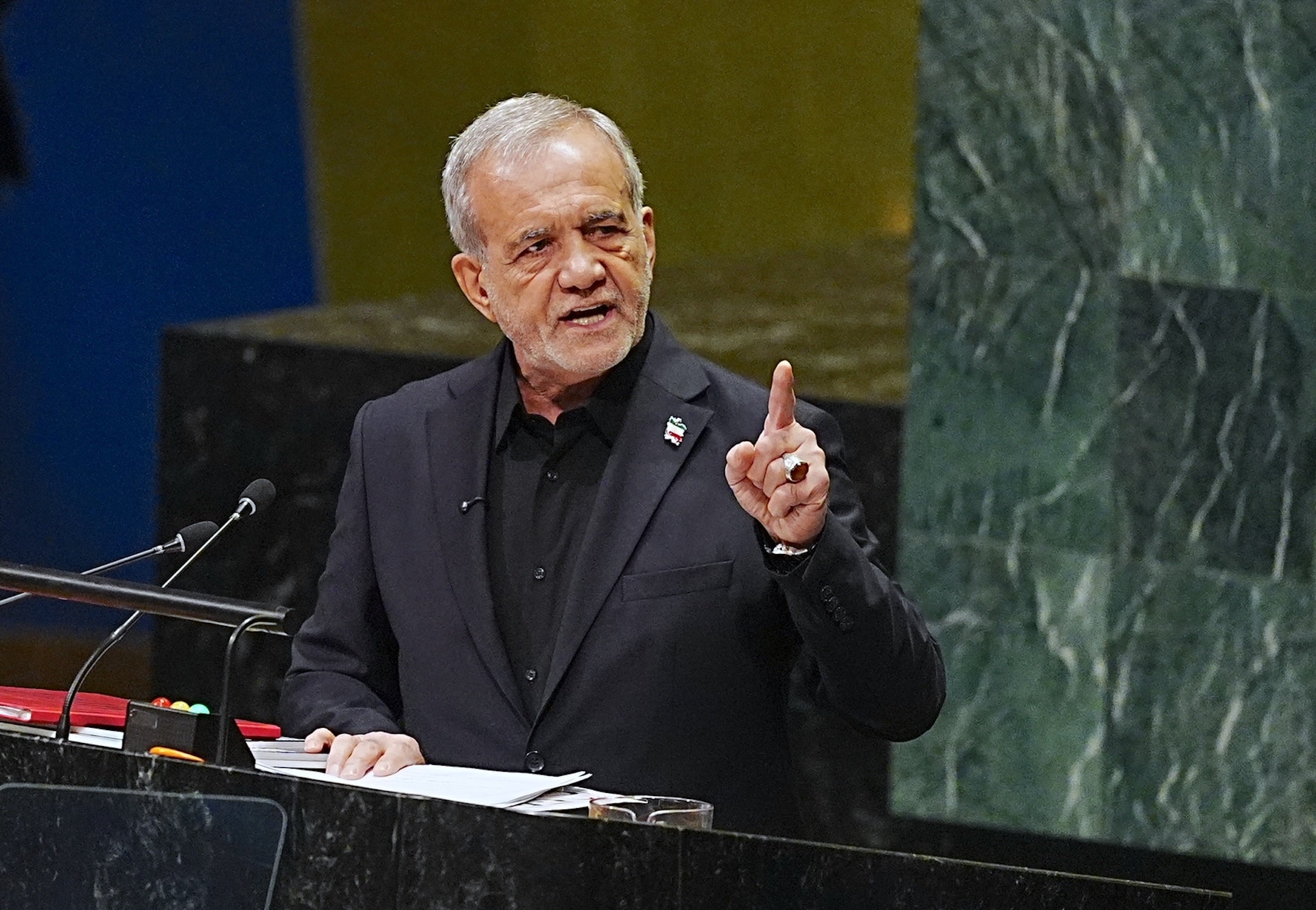
Iran won’t be bullied by military action or economic sanctions into giving up its nuclear program, the country’s president, Masoud Pezeshkian, pledged to the United Nations General Assembly on Wednesday as the United States deliberates whether to resume the war it joined Israel in launching.
“We will never bow our head or bend at the knee,” Pezeshkian said, speaking one day after President Donald Trump told the 81st high-level opening session of UNGA that he was wavering between diplomacy and annihilating the Islamic Republic.
“We’re not afraid of fighting, of war,” Pezeshkian said.
The two men were in New York amid a pause in the war that the U.S. and Israel began in February. A 60-day ceasefire was put in place in April, but broke apart in July, without a resumption of full-fledged conflict or a diplomatic deal.
That war was an outgrowth of the last three years of Iranian proxies’ war with Israel, which began with the deadly Hamas mass attack on Israel’s southern border on Oct. 7, 2023. It continued the next day with Hezbollah’s attack on Israel’s northern border, as well as aerial attacks by the Houthis in Yemen against Israel. Hamas, Hezbollah and the Houthis each have Iranian backing, and Iranian personnel were directly involved in Hezbollah’s attacks on Israel.
In response to the February strike, Iran closed the Strait of Hormuz through which a quarter of the world’s oil supply flowed before the war. It has since only partially reopened.
U.S. and Iranian officials held two hours of Qatari-mediated talks on the sidelines of UNGA on Tuesday, according to a post on X by Iranian foreign ministry spokesperson Esmaeil Baqaei. He wrote that Iran set clear conditions for a diplomatic resolution: the lifting of the U.S. naval blockade and sanctions, an end to the war, the release of Iranian frozen or restricted assets and the acceptance of shipping routes determined by Iran and Oman, the small Arab country on the other side of the strait.
Israel, which is not a party to the talks, has focused on the elimination of Iran’s nuclear capabilities, which were already weakened by joint Israeli-American strikes on its nuclear facilities in June 2025.
Prime Minister Benjamin Netanyahu, who is set to land in the U.S. on Thursday morning and deliver remarks to UNGA later in the day, is expected to address the war with Iran and what Israel says is Iran’s pursuit of nuclear weapons.
U.S. Secretary of State Marco Rubio spoke about Iran during a press conference at the U.N. around the time of Pezeshkian’s speech on Wednesday. “Iran can never have a nuclear weapon,” he stated.
The U.S. makes this point “in every interaction,” he said. Trump is open to a diplomatic deal, he explained, adding that this would not happen if Iran continues to sponsor regional proxies and global terror, and pursue nuclear weapons. Rubio warned that in that scenario, Iran would face either sanctions, “military options” or both.
Iran has “a choice to make,” Rubio said.
Pezeshkian said in address to the U.N. that the U.S. misread his country.
“Iran must be understood by Mr. Trump, and those who seek to bully us. We are ready for dialogue and diplomacy and negotiations without accepting the language of force,” he said.
Sanctions and pressure will only increase “the resistance of the Iranian people,” Pezeshkian stressed, adding that “the expansion of warfare will not result in security.”
He took issue in particular with Trump’s characterization of Iranians as terrorists and their actions as terror.
The opposite is true, he said, stressing that “we have been the victims of terrorism.” As an example, he cited the Israeli-U.S. assassination of Iran’s Supreme Leader Ayatollah Ali Khamenei in an airstrike in Tehran in February.
According to Reuters, the U.S. delegation walked out of the room at the start of his speech.
Pezeshkian also called the U.S. missile strike on the Shajareh Tayyebeh Primary School in Minab a terror attack, which killed over 150 including 120 boys and girls, as well as a strike on a sports complex in the residential area of Lamerd that killed 22 civilians.
Pezeshkian held up photographs of the school and the sports complex stating, “You see these children? These children perished under bombs.” The United States is investigating the attack.
Pezeshkian described Israel and the U.S. as terrorist countries that targeted Iranian civilians, saying that his country’s military actions were defensive and designed to deter other countries from attacking it. He said Iran’s nuclear program was a civilian one and did not involve weapons, and that Iran will not accept limitations to its nuclear technology.
It is wrong to demand that Iran give up its “peaceful” nuclear program when Israel has atomic weapons, Pezeshkian said as he highlighted the presumption that Israel is one of only nine countries in the world to possess nuclear weapons. Israel has never acknowledged possessing such weapons.
Pezeshkian accused Israel of a “double standard,” saying that his country’s nuclear program is expected to be under international supervision, while there is no similar requirement on Israel.
Israel “has the nuclear weapons” but “the inspectors are in Iran. Israel kills. But Iran is subject to sanctions. This is a true tragedy, which would make anyone hearing it laugh, at best,” he said.
Access to the Strait of Hormuz would remain limited and free access would not be provided to aggressors against Iran, he said. “We do not, we cannot let some have free access and gain their interest from a waterway, while at the same time using that waterway to impose their aggressions upon us,” he added.
Pezeshkian defended the rights of Palestinians to resist Israel or risk being driven from their homes. He described Israel as an occupying force on Palestinian land, with a focus in particular on Palestinian suffering in Gaza.
“As long as occupation, aggression and injustice persist in the world, resistance will continue,” he stated.
As the Year Turns, Support the Journalism You Trust. JR covers the stories shaping Jewish life around the world — with the depth this moment calls for. As you reflect on the year ahead, consider a gift that keeps independent Jewish journalism strong.