
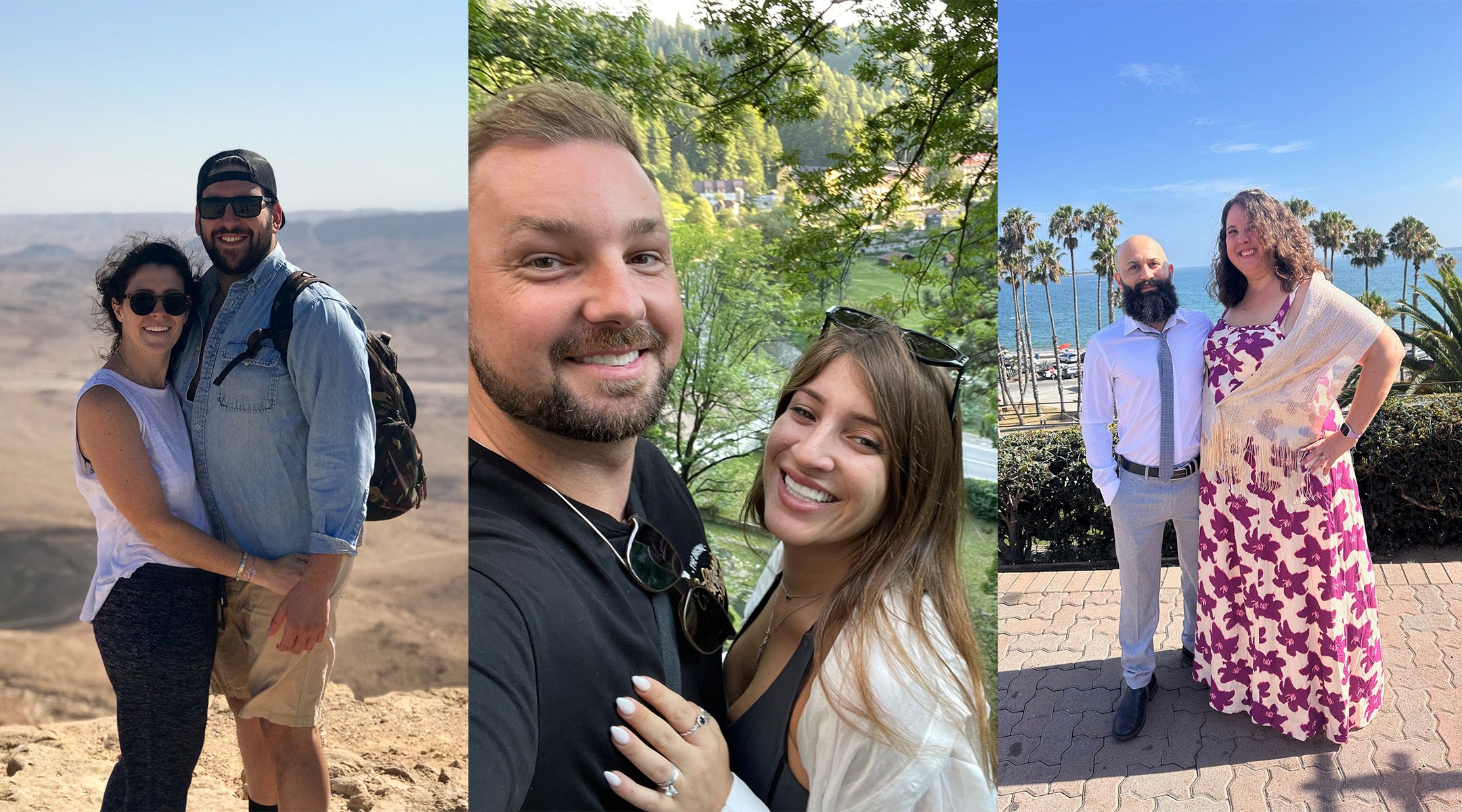
Marriage was not something on Shantal Ben-Aderet’s mind when she embarked on a Birthright Israel trip in 2020.
“My mom and my dad were both like, ‘Oh, maybe you’ll meet someone there,’” Ben-Aderet recalled. But Ben-Aderet dismissed their suggestion as a “silly concept.” After all, it wasn’t why she had signed up for the free, 10-day trip to Israel.
Though Ben-Aderet, now 36, had been to Israel before, her experience was limited to childhood visits to see her Israeli father’s family. By contrast, Birthright Israel would offer “a trip where you’re doing a bunch of things, where you’re seeing all of Israel,” Ben-Aderet, a school psychologist, said via Zoom from her California home. “It also sounded like a nice, social opportunity to meet other Jews.”
Ben-Aderet’s trip was all of those things: She visited the Dead Sea, went to the Kotel in Jerusalem’s Old City and traveled to a Bedouin tent. She also met a bunch of other Jews — including Daniel Cohen, who eventually became her husband.
The pair first connected when Ben-Aderet found herself at an impasse on a group hike down Mt. Arbel, in the lower Galilee. Cohen came to her rescue, and while it wasn’t exactly a meet-cute — Cohen, now 38, had a girlfriend at the time — the connection was undeniable.
Cohen, who is Israeli, had joined the trip for a few days — Israeli participation (known as “mifgash”) is a regular feature of a Birthright Israel tour, as cross-cultural exchange is one the program’s aims. The pair continued to get to know each other on bus rides between sites, and they stayed in touch as friends once Ben-Aderet returned to the U.S.
After nearly two years of regular phone calls, the relationship blossomed into something more. In 2021, they met up in Iceland, and the long-distance romance culminated when they married over Zoom in April 2022, for visa purposes to facilitate Cohen’s move to California. A year later, they had a more traditional Jewish ceremony in Israel.
“Birthright really changed my life, not just because I met Daniel, but it really brought about how important it is to me to be Jewish,” Ben-Aderet said. “Now that I’m married to a Jew — and an Israeli Jew, at that — I realize that, wow, it really feels good that my home is completely Jewish. Not necessarily religious, because I’m not a religious person, but ethnicity-wise, culture-wise.”
Ben-Aderet and Cohen are far from the only couple who met on a trip with Birthright Israel, which has hosted nearly 1 million Jewish young adults from 70 different countries since its founding in 1999. Young Jews meeting their bashert, or soulmate, on Birthright has become something of a trope, with Jewish newspapers regularly publishing feel-good stories about couples who met during the program.
This phenomenon isn’t only anecdotal: Research into the myriad impacts of Birthright Israel shows a strong link between program participation and future marriage to a Jewish partner.
Leonard Saxe, the Klutznick Professor of Contemporary Jewish Studies and Social Policy at Brandeis University, has been studying the spectrum of effects of Birthright Israel for roughly 25 years, under the auspices of the Jewish Futures Project, a longitudinal study that followed the lives of Jews who applied to participate in the program between 2001 and 2009.
Among key takeaways cited in the project’s 2025 publication, “L’dor v’dor: Birthright Israel’s Impact Across Generations,” is that program participants “are much more likely to have a Jewish spouse or partner compared to similar nonparticipants (63% compared to 46%).”
“Birthright Israel engages people with their Jewish identity and makes them feel part of something larger/more meaningful,” Saxe elaborated over email.
“Seeking a like-minded soulmate is one of the implications,” he added, of such engagement.
Contrary to popular misconception, however, coupledom was not an explicit objective of the Birthright initiative when it launched. “The goals of the program were to promote Jewish identification, love (ahavat) Yisrael, and klal Yisrael,” said Saxe, using a Hebrew term that refers to the Jewish people as a whole.
Like Ben-Aderet, Max Rind, an event and wedding planner, also grew up with a strong Jewish identity. The eldest of three children, he was born to parents who emigrated to the U.S. from Germany. Rind, now 39, attended an Orthodox day school in South Florida through middle school and he had an Israeli best friend who lived down the street.
“My entire life was always around Hebrew, was always around Jewish school, was always around hearing about Israel, knowing about Israel,” he said. Still, he’d never been in person.
Years later, when that same childhood friend became romantically involved with an enthusiastic Birthright Israel trip leader, the stars aligned for Rind to finally visit Israel. In 2019, the leader-girlfriend video-called Rind and other mutual friends to let them know she’d be heading up a trip departing from Los Angeles.
“She had this very stern look on her face, and she’s like, ‘Guys, listen to me very carefully. I’m sending you all a link. You’re signing up for it now’,” Rind recalled. An avid traveler, he didn’t need much prodding, having heard raves about Birthright Israel trips from friends and relatives who’d gone before.
As it happens, Rind met and eventually married an Israeli he befriended on Birthright — the pair started out as members of a larger made-in-Birthright friend group. Today, he and Sapir Glazer, 34, who works in residential remodeling, are parents to two young children and live in Houston.
That was an eventuality he didn’t foresee but also didn’t exclude from the realm of possibility when he departed for the trip.
“Whenever you go somewhere new, and especially if you’re single, it’s always on your mind. Maybe I’ll meet somebody, maybe in the group, maybe overseas, because you never know where life takes you,” Rind said.
While on the trip, Glazer immediately stood out to him. She “was the light of the show, having everybody dance and have fun and was constantly like, ‘This shouldn’t be just a learning experience. You should have fun. This is what this country is about,’” he said.
Not only did Rind find love on Birthright, he also found a lasting group of Jewish friends. “We’re still all in this big WhatsApp group chat,” Rind said. “It’s cool to have almost like a mini Jewish community in your back pocket, to be like, ‘Hey, remember, we all went on this life-changing kind of experience together.’ To have a group like that that you can always reach out to.”
Sales consultant Max Marschark, 37, grew up in Buffalo, New York. By his account, he was usually the only Jewish kid around, and though his mother tried to keep traditions alive at home, Marschark’s personal interest in such matters was limited. Still, as soon as he turned 18, his mom urged him to apply for a Birthright Israel spot. He rebuffed her, but she kept suggesting it.
“When I was 25, I was just like, ‘You know what, I’m a single guy, I’ve got nothing else going on,” he said. “It’s an opportunity to travel the world.”
As it turned out, the 2015 trip had even more opportunities in store. “I always say he fell in love with me at the airport,” said Marschark’s wife of three years, Arielle Levy Marschark, now 37. “I think he liked my energy. But it might have been the night out in Tel Aviv — the third night — we just hit it off, I guess.”
In contrast to her husband, Levy Marschark grew up in a rich Jewish communal environment — she went to Jewish summer camp, was involved in Hillel in college and eventually became a Birthright Israel trip leader.
Her engagement with Jewish tradition and Israel made a deep impression on Marschark. As the spark of romance kindled, Marschark and Levy Marschark both decided to extend their stay in Israel. Over the next five days, the pair spent time on the beach, eating their way around Tel Aviv and getting to know each other better.
When they returned home — Marschark to Brooklyn and Levy Marschark to Austin — the couple continued to date long-distance. In 2018, Marschark took the plunge and moved to Texas and, in 2023, they married. The couple welcomed their first child this September.
“It was the most impactful trip I’d ever been on,” Marschark reflected. “I fell in love with Israel immediately after being there, and … it was pretty transformative for me to meet the person who I’m married to now.”
It was transformative for his Jewish identity, as well. “Without really having any sort of tie or relationship to Israel, I still feel like I’ve always had this sense of, you know, ‘my people,’” Marschark said.
Thanks to his wife’s strong ties to the Jewish tradition, that sense has likewise pushed him to engage more with Jewish life. The couple are members of a Conservative synagogue and Marschark recently took on a leadership role there for the first time, heading up its kosher chili cook-off.
“He did excellent,” Levy-Marschark boasted. “He raised money, helped organize entertainment tents, recruited different kosher chili cook-off teams.”
“Now my proud moments of when I kvell over Max is when he’s like, ‘You know, today I stood up for Israel,’” she added. “To hear him say that is just really special.”
Every love story here began with one Birthright trip to Israel. Now it’s your turn to send the next group of Jewish young adults. Give today, and your gift goes 5X as far. Match my gift.
Count yourself in. Independent Jewish journalism runs on thousands of readers. Join them with a year-end gift. We can’t do it without you.