

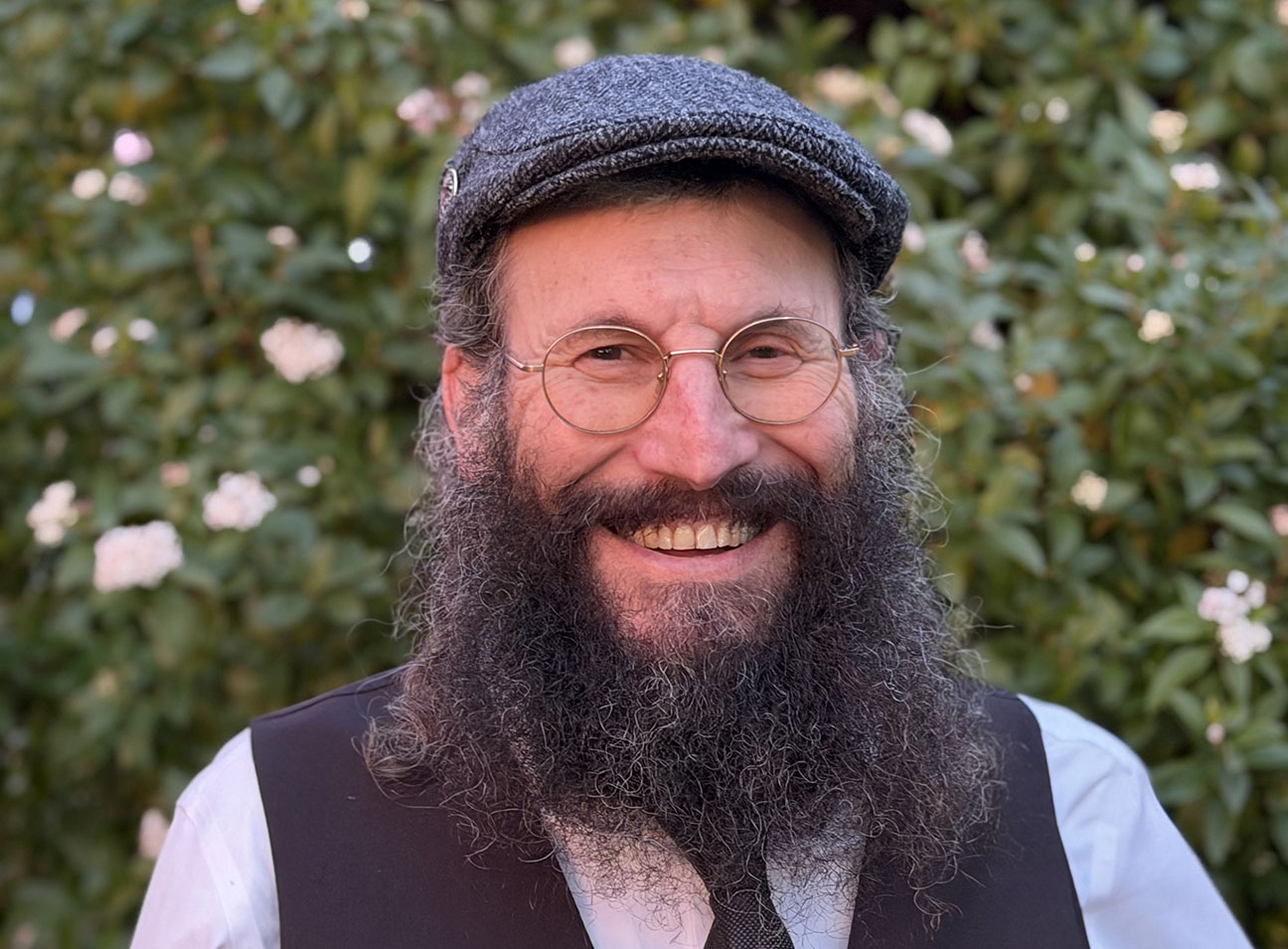
Community outreach has long been important to Rabbi Yonah Bookstein. But sitting in his modest upper-story office on Pico Boulevard, the founder of Pico Shul offers no hint of his extensive background.
How does the rabbi see his career? “I’m at an amazing point,” he said. “I have been in Jewish communal work for more than 30 years. I started working with the Jewish community in Poland before I was officially a rabbi. I started working as a volunteer when I was a graduate student. I had a Fulbright Fellowship in Kraków, and when I was at Oxford, I used to go back and forth to Poland. I lived there as a Fulbright [Scholar].”
One of the friendliest rabbis you’ll ever meet, you feel as if you have known him for years, before you take a seat. Engaging and passionate, he was attracting Orthodox crowds to Pico Shul before COVID.
But the story he wants to tell is from his past, when he was attending University of Oregon (“Not many Jewish boys from Detroit end up at the University of Oregon,” he joked).
He was off to Israel in 1990 for his junior year abroad. “In the spring of ’91,” he said, “I went to Turkey and Hungary as a representative of the Zionist youth movement from Israel to help work with youth groups there. Since I was going to Europe anyway, I said ‘Oh, I should go see where my grandparents are from.’”
To this day, he can’t say what inspired him to go. “I had a buddy in Detroit whom I had grown up with who also had a grandfather from Poland,” and they decided to meet up in Warsaw in June 1991. “That trip changed my whole life.” They ended up going to Łożma, the town in northeastern Poland where his grandfather had grown up.
“The Pope showed up in town on the same day. It was the craziest thing. As we were trying to get there, the train was packed, the bus was packed. Pope John Paul was making his first visit. It seemed as if there were a million people there to see the Pope.”
Bookstein and his friend went back to Warsaw, where his friend decided to move on. “I wanted to stay for Shabbos,” he said. “I met young Jews in Warsaw who were putting together Shabbos meals in the basement of the Jewish theater. And so I had Shabbos dinner with them.”
He was in for a shock. “My mind was blown,” he said, “because I had been told everyone (Jewish) is dead. No Jewish life. I had a black-and-white picture of Poland. But now I was getting a very different perspective. Young Jews are there. And they are interested in their Jewish roots. I was very passionate about it.”
Bookstein ended up spending three weeks with his new friends in Warsaw and Kraków. He also went to Lublin, “meeting all kinds of interesting people interested in Jewish things. There was a whole post-communist euphoria … about everything. One was about discovering people’s roots – Jews and non-Jews.”
The lure of Poland was so strong that Bookstein’s wife joined him there in 1996, following their marriage. “So we started to commute from Israel, and we moved there in ’98,” working as director of the Ronald S. Lauder Foundation, spanning his 10-year commitment to the rebirth of Polish Jewry. “Although I still wasn’t a full rabbi – I had studied. I had a lot of knowledge under my belt but hadn’t finished all of my smicha studies – but they needed us to run the Lauder Foundation.”
He cut short his studies and moved to Poland in ’98, where he spent four years. Then he moved to New York where he finished his rabbinic studies. But “while we were in Poland, I was basically an acting rabbi – I did funerals, I worked on kashrush and education for the Lauder Foundation.”
He had a good background for it, he said. “I grew up going to Jewish day school, very traditional, in Detroit. There’s not really an equivalent today in LA, but we had Shabbos and Pesach. We were traditional. Thank God. In college I was much more interested in learning all about different streams in Jewish life, from Hassidic to Reconstructionist. I was fascinated.”
Next came two life-changing introductions. “I met Rabbi Shlomo Carlebach my freshman year in college, and I had a great Hillel rabbi, Rabbi Hanan Sills (z”l). He opened my mind because I came to college quite down on the (Conservative) Judaism I had experienced growing up in Detroit.”
Detroit, he said “was just not inspiring … I might have learned or done a lot, but I was not inspired by it. Rabbi Hanan, one of the founders of Jewish Renewal, and Shlomo Carlebach, they kind of opened my eyes to the possibility Judaism is inspiring, meaningful, contemporarily relevant, more than I had experienced as a kid. Rabbi Hanan was incredible. He had gotten arrested with Martin Luther King in St. Augustine, Fl. Terrific, wonderful man.”
Jewish Journal: Your favorite form of relaxation?
Rabbi Yonah: Walking in nature, a quiet Northern California beach, in the Redwoods, walking through forests and valleys in Scotland.
J.J.: Your favorite Shabbat moment?
Rabbi Yonah: Singing Shabbat songs at the table with my kids.
J.J.: Do you have any unfulfilled goals?
Rabbi Yonah: I’d like to have a plum orchard.