

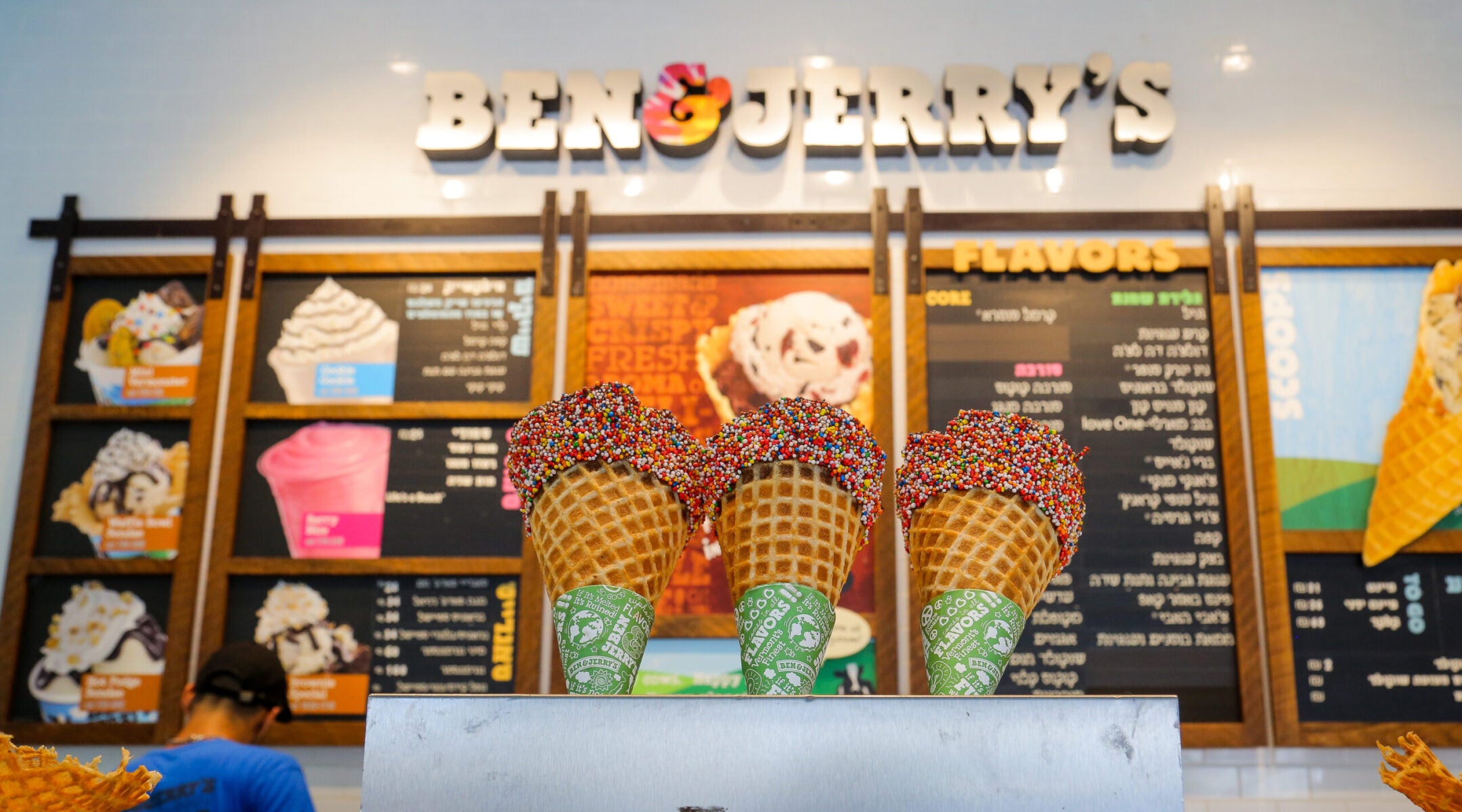
Ben & Jerry’s Israel operation has come up with a flavor that does not leave much to interpretation. Called “Milk and Honey,” a nod to the biblical description of the Land of Israel, its namesake ingredients are supplied by Israeli cows and bees and its chocolate fudge pieces come shaped like Stars of David.
The company, which split from its American counterpart after a contentious 2021 boycott fight, is billing the new pint as its “most Israeli flavor ever” and, on its website, as a “symbol of hope, rehabilitation, and positive action” after the Hamas-led Oct. 7 attack.
Its ingredients and production come from southern Israeli communities most affected by the massacre and the war that followed. The company, based in the southern city of Kiryat Malachi, said it “felt a responsibility to take an active part in the region’s recovery process.”
The milk and cream come from the dairy in Kibbutz Alumim, one of the Gaza-border communities infiltrated by Hamas terrorists on Oct. 7, 2023. The honey comes from the beehives of Kibbutz Yad Mordechai. The chocolate Stars of David are made by hand at the Korint factory in Beersheba, part of the Shkulo Tov social enterprise, which helps integrate people with disabilities into the workforce.
Even the wrapper is local: the pint is adorned with “Fields of Light,” a painting by Rivi Doron-Gerloy, a southern Israeli artist who was killed in a Miami car accident last year.
The flavor was developed in partnership with the Ayalim Association, a nonprofit that works to strengthen Israel’s periphery. The company said royalties from sales of the new flavor will go to Ayalim’s rehabilitation and educational initiatives in the south.
The Israeli and American Ben & Jerry’s operations are now completely separate, a split that followed one of the more improbable diplomatic dramas ever to involve ice cream. In 2021, Ben & Jerry’s said it would stop selling in Israeli settlements in the West Bank, saying sales there were “inconsistent” with its values.
The move set off an uproar in Israel. President Isaac Herzog called the boycott a “new kind of terrorism,” while Benjamin Netanyahu, then opposition leader, retweeted the company’s announcement that it would stop selling in the “Occupied Palestinian Territories,” writing, “Now we Israelis know which ice cream NOT to buy,” alongside Israeli flag and flexed-bicep emojis.
The original founders, Ben Cohen and Jerry Greenfield, who no longer control the company but remain its best-known faces, also came under fire after the decision. In an interview, they were asked why the boycott logic did not extend to places such as Georgia and Texas, despite their opposition to those states’ voting rights and abortion laws.
“Why do you still sell ice cream in Georgia? Texas?” Axios reporter Alexi McCammond asked in a video that went viral on pro-Israel platforms.
Clearly stumped, Cohen shrugged his shoulders. “I don’t know,” he said, laughing. “You ask a really good question and I think I’d have to sit down and think about it for a bit.”
Ben Cohen and Jerry Greenfield, who founded Ben & Jerry’s in 1978, spoke about the company’s decision to stop selling ice cream in the West Bank in an interview with Axios released in October 2021. (Screenshot)
Unilever’s then-chief executive, Alan Jope, also appeared to suggest that Israel had become an inconveniently sticky scoop of activism. “There is plenty for Ben & Jerry’s to get their teeth into in their social justice mission without straying into geopolitics,” he reportedly said in a quarterly earnings review at the time.
The standoff ended, at least commercially, when Unilever, Ben & Jerry’s parent company, sold the Israeli business in 2022 to Avi Zinger, the longtime Israeli licensee and owner of American Quality Products. The sale was accompanied by a legal fight that was inflamed when Zinger told an Israeli news outlet that, once he took control of the company in Israel, he could rename the signature flavor “Chunky Monkey” to “Judea and Samaria,” the Hebrew term for the West Bank.
Under the ultimate deal, Ben & Jerry’s could continue to be sold throughout Israel and in Israeli settlements, under Hebrew and Arabic branding, while the Vermont-based company said it disagreed with the move and would no longer profit from Israeli sales.
The split left the Israeli operation in an unusual position: carrying one of the most recognizable American ice cream names, while openly defying the political stance associated with that name abroad.
But the corporate restructuring has not been enough to cleanse the palate for everyone. On social media, the new flavor drew curiosity and praise, but also lingering resentment from those who said the brand name still carried too much baggage, even under Israeli ownership.
“I really don’t care if it’s owned by someone other than Ben and Jerry in Israel. Those two clowns’ names are still associated with the brand. I wouldn’t spend a penny for this ice cream regardless. That brand is done,” one person wrote on Instagram.
“We’ve been eating Häagen-Dazs since October 7th,” another said.
Last year, Cohen announced that he planned to produce a “flavor for Palestine” independently after Unilever blocked Ben & Jerry’s from creating one, soliciting suggestions about what should accompany watermelon, a symbol of Palestinian solidarity, in his concoction.
“Milk and Honey” has come to market faster. So does the new flavor deliver a taste of the Holy Land?
One food influencer, who called the new flavor a “statement,” offered a less scriptural verdict on the taste, shrugging that it “tastes like vanilla with chocolate chips” — a conclusion echoed by others in Israeli food aficionado groups, who lamented that the honey was barely noticeable.
One commented, referring to dairy-free desserts made to comply with kosher laws prohibiting the mixing of milk and meat: “Not the tastiest thing I’ve ever eaten, but not as bad as a pareve dessert either.”
Reporting the stories that define our era. When history unfolds in real-time, the Jewish world turns to (JEWISH REVIEW). Your support ensures we can document the complexities of war and the resilience of Jewish communities with integrity.