

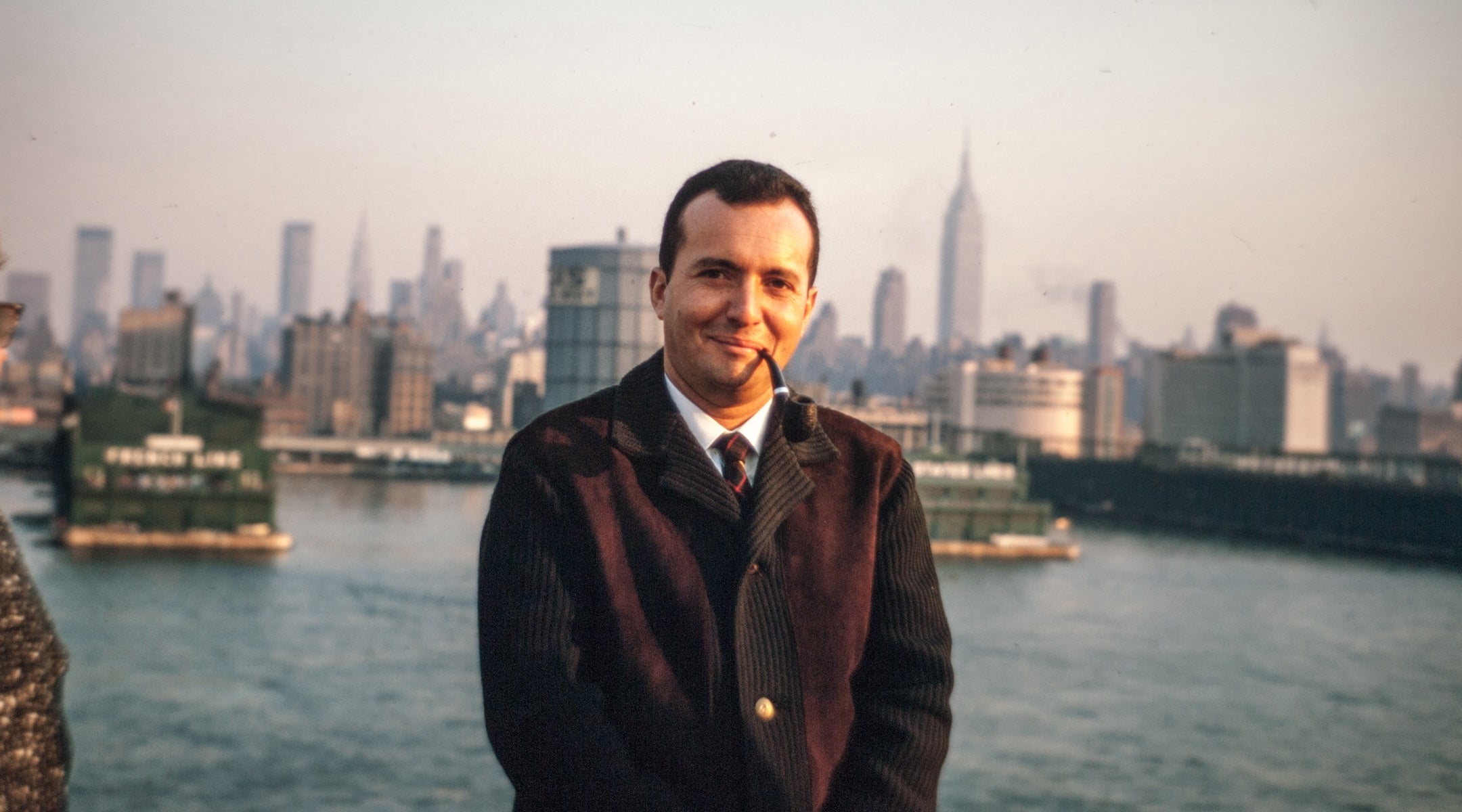
When Boaz Dvir flew from the United States to Israel in late September to screen his new film, “To Kill a Nazi,” he didn’t expect its story to become newly relevant. But just as Dvir arrived, the thwarting of an apparent hijacking of a flydubai flight bound for Israel offered an uncanny echo of the history his film recounts.
The film tells the largely overlooked story of Michel Cojot, a French Jewish Holocaust survivor and Nazi hunter who helped fellow hostages during the Entebbe hostage crisis and later provided intelligence that aided the Israeli rescue mission. For Dvir, the timing was striking.
“As I’m driving around, what do I hear?” he told the Jewish Telegraphic Agency. “Somebody tried to hijack a plane from Dubai to Israel and do a 9/11 type of terrorist attack? And the passengers saved the day? Ordinary guys?
“And of course, people brought it up everywhere I went, because the parallels are uncanny.”
Michel Goldberg was born in Paris in 1938. After the Nazis invaded, his father Joseph Goldberg was captured and sent to Auschwitz, where he was killed. According to his 1982 memoir “Namesake,” Michel was raised in France’s so-called “free zone,” which the Nazis would also occupy starting in 1942, and took his last name from his stepfather after his mother remarried.
Growing up to become a successful banker, Michel teamed with the famed Nazi-hunting couple Beate and Serge Klarsfeld and in 1975, while working in South America, embarked on a plot to find and kill Klaus Barbie, the Gestapo commander who had signed the arrest papers for Cojot’s father, and who was at that point hiding out in Bolivia.
Posing as a journalist, an armed Cojot met the “Butcher of Lyon,” but given the opportunity, Cojot failed to pull the trigger. In his memoir he writes that Barbie instead deserved to live in constant fear of reprisal, and that murder was a “Nazi” solution.
The year after his mission to Bolivia, Cojot and his son were on the fateful Air France flight that, bound from Tel Aviv to France, was hijacked by Palestinian terrorists and West German far-left radicals, with 102 Israelis on board. It led to the standoff at Entebbe International Airport in Uganda and the heroic rescue by Israeli commandos.
During the seven-day crisis, Cojot acted as a translator and go-between among the hijackers and passengers. When the Ugandan dictator Idi Amin spoke to the hostages, Cojot translated his English into French. He was even credited with persuading the lead hijacker, Wilfried Böse, to release the non-Israeli hostages. After his release, Cojot provided information to Mossad, including the layout of where the hostages were being held, which greatly assisted the Operation Thunderbolt rescue mission.
Cojot went on to write a book about Barbie’s crimes, and then testified in Barbie’s war crimes trial in the late 1980s. Barbie was sentenced to life in prison; he died of cancer in 1991. Cojot himself passed away in 1999. While the story of Entebbe is very well-known, Cojot’s role in it has often been left out of such tellings. None of the feature films about the rescue, most recently 2018’s “7 Days in Entebbe,” include him as a major character.
Divir hopes to give the forgotten hero the recognition he deserves. The grandson of Holocaust survivors who was born in Petah Tikva a few weeks after the Six-Day War in 1967, the filmmaker remembers the weeklong Entebbe crisis. He was nine years old then.
“I was like most Israeli kids at the time, outside most of the day and playing,” Dvir said. “But my brother and I, who was a year younger, decided that in solidarity with the hostages, we’re gonna ground ourselves, and so we did for that whole week.”
At the end of the week, he remembers his father waking him up and telling him, “The IDF did it.”
“We knew immediately what he meant, and of course we were thrilled for everybody, the released hostages, the military, but we’re also happy to be able to go outside again,” said Dvir.
While histories of the Entebbe affair omitted the actions of Michel Cojot, another Frenchman, pilot Michel Bacos, has often been recognized as a hero of the affair for having refused to be freed in the first release of the hostages. Most obituaries of Bacos, who died in 2019 at age 95, included this.
In fact, Dvir originally planned to make a documentary about Bacos. However, his research, including an interview with Bacos himself, led Dvir, a journalist and journalism professor at Penn State, to doubt Bacos’ version of the events.
But those former hostages kept mentioning another Michel, a genuine hero. “The story that I knew so well, Operation Thunderbolt, that I grew up with, now suddenly took on a whole new meaning,” Dvir said.
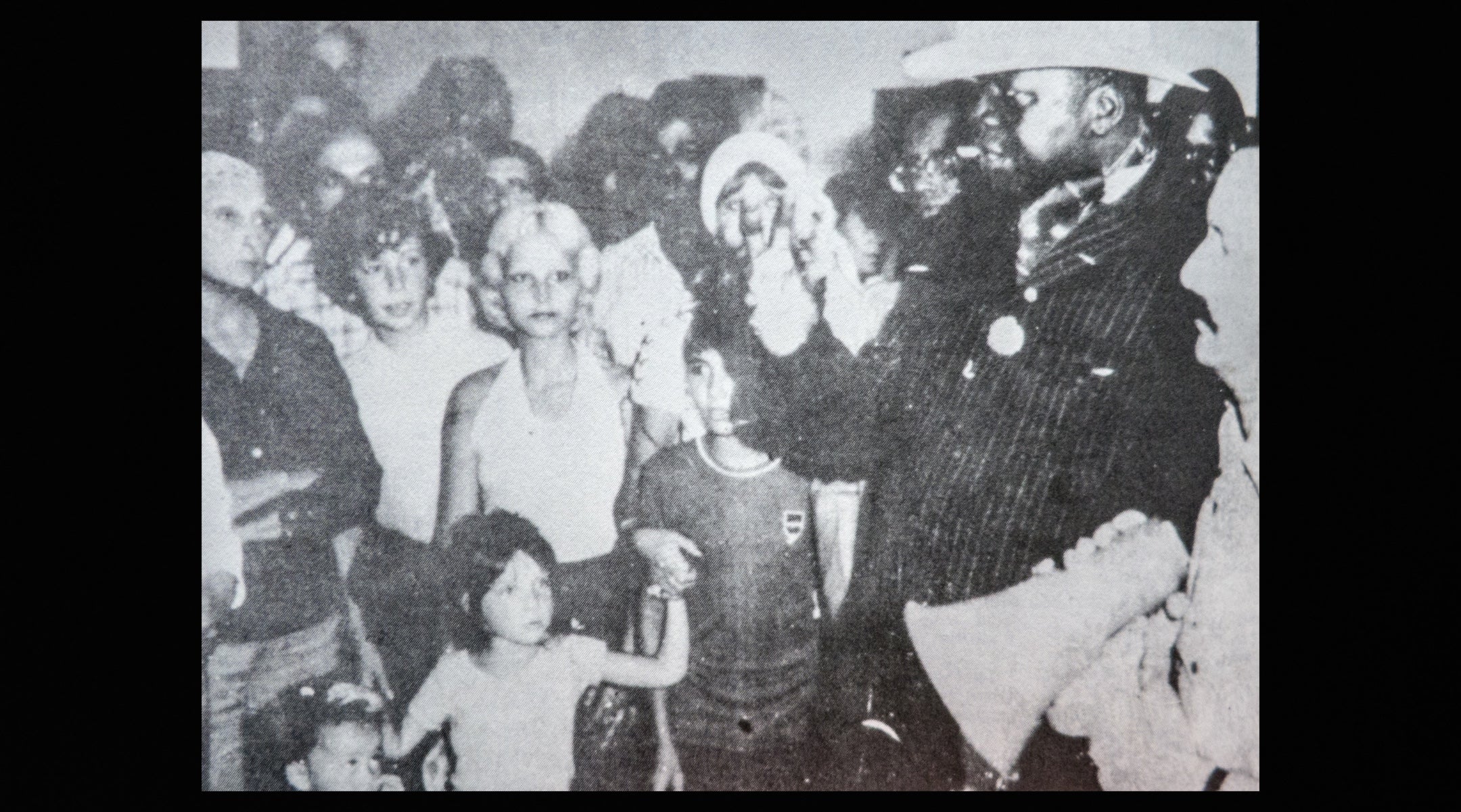
The film includes interviews with all four of Cojot’s children, including his son Olivier, who was with him in Entebbe, along with hostages and experts; Cojot himself appears in archival footage.
Dvir also composed the film’s music, which Penn State musicians perform on the soundtrack.
Dvir worked on the project for nearly a decade, even presenting it publicly as a work in progress as early as 2018.
“This project took a lot longer than most of my projects,” the director said.
A familiar voice narrates the film: Jason Alexander, the Jewish actor best known for “Seinfeld.” Dvir’s manager and business partner is a friend of Alexander’s, who agreed to narrate after viewing a rough cut.
“To Kill a Nazi” premiered at the Dances With Films festival in June. It has also screened at the Nashville Jewish Film Festival and the Croatian International Film Festival, and premiered in New York City on Oct. 16 at Regal Battery Park as part of the Chelsea Film Festival.
It’s also set to play the Austin Film Festival at the Boulder Jewish Film Festival, and the Silicon Valley Jewish Film Festival on Oct. 29; at the Galaxy Theatre in Austin, Texas on Oct. 31; and at the Harrisburg Jewish Film Festival on Nov. 12. Dvir hopes it will be picked up by a streaming service.
Some Jewish and Israeli filmmakers, especially since Oct. 7, have complained that they’ve had difficulty getting their films into festivals.
Dvir said that while “To Kill a Nazi” is “doing very, very well” and has been accepted to film festivals both Jewish and non-Jewish, “it’s been a little more of an effort than I’m used to putting in.”
“I don’t have any proof for it, but my sense is that there are some film festivals to which we submitted that may not have even really watched it or given it a fair shot,” said Dvir, who denounced the apparent boycotts of other films and artists. “At the end of the day, it really doesn’t matter. Because we can only do so many film festivals anyway. I’m very happy with what we got.”
A Season of Big Decisions. From the Knesset campaign to American midterms, Jewish communities are weighing what comes next. Help (JR) keep delivering the deeper context.


