

What do the ultra-wealthy owe the rest of us? It may be the defining argument of our second Gilded Age.
While Elon Musk insists that his businesses “are philanthropy,” and America’s richest people gave away on average less than 5% of their total wealth in 2025, an actual Gilded Age titan offers a different example.
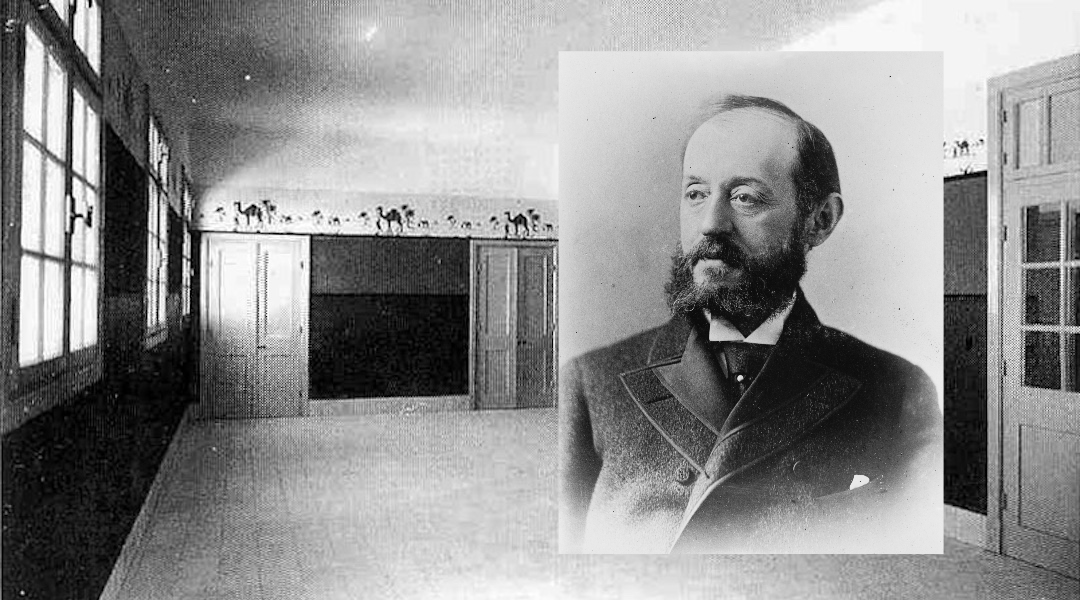
Nathan Straus, who helped build Macy’s into a retail empire in the 1890s, gave away his money the old-fashioned way, creating milk depots for sick babies in the slums of New York City and malaria treatments for all those living in pre-state Palestine.
With a strong Jewish upbringing, and a life haunted by tragedy, Straus (1848-1931) pioneered, along with other public health programs, a milk pasteurization program in New York City in the 1890s that he duplicated around the country and in Palestine. A Jew with power and a big heart, he was hailed by Jewish leaders of his generation, including Rabbi Stephen Wise and Henrietta Szold, founder of Hadassah.
His story is told comprehensively by Andrew Fisher in “Nathan Straus: From Macy’s Magnate to International Humanitarian,” the first full-length biographical treatment of his life.
“As a person who had substantial rather than titanic wealth,” recounted Fisher in a conversation with (JR), Straus “had been able to affect the health of whole populations in America and Palestine. He had an order of magnitude less wealth than John D. Rockefeller or Andrew Carnegie but was able to pull off really unusual philanthropic achievements.”
Fisher was drawn to the story not only because of Straus’ successful business career, but because of the businessman’s devotion to doing good, and his unbridled initiative in conceiving and developing previously unrealized social and health programs for which he had no specialized expertise.
Unlike Rockefeller or Carnegie, Nathan Straus began to give his money away early on and was devoted to several significant philanthropic initiatives as he continued to build his two major retail businesses.
Independent scholar Andrew Fisher has written the first comprehensive biography of Straus, who was credited with saving the lives of countless thousands of infants in New York City and beyond. (Rutgers University Press)
Raised in a German Jewish family in Georgia in the mid-19th century, Straus strongly identified as a Jew, and found his own religious expression in philanthropic endeavors that emerged from a generous family background. Taking a cue from his parents, said Fisher, “Nathan thought that it was incumbent upon the rich, by the laws of God and conscience, to give back. That was their duty.”
Nathan’s parents also believed in cultural outreach. As Fisher notes, “Nathan’s father was fluent in Hebrew and brought Protestant ministers in the home to talk about sections of the Torah over the family dinner table. Nathan was instilled with that.”
This world impulse enabled Nathan to stretch beyond the borders of his father’s small family business, to merge with R.H. Macy’s in the 1880s to form Macy’s Department Stores, and with Wechsler & Abraham to form Abraham & Straus in the 1890s.
“Nathan had a nonstop bubbling of new ideas and gave rocket fuel to the innovations in his family business,” said Fisher. And he carried this creativity and drive into his philanthropic endeavors as well.
But some of his philanthropic drive was also spurred on by tragedy. Between 1878 and 1893, Nathan and his beloved wife Lina lost three children to disease, at least one of whom was thought to have been infected by contaminated milk.
This prompted Straus to initiate a program to distribute pasteurized milk at low cost to poor families in New York City. At the time, tainted milk contributed to an unimaginable 25 percent mortality rate among infants under age one. Although the benefits of using mild heat to remove harmful bacteria was known in the West as early as 1864, the dairy industry and public health authorities were slow to make it a regular practice.
Straus’ first pasteurization plants and milk depots were established in 1893 and operated until 1919, by which time Straus pasteurization plants had been established in cities across the United States and in Europe.
Devoted to the Zionist cause in the 1920s when other German Jews were cool to the idea, Straus held the strong belief “that there absolutely had to be a safe refuge for Jews from throughout the world, who wanted to escape, autocratic and often antisemitic regimes, including those in Eastern Europe and Russia,” said Fisher. Straus extended his health initiatives to Palestine in the 1920s and 1930s, where malaria was a constant threat among both Jews and Arabs.
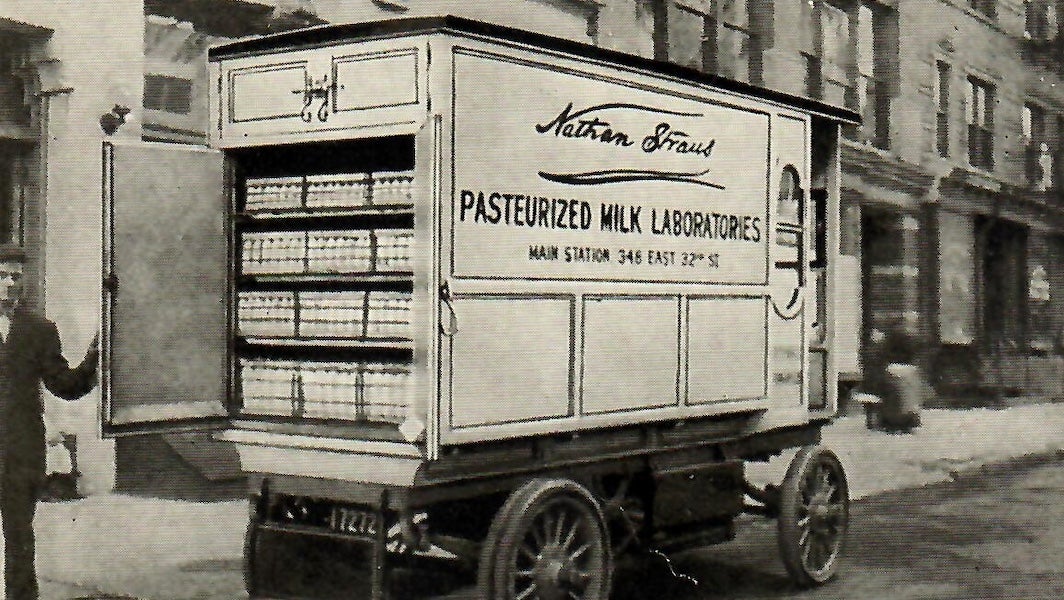
A motorized Straus milk delivery truck. (Lina Gutherz Straus, “Disease in Milk”)
Working with Szold, Straus established a health center in Jerusalem and was involved in funding soup kitchens and workrooms to employ unemployed Jews and Arabs. He also led an effort to bring electrification to Palestine.
Major Jewish figures of the early 20th century knew Straus well and applauded his generosity. Wise noted “his elemental passion to love, to help, to serve.” Szold applauded Straus’ watchwords “to have faith, and the rest will follow.”
When Straus died in New York in January 1931 at age 82, he was mourned by Palestine’s chief Ashkenazi rabbi, Abraham Isaac Kook. “With wounded soul and aching heart I express regret and sorrow at the departure of a knight among the benefactors of Israel and humanity, a treasure-store of mercy and kindness in whose name and tremendous deeds we find consolation,” Kook said in a message sent to the Jewish Telegraphic Agency.
Certainly, Straus’ faith in what was good, and what was possible, enabled him to innovate and to give in unexpected ways.
Straus’ example teaches us, said Fisher, that people of considerable wealth can find enormous meaning in helping the poor and the disenfranchised. Straus’ estimable talents at building Macy’s and Abraham & Straus demonstrated his great power for initiative and expansion.
His public health and social programs demonstrated what, for Straus, was a far more important quality than accumulating wealth: attention to what good could be done in the world and the vision and dedication to pull it off.
Reporting the stories that define our era. When history unfolds in real-time, the Jewish world turns to (JR). Your support ensures we can document the complexities of war and the resilience of Jewish communities with integrity.