
For decades after 1945, Austrians often emphasized their own victimhood under Nazi Germany.
Only in the 1980s and ‘90s did they formally and informally acknowledge the role of Austrians as perpetrators and supporters of Nazi crimes.
In 1998, at the peak of this reckoning, the Austrian Service Abroad program was established to provide young Austrians the chance to work with nonprofit organizations that preserve the memory of the Holocaust and its victims.
Young Austrians just out of high school can choose the program as an alternative to military service. They work in non-profits around the world for 10 months, 34 hours each week at no cost to the receiving organization.
“It has been a big boon to our work and allows us to greatly expand our Holocaust educational offerings,” said Olivia Mattis, the president and CEO of the Sousa Mendes Foundation, a Long Island-based nonprofit that perpetuates the memory of Holocaust rescuer Aristides de Sousa Mendes. The Portuguese diplomat issued visas to thousands of refugees fleeing Nazi-occupied France.
“There are things we can now do having this extra hand that we were not able to do before,” said Mattis, whose father was rescued by Sousa Mendes.
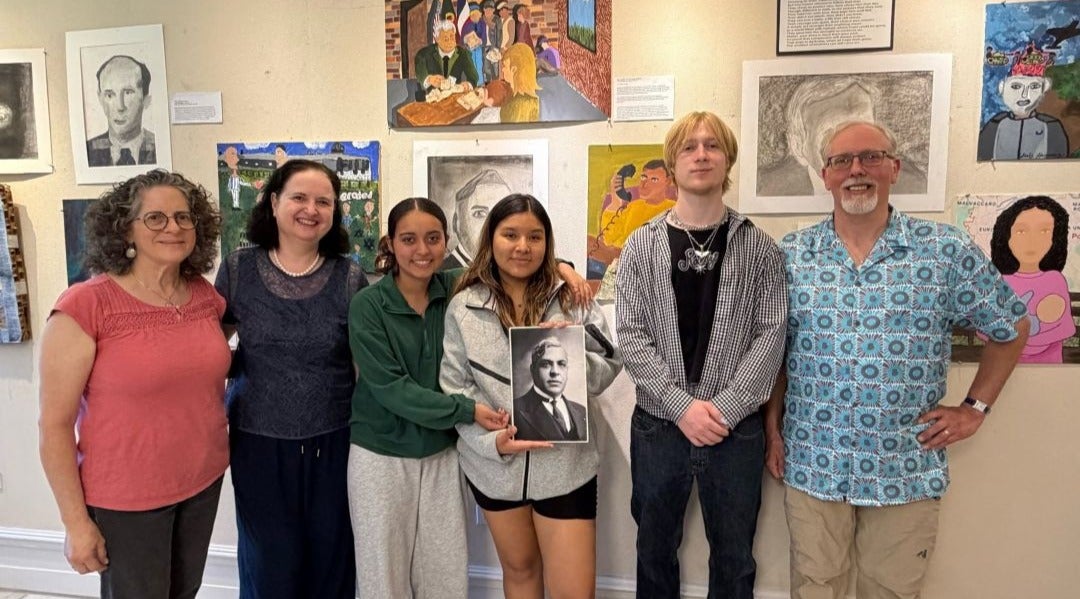
This year the foundation, which has been part of the program 2022, has welcomed Robin Bigga-Piskernig, 19, as its fifth Austrian participant.
Bigga-Piskernig said he views the program as a way for Austria to “make amends” for its actions during World War II. He’s available for whatever the foundation needs, which includes the production of various educational materials.
“We just now finished new translations for a graphic novel that’s going to be published in an English version as well as French and German,” said Bigga-Piskernig. “Right now there’s a project that involves old passports from the 1940s and an upcoming program about Freud and how he was saved during the Holocaust.”
Jean Lou Cloos, managing director of Austrian Service Abroad, said in an email interview that there is a direct connection between the program and the country’s belated efforts to come to terms with its past.
The program “grew out of Austria’s long and difficult process of confronting National Socialism and the Holocaust,” Cloos said. “For decades after 1945, Austria often emphasized its own victimhood under Nazi Germany. Later, public and political debate became clearer about the fact that Austrians had also been perpetrators, supporters and beneficiaries of Nazi crimes.”
Some 1,323 Austrians 17 and older have taken part in the program since its founding, 85% of them men. Austrians in the program are now in 66 countries, including Germany and Italy.
“Our volunteers work in Holocaust memorials, Jewish museums, archives, research institutions, survivor-related organizations and educational institutions,” he said. “Volunteers serve where memory is preserved, researched and passed on, whether that is Auschwitz, Yad Vashem, a Jewish museum in Europe, or a Holocaust education center in the United States.”
The participants bring a perspective to Holocaust education that is useful in reaching young people like them. As a result of the work of Bigga-Piskernig and his predecessors, Mattis said her organization since 2024 has had an active Instagram account that enables it to post its “hero of the week,” a rescuer during the Holocaust.
Recently it highlighted Michael Ber Weissmandl, an Orthodox rabbi from present-day Solovakia, who helped Jews escape deportation by bribing Nazis and their local collaborators. “He wrote desperate letters through Switzerland to Allied powers asking that they bomb the gas chambers and the train tracks — and of course that never happened,” said Mattis.
Ber Weissmandl is also featured in a set of 52 poker-sized playing cards, each containing a photo of a Holocaust rescue, created and printed by the Sousa Mendes Foundation. The cards would not have been possible without the effort of the Austrian service workers.
“They researched the background of each of the rescuers,” she said.
The Austrian interns were also “absolutely integral” to the foundation in creating graphic novels that tell the story of Sousa Mendes and the families he saved. “We want to get them into bar mitzvah training programs,” said Mattis.
Workers plant an Anne Frank Sapling on the grounds of the Museu Aristides de Sousa Mendes in Cabanas de Viriato, Portugal. The dedication of the tree will take place on July 9, 2026, as part of the foundation’s Educators’ Institute in Portugal. (Courtesy Sousa Mendes Foundation)
In addition, the foundation helps to produce Sunday film-and-discussion programs on stories of rescue and resistance. It also developed a children’s picture book about Sousa Mendes and his work, and another about Anne Frank and the Anne Frank Sapling Project.
“When she was in hiding with her family from the Nazis in a secret annex in Amsterdam,” Mattis said, “there was only one piece of nature outside that she could see. It was a tree and watching it was how she could mark the change of seasons. It lived to age 170, dying in 2010. At that point, the Anne Frank House in Amsterdam took saplings from that tree and sent them to sites of remembrance so the Anne Frank story could travel all over the world.”
One of these trees is to be planted at the Sousa Mendes Museum in Portugal and dedicated in July. The foundations invited 20 teachers to the dedication.
“The reason we were so anxious to get this tree is because Anne Frank had a cousin, Jean-Michel Frank, the first cousin of Anne’s father, Otto Frank, and he got his visa from our hero, Sousa Mendes. So we are combining both Anne Frank and Sousa Mendes through this tree.”
Asked about his experience in Austrian Service Abroad, Bigga-Piskernig said his work and the education he has received at the Sousa Mendes Foundation “has helped me better understand the Holocaust and the role of education in helping to reduce antisemitism.”
Jewish stories matter, and so does your support. The New York Jewish Week brings you the stories behind the headlines, keeping you connected to Jewish life in New York. Help sustain the reporting you trust by donating today.