

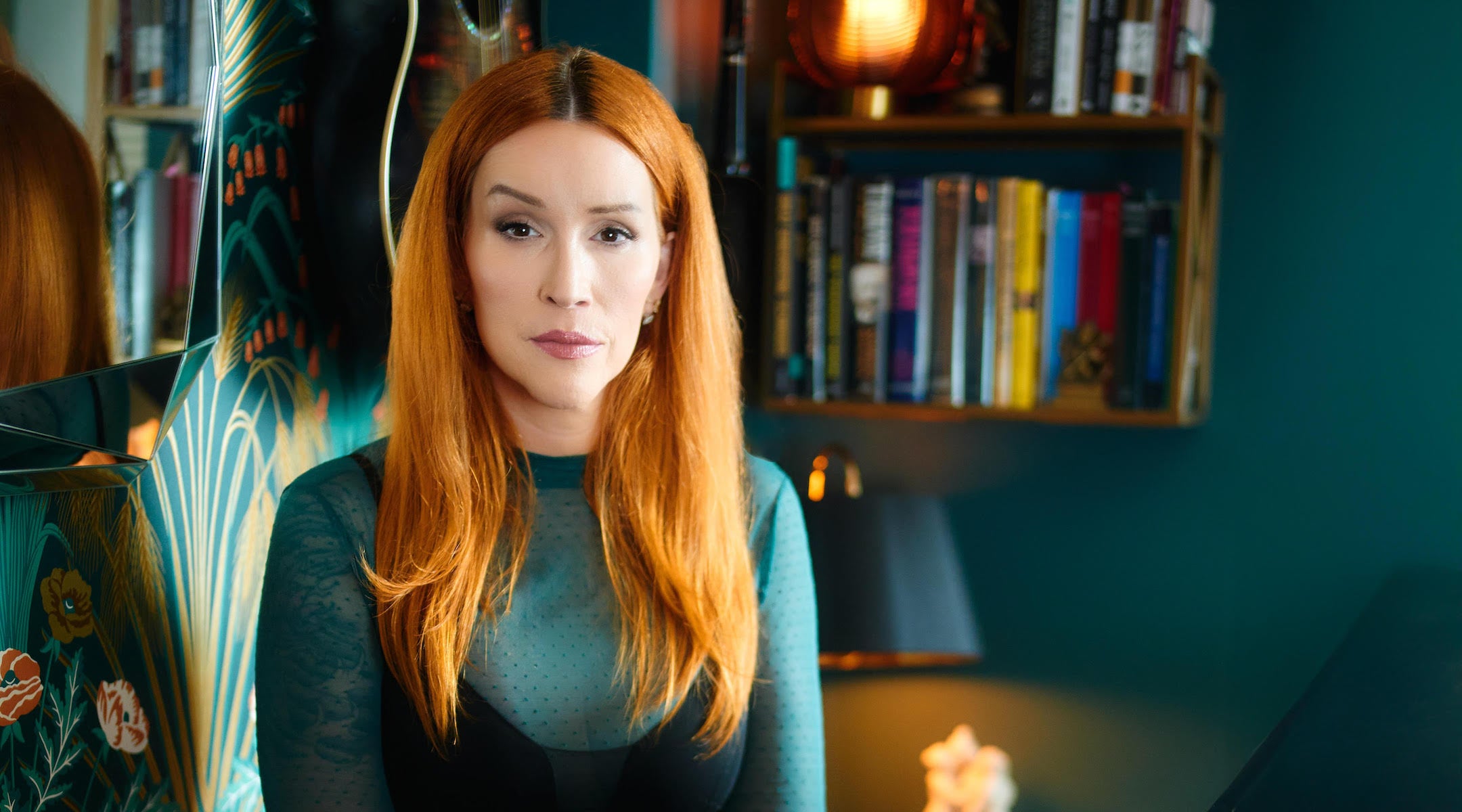
Hours after emerging from a ritual bath marking her conversion to Judaism, Yona Speidel was leaving a celebratory dinner with her rabbi when a man across the street yelled “f–ck Jews.”
For Speidel, it was an unexpected welcome into the Jewish community.
“My rabbi looked at me and he goes, ‘Welcome,’” Speidel recalled. “And I was like, ‘Oh, great, I’m home.”
The conversion ceremony in Los Angeles in March marked the conclusion of a decade-long exploration of Judaism for Speidel, the prominent transgender Emmy-nominated television writer and producer formerly known as Our Lady J.
“Over a period of 12 years of casually dating Judaism, I eventually got engaged when I realized that Judaism holds so much space for all of me, and then some,” Speidel said.
Growing up in Central Southern Pennsylvania, where two of her great-grandparents had been Mennonites, Speidel said that she had little exposure to Jews. Still, she felt a pull toward Jewish culture from an early age.
“I don’t remember when I first became aware of Judaism as a culture,” Speidel said. “But I knew I loved New York City. Many years later, I look back, and I’m like, ‘Oh, I love Jews, I love Jewish culture, that’s what drew me to New York.’”
Speidel is believed to have become the first out trans writer to be hired in a television writers’ room when she joined the hit TV show “Transparent,” which follows the story of a Jewish family in Los Angeles with a parent who comes out as trans.
During the show’s third season, as she became immersed in researching Judaism for the show, Speidel said she began taking conversion classes but then put them on pause because she “wasn’t sure if there was space for me in Judaism.”
That all changed during the COVID-19 pandemic, when Speidel said she began opening up to faith and spirituality after becoming “burnt out” by her work on “Transparent” and another hit LGBTQ TV show, “Pose.”
“As the world got more complicated and darker and scarier for a lot of people, and especially for Jews, I found that Judaism was able to hold everything for me that I needed to pour out, to release,” Speidel said.
Speidel, who learned as an adult that she is intersex, said that at the time she discovered Isaiah 56, a passage of the Hebrew Bible that promises a place for eunuchs in the Temple.
She said discovering the passage left her feeling that her “intersex and trans identity feels really seen and awakened.”
“It was not only that I was accepted as, you know, this idea of tolerated, but rather I could see a part of me that would be uplifted, actually, and be embraced, and that’s always been in Judaism,” Speidel said.
In late 2024, Speidel began taking conversion classes again at the American Jewish University, saying that rising antisemitism had strengthened her commitment to Judaism.
“In a post-Oct. 7 world, I felt, even though I wasn’t officially Jewish at that point, I felt how much Judaism meant to me — and how much it informed my life and enriched my life — was under threat, and so it made me want to step up and be more conscious in my relationship with Judaism,” Speidel said.
Speidel is not the only person to embrace Judaism amid rising antisemitism. In recent years, some rabbis have reported increased interest in conversion, with prospective converts saying the post Oct. 7 environment strengthened rather than diminished their commitment to Judaism.
In the midst of her conversion, which she completed with Rabbi Igael Gurin-Malous, the lead rabbi at the Reform Beit T’Shuvah in Los Angeles, Speidel also took aim at what she described as anti-Zionism within the LGBTQ community in a social media post.
“Zionism is not a dirty word,” she wrote. “It is the belief in Israel’s right to exist as a Jewish state.”
Speidel faced a spate of online attacks following the statement, but she said she felt obligated to be the “bridge” between the Jewish and LGBTQ communities.
“I think that word ‘Zionist’ means a lot of different things to a lot of people, and so people ran with it and did what they wanted to do with it, and that did not feel good, but at the same time I was grateful for the people who got closer to me and understood my intentions,” Speidel said.
While Pride Month celebrations and parades took place in cities across the United States during June, Speidel said that she had not participated in them in years because of the antisemitism she had seen in those spaces.
“The LGBT movement needs to really look at itself in the mirror and say no to antisemitism, you know, before I come back and dance under the rainbow again,” Speidel said.
Looking ahead, Speidel said she remains optimistic about the future of Jewish life despite present challenges.
“A storm is here, and the storm is going to pass,” Speidel said. “But at the end of the day, we carry this incredible legacy with us, and we get to pass it down, and it’s something to be proud of.”
Reporting the stories that define our era. When history unfolds in real-time, the Jewish world turns to (JR). Your support ensures we can document the complexities of war and the resilience of Jewish communities with integrity.


