
In the midst of the Holocaust, a child sang a song about his mother’s death in the Bershad ghetto, a pocket of current-day Ukraine that was occupied by Romania and Nazi Germany. In the song, the child watches strangers come and pray for his mother, and other strangers carry her away to be buried, but none pay attention to him.
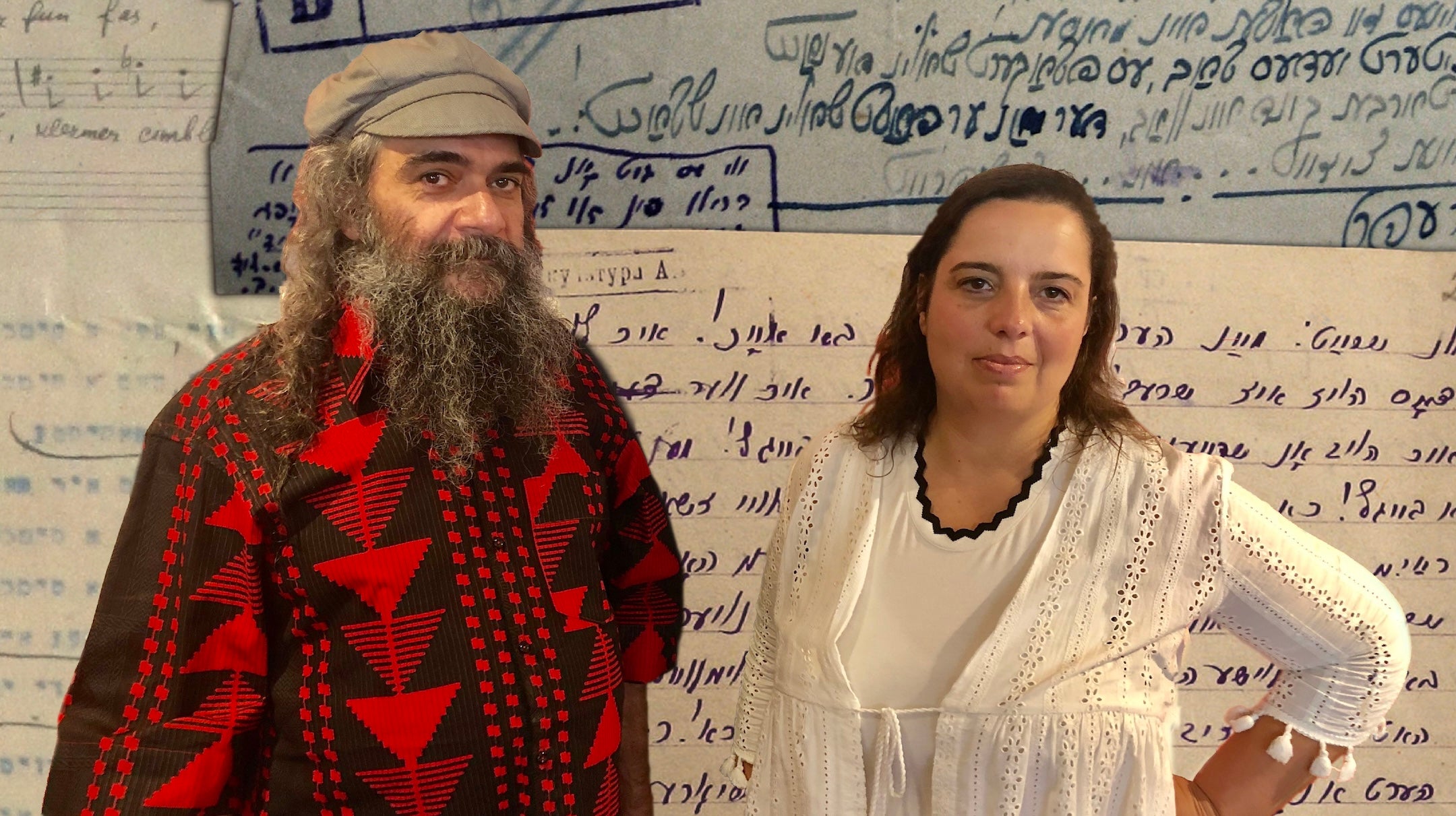
This story was discovered in a trove of 263 songs collected by Moisei Beregovsky, a Soviet Jewish ethnomusicologist who recorded Yiddish music from Jews in Ukraine just after they were liberated from the Romanian occupation in 1944.
The music rescued from the Holocaust was nearly lost in Joseph Stalin’s crackdown on Yiddish culture. Beregovsky was arrested in the Soviet Union in 1950, accused of “Jewish nationalism” and sent to a gulag for six years. The music was confiscated, and Beregovsky died in 1961. Only in the 1990s did librarians discover his collection in the basement of Ukraine’s Vernadsky National Library in Kyiv.
Now, the song about a mother’s death is one of 15 in “Yiddish Glory: The Silenced Songs of World War II,” an album released in April by Six Degrees Records. It was compiled by Anna Shternshis, a professor of Yiddish and Jewish studies at the University of Toronto, together with 17 musicians.
Shternshis took the album on tour in May to perform concerts across Asia, with stops in Seoul, Shanghai, Hong Kong and Beijing. The music project is complemented by a new book she published in June, “Postwar Life, Hopes, and Fears,” the latest in a series about the history of Soviet Jews published by New York University Press.
At first, Shternshis believed the song now titled “Dear Mama” gave an account of daily life in the Bershad ghetto, where more than 8,000 people died of hunger and disease. But the more she patched together testimonies and memoirs, the more she recognized a series of untruths.
Funerals were scarcely allowed in occupied Bershad, and public prayers for the dead were virtually impossible, said Shternshis. She realized that this song was fiction — an imagination of a dignified death.
“One of the biggest traumas that people had in the Bershad ghetto was that no one would notice the death,” Shternshis told the Jewish Telegraphic Agency. “So the song that did talk about the lack of empathy, but also talked about the funeral, was actually a fantasy that all these things would happen — a prayer, a grave.”
This is Shternshis’ second “Yiddish Glory” album aiming to resurrect music from witnesses of the Holocaust in the Soviet Union. Her first album in 2018, titled “Yiddish Glory: The Lost Songs of World War II,” was nominated for a Grammy.
That project was the first she reaped from the discovery of Beregovsky’s documents, and it focused largely on songs collected from Russian soldiers who fought against the Nazis. The “Silenced Songs” album centers almost entirely on Jews who lived in the ghettos and concentration camps of Ukraine’s Vinnytsia region, which was occupied by Romania and Nazi Germany from 1941 to 1944.
Shternshis wanted to trace the footsteps of Beregovsky, who was himself a survivor of the Holocaust. After Germany invaded the Soviet Union in 1941, Beregovsky and other academics from the Ukrainian Academy of Sciences were evacuated to the eastern republic of Bashkir. He returned to Ukraine in 1944 with a group of scholars, including linguists and folklorists, seeking to record music from survivors.
Beregovsky hoped to publish this music. Because of that, he and his editors likely tailored the words to make them acceptable to the Soviet regime after World War II, said Shternshis. That meant removing explicit references to Jewish despair, which could contradict the Soviet narrative of total victory.
Any such alterations were not sufficient. When Beregovsky was arrested, his interrogators accused him of promoting “Jewish nationalism” by coaching his subjects to speak about their experiences as Jews. He never saw his musical documents returned, and he believed they were destroyed.
“This is why we called this album ‘The Silenced Songs of World War II,’” said Shternshis. “Because those words kept being silenced, first by self-censorship, then by scholars and editors who tried to preserve it, and then by Stalin’s government.”
Her goal was to present not just eyewitness accounts of the Holocaust, but also partial truths and untruths, like the fantasy of a mother surrounded by prayers in the Bershad ghetto. The result was a patchwork of stories that mattered to people living through extreme violence, death and censorship.
Pavel Lion, a Russian literature scholar better known by his stage name Psoy Korolenko, played a key role as a singer-songwriter on both “Yiddish Glory” albums. Kolorenko grew up in a secular Jewish family in Russia during the Soviet era. Yiddish was not spoken in his home, other than a few words from his grandmother, but he became deeply interested in Yiddish music as a young adult.
Psoy Korolenko sings during a recording session for Yiddish Glory. (Dan Rosenberg)
The more Korolenko studied klezmer music, the more he discovered a “latent, indirect, unconscious Jewish heritage,” he said. Although the Soviet Union repressed many forms of Jewish culture and communal life, Korolenko said he gradually became aware of how Jewish history marked popular music during his childhood in the 1970s.
“Many composers in the Soviet Union were influenced by Yiddish popular folk and theater songs, sometimes directly, because many of them in that generation were actually Jewish,” said Korolenko.
He added that broader trends in popular music during the Soviet era embraced folk genres.
“The entire spectrum of post-imperial music included peasant songs, Romani gypsy songs, street songs — and one of the important trends, klezmer folk and theater songs in Yiddish,” said Korolenko. “These were trends that came from the periphery to the center in the Soviet Union.”
While Shternshis extracted a growing body of songs with sheet music from Beregovsky’s archive, she found other documents with lyrics alone. Korolenko wrote melodies for these songs from scratch, drawing on his knowledge of Yiddish, Soviet and 19th-century Russian music traditions.
Shternshis and Korolenko traveled together to perform the “Yiddish Glory” songs in Asia. Most of their audiences were hearing Yiddish music for the first time, translated through subtitles.
Sealing Cheng, a professor at the Chinese University of Hong Kong who researches migration, forced displacement and gender, hosted the pair for a concert that drew about 80 attendees. Cheng said much of the audience knew little about the history of Soviet Jews and the daily experiences of Holocaust victims. Many learned about the period through their regional history: Hong Kong was occupied during World War II by Japan, which allied with Nazi Germany to expand its empire and committed atrocities in Asia.
“I don’t think we have a lot of discussion of what World War II was like outside of the Japanese colonial context,” said Cheng.
Another Yiddish Glory concert took place at the Holocaust Museum of Korea in Paju, located near the demilitarized zone that separates North and South Korea. Shternshis said the audience there raised comparisons with their own history, including “topics of separation, longing, the impossibility of returning home, and also communism versus non-communism dividing families.”
At the Museum of Jewish Refugees in Shanghai, listeners asked questions about censorship and the subversiveness of music.
“They were asking what it takes for a folk song to become a dangerous artistic production, what kind of folk song could lead to imprisonment,” said Shternshis. “People were very interested in what is in between the lines of these songs. They are praising Stalin, they are praising the Soviet regime, they are condemning Hitler, but they’re also saying other things that they cannot fully say in the Soviet context — we got a lot of questions about that.”
Shternshis hopes to continue broadcasting the silenced voices of “Yiddish Glory” to listeners around the world. But there is one place in particular where she dreams of transporting their music.
“The only country where we haven’t presented it yet, and where I really want to go one day, is Ukraine,” said Shternshis. “Once that war is over, once peace comes back to that land, it would be so important to me, and to Psoy and to other musicians, to just go there and perform this program.”
Reporting the stories that define our era. When history unfolds in real-time, the Jewish world turns to JR. Your support ensures we can document the complexities of war and the resilience of Jewish communities with integrity.