
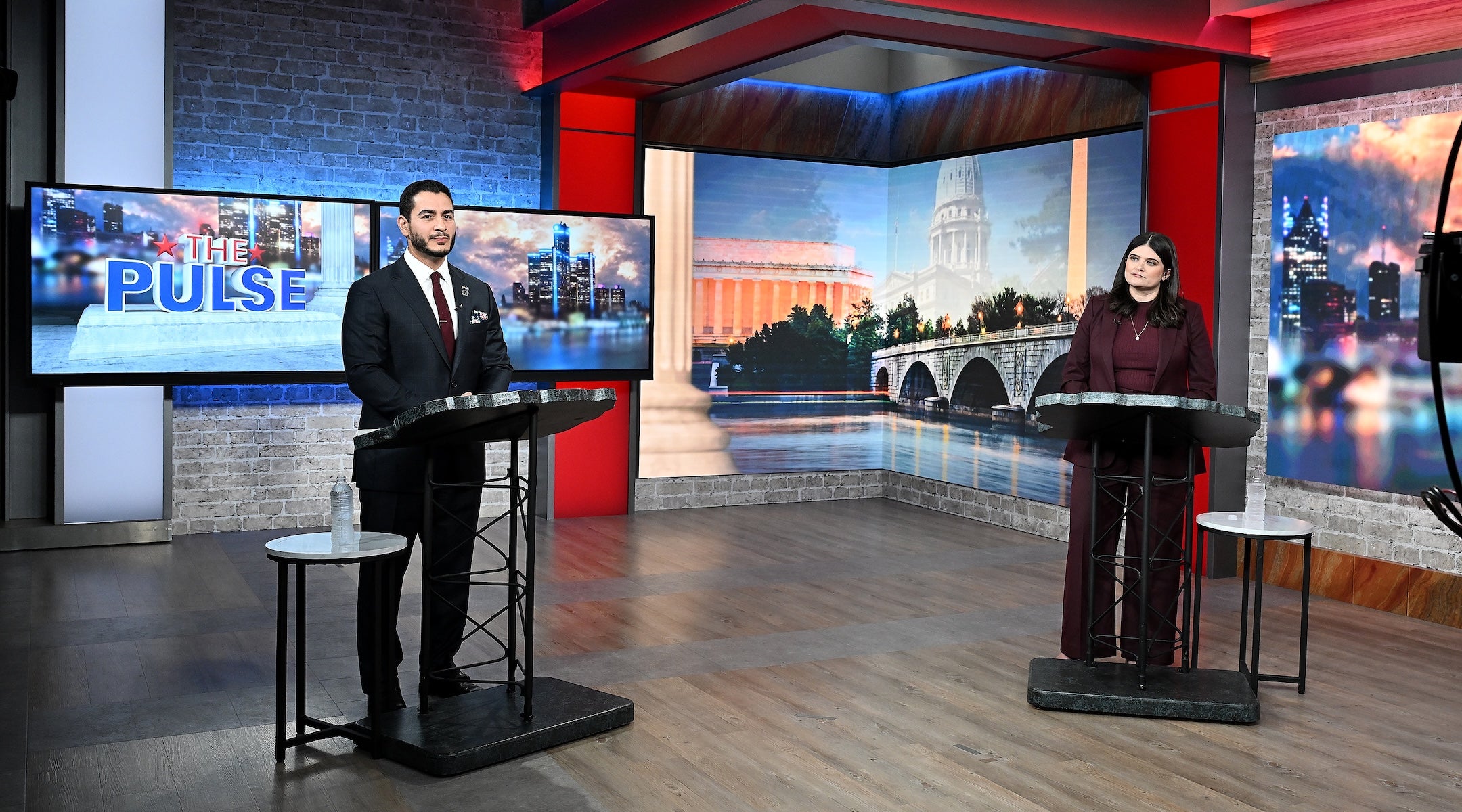
SOUTHFIELD – The two figures standing on the suburban Detroit debate stage vying for the right to battle for Michigan on Capitol Hill were U.S. Rep. Haley Stevens and former county health official Abdul El-Sayed.
But the dominant topic Monday night wasn’t either of them: it was AIPAC.
In Michigan’s closely watched Democratic Senate primary, the pro-Israel lobby group’s spending for Stevens has smashed its previous records — a fact that has come to loom over nearly every aspect of a swing-state race where rhetoric on Israel has torn the party apart ahead of the Aug. 4 primary.
During the final debate, Stevens repeatedly dodged questions from both El-Sayed and the debate moderator about the specifics of her relationship to AIPAC.
“I have been very clear, consistent and transparent, and I have continued to be,” Stevens said after being pressed a second time about AIPAC’s spending. She then pivoted to praising the large suburban Detroit Jewish community in her congressional district.
“I am deeply proud to represent one of the largest Jewish populations in a congressional district in the country,” she said. “This is a community that I grieve alongside, that I have mourned alongside, and have fought to bring the hostages home. And I’m still looking to get us to long-term peace.”
Asked again by the moderator, Roop Raj, the Detroit Fox 2 evening news anchor, whether AIPAC’s spending would result in her “doing their bidding,” Stevens retorted, “I don’t think there’s much difference between super PACs going in for Abdul and super PACs going in for me.”
Abdul El-Sayed speaks during the U.S. Senate debate with U.S. Rep. Haley Stevens moderated by Roop Raj from Fox 2 on July 27, 2026 at Fox 2 Studios in Southfield, Mich. (Robin Buckson/Pool photo)
El-Sayed, who has made AIPAC’s support of Stevens a cornerstone of his attacks on the campaign trail, continued the theme during the debate.
“They’ve set a record in this race to help elect my opponent because they know that she’ll be a reliable vote,” El-Sayed said. He alluded to her vote against a recent U.S. House amendment to strip U.S. military and other aid to Israel that more than 100 Democrats had supported.
El-Sayed said his opponent has voted “to send your tax dollars to a foreign government that is aiding, arming and abetting the very people who want to foreclose on the possibility of Palestinian self-determination.”
Criticizing some of AIPAC’s ads, including one linking Stevens to former President Barack Obama, who has not made an endorsement in the race, El-Sayed said, “That’s exactly what happens when you stand up and say, ‘Maybe Palestinians should have rights, too.’”

Supporters of U.S. Rep. Haley Stevens rally outside the Detroit-area TV studio where she is participating in her final debate with Abdul El-Sayed before the Michigan U.S. Senate Democratic primary, Southfield, Michigan, July 27, 2026. (Andrew Lapin/(JEWISH REVIEW))
Sources of money were a central topic of the debate even beyond AIPAC. Stevens also came under fire for erroneously claiming she hasn’t accepted funding from a local power utility, while she went after El-Sayed for delaying the release of his tax returns and repeatedly called him a “millionaire.”
But the repeated invoking of the pro-Israel group was a symbol of how toxic the lobbyist’s brand has become to the Democratic electorate in certain races, a shift that has alarmed some Jewish leaders who see darker messaging behind the trend.
It was also a sign of how much of a liability AIPAC’s spending has become to Stevens’ campaign, which many of the state’s Jews view as existential for their communal safety.

U.S. Rep. Haley Stevens speaks during the U.S. Senate debate with Abdul El-Sayed moderated by Roop Raj from Fox 2 on July 27, 2026 at Fox 2 Studios in Southfield, Mich. (Robin Buckson/Pool photo)
Both El-Sayed and Raj repeatedly stated that AIPAC and its affiliates have spent as much as $46 million on Stevens’ behalf — a figure the Jewish Telegraphic Agency could not independently verify. Recent, week-old figures from independent political ad trackers have estimated the figure at closer to $30 million, which would still mark AIPAC’s largest-ever spending in a single campaign. An AIPAC representative did not immediately return a request for comment.
While insisting during the debate that he has “never touched a dime of corporate PAC money,” El-Sayed has received contributions from super PACs — in his case, groups that share a pro-Palestinian agenda.
Those include Fighting for Michigan PAC, which has spent around $2 million on the race, and which Stevens dinged during the debate for being partially funded by El-Sayed’s father-in-law. American Priorities PAC, another pro-Palestinian super PAC, has also spent for him, though its totals have been dwarfed by AIPAC’s spending for Stevens.
Asked by (JEWISH REVIEW) about these super PACs in the spin room after the debate, El-Sayed said they were not “corporate money” and that he, as with all candidates for public office, is legally prohibited from coordinating with super PACs. He added, “Let’s just talk a little about scale here. How much are we being outspent? Twelve to one.”
Stevens offered a slightly more direct answer in the spin room when (JEWISH REVIEW) asked her if she regretted how much AIPAC had spent on her behalf.
“I’m proud of my record,” she said, listing various Democratic leaders who have endorsed her.
“I have no regrets fighting for the people of Michigan,” she concluded, “and standing by my values as I do it.”
Reporting the stories that define our era. When history unfolds in real-time, the Jewish world turns to (JEWISH REVIEW). Your support ensures we can document the complexities of war and the resilience of Jewish communities with integrity.