
Even a powerful Nor’easter couldn’t stop the crowds from showing up at the North American premiere of the controversial Israeli documentary “NAZA” on Saturday afternoon.
The two weekend screenings scheduled at Lincoln Center as part of the New York Film Festival sold out in minutes. Dozens of people waited in a box office standby line that stretched around the corner despite the blustery conditions, while at least one local politician scored a ticket: Brad Lander, the Jewish progressive and Democratic nominee for New York’s 10th Congressional District.
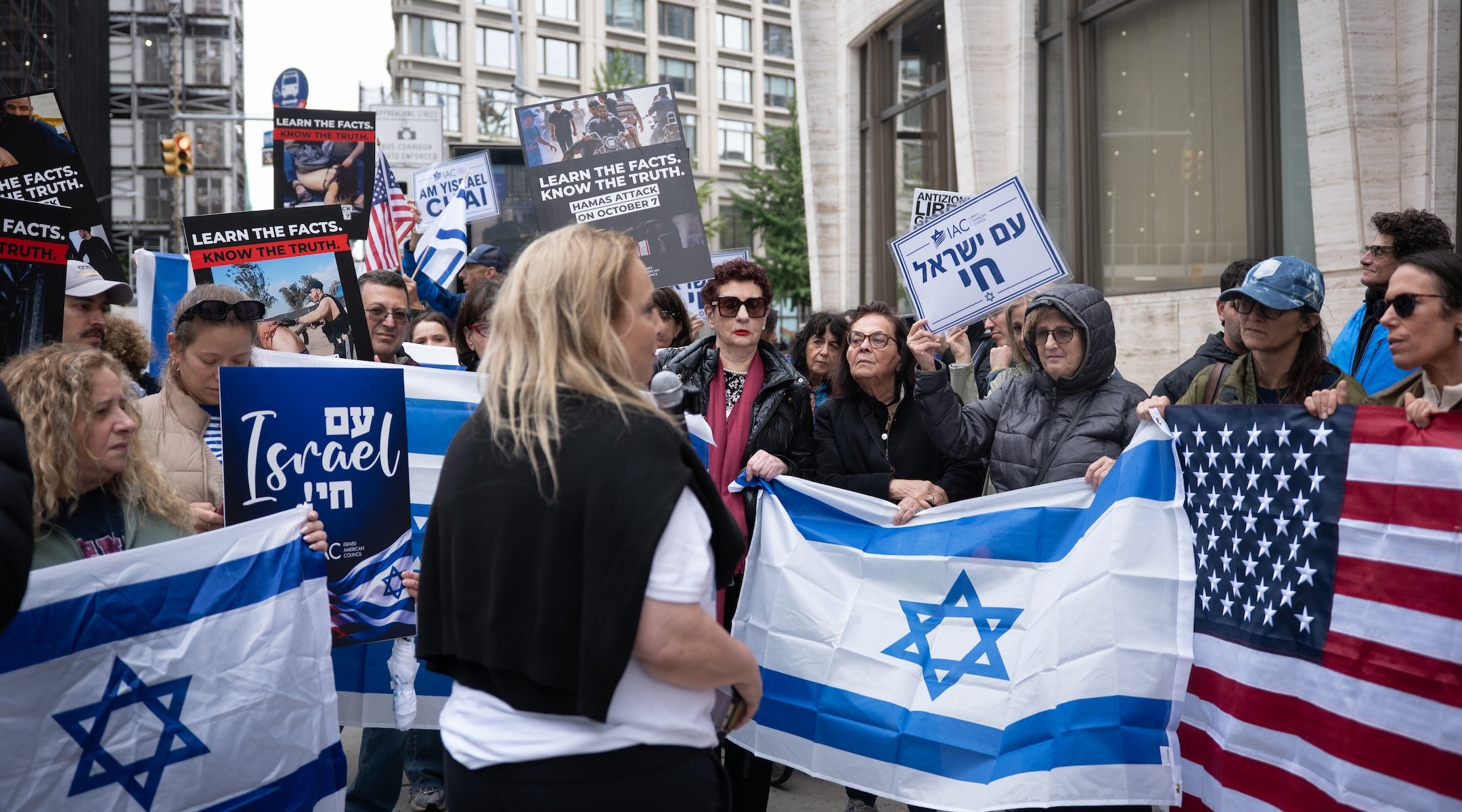
Meanwhile, two groups of Israeli-Americans showed up on Saturday with no intention of going inside the theater: one demonstrating in solidarity with the filmmakers, and a larger group across the street that denounced the film as they waved Israeli flags.
The documentary, which was produced by The Guardian and alleges that Israeli forces knowingly killed large numbers of civilians in Gaza, has received early acclaim, winning the Special Jury Prize at the Venice Film Festival earlier this month. It will be made available for free on The Guardian’s website later this fall.
John Kwiatkowski, senior manager of publicity and communications for Film at Lincoln Center, told the Jewish Telegraphic Agency that “NAZA sold out almost immediately.”
But “NAZA,” whose name is the Hebrew acronym for “collateral damage,” has also roiled a number of Israeli officials and the country’s military. The Israel Defense Forces issued a public rebuttal after the film’s reception in Venice, with the IDF chief of staff calling the film a “deliberate distortion of reality.”
The Israeli filmmakers, Yuval Abraham and Rachel Szor, have faced intense backlash at home. Israel’s culture minister threatened to strip them of their citizenship and protesters accused the duo of treason in a demonstration outside Szor’s parents’ home.
Roni Tamari, who organized the rally supporting the filmmakers on Saturday, called the Israeli reaction “out of proportion.”
David Lawson, a Jewish Queens resident who had purchased a ticket for the Saturday premiere, told (JR) that he’d appreciated Abraham and Szor’s previous film, “No Other Land,” which focused on settler violence in the West Bank community of Masafer Yatta.
Minutes before the screening’s slated start time, Lawson said that he was “very excited” to see “NAZA,” not just for what it will say “about Israel, but also just about the alarming use of AI in warfare in general.”
Lawson said he likes “to hope that the tide is shifting on acceptance of Zionism in the United States,” and that support for “NAZA” was an example of that shift. He also said he was “expecting” to see protesters who disagreed with the film. “Pathetic,” another person in line chimed in, describing the demonstration.
They were referring to the protest organized by the Israeli-American Council, which drew dozens of critics of the film who believe it omits the context of Hamas’ Oct. 7, 2023, attack in its depiction of the IDF’s military campaign in Gaza. Speakers included IAC’s chief communities officer Noa Peri-Jensch and a pair of survivors of the Nova music festival that Hamas attacked.
A fleet of four black trucks circled the area with LED screens that displayed images of Hamas’ Oct. 7 attack along with various messages. “Movies have editors. History does not,” one message read. The trucks were commissioned by the IAC.
“We mourn every innocent life lost in this war, Israeli or Palestinian,” Peri-Jensch said during the rally. “But compassion for Palestinian civilians does not require [us] to erase Oct. 7, ignore Hamas or accept one narrative without questioning it.”
Peri-Jensch was not calling for the film’s screenings to be canceled, she said in an interview, but rather for them to be paired “with context” at festivals, like panels featuring Oct. 7 survivors.
Asked about Israeli officials’ threats toward the filmmakers and the demonstrators calling them traitors, Peri-Jensch said she “cannot comment on what people in Israel do, I can only comment here,” adding that viewers “deserve to know the full scope.”
Prime Minister Benjamin Netanyahu backed legislation last week that would strip the Israeli filmmakers of their citizenship, while the Israeli army has weighed taking legal action against them.
Protesters gathered outside Szor’s parents’ home multiple nights in a row last week calling on authorities to “expel the traitors.” One speaker called for Abraham and Szor to be executed while the crowd chanted, “Execute the traitors.” Participants in the right-wing protest included activists and campaign staff from National Security Minister Itamar Ben-Gvir’s far-right party, according to Haaretz.
On Saturday, Nova massacre survivor Rom El-Hai himself referred to the filmmakers as “traitors,” and said that there have been “liars” like Abraham and Szor within the Jewish community since the Bible and during the Holocaust.
In an interview following his remarks, El-Hai said it isn’t his job to say how exactly Abraham and Szor should be dealt with in Israeli society, but that they “should be punished” and that they cannot “live their life in Israel like nothing happened.”
“People need to understand there is a price for what they’re doing,” he said.
Near the standby line running along the sidewalk of Broadway, about a dozen demonstrators who are involved with the group Israelis for Peace held signs reading, “We stand by the countless victims in Gaza and Rachel & Yuval for speaking truth to power.”
Tamari, one of the organizers, said she felt it was “actually very disrespectful” for images of wounded and killed Oct. 7 victims to be shown in public.
Moshe Kayam, an Israeli-American who demonstrated in solidarity with the “NAZA” filmmakers on Saturday, said IAC’s rally was “doing a disservice” because the Oct. 7 attacks were indeed “horrendous,” but “did not justify the mass killing” of civilians in Gaza.
“We want the truth to come out,” Kayam said of the film. “We want everyone to see what really happened there, and the damage that it caused to Gaza, to Israel’s image and to us as Israelis.”
Jewish stories matter. As the new year begins, so does another year of covering the people, stories, and institutions that make Jewish life in New York what it is. Help sustain the reporting you trust by donating today.