
Reporting on the Jewish community is a lot like ornithology, except instead of birds the goal is to describe the dress, the habits and the particular behavior that distinguish, say, the Black-Hatted Monsey Orthodox from the Greater Philadelphia Jewish Renewalist. The careful shul-watcher notes their habitats, listens carefully to their songs and pays close attention to the things they eat.
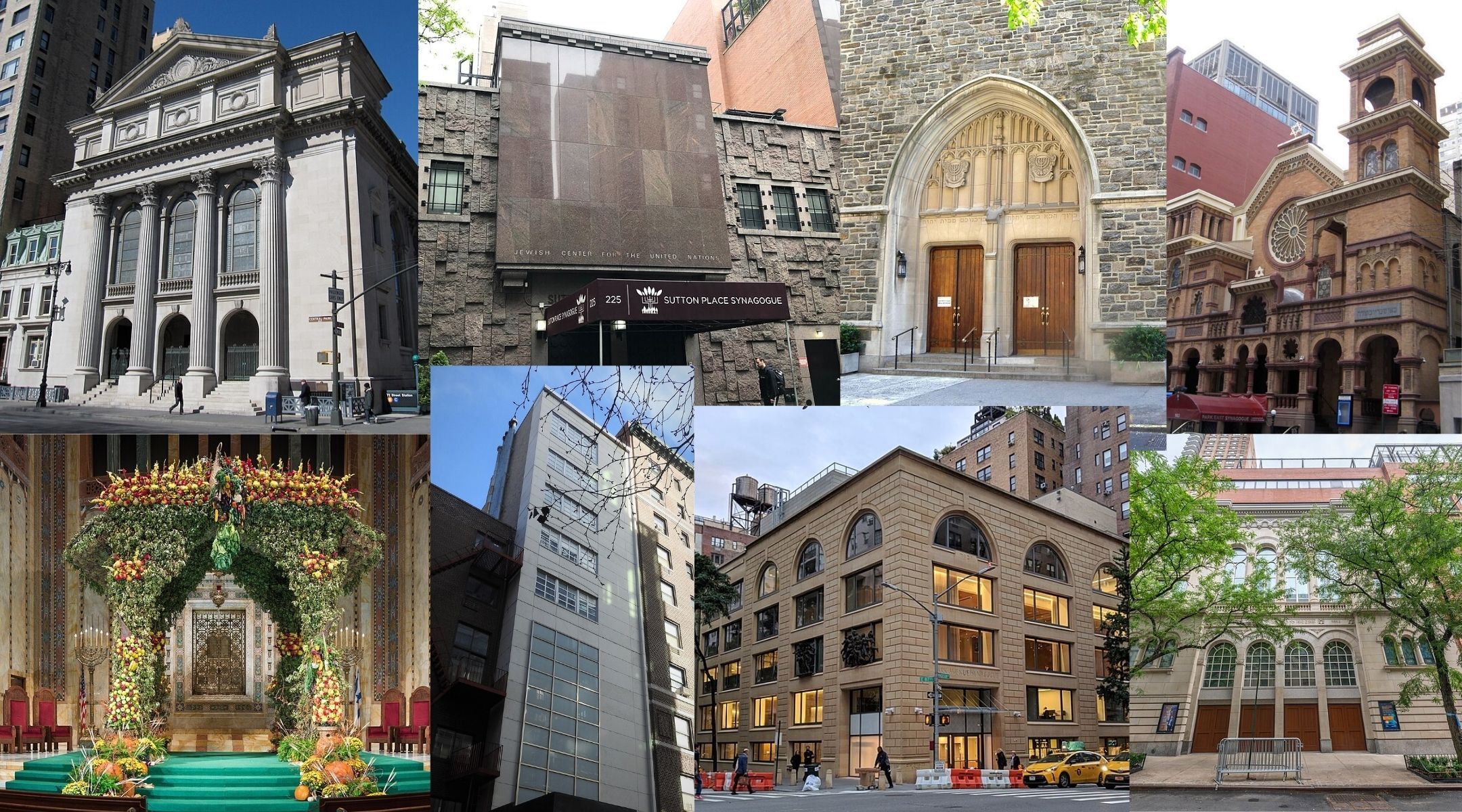
Andrew Waxman is a banking and risk management consultant, not a journalist or an ornithologist. Yet he’s written what amounts to a field guide to the varieties of being and praying Jewish in New York City. For “My Year in New York Synagogues,” he spent his Friday evenings and Shabbat mornings in 2025 visiting nearly every synagogue within walking distance of his home on the Upper West Side.
That’s close to 50 synagogues, including most of Manhattan’s significant congregations. He also includes a few unclassifiable communities, such as a Jewish runners’ club and meetings of the Hostages Forum in Central Park.
The result is part sociological field trip to New York City’s Jewish landscape and part love letter to the city’s Jewish variety: Ashkenazi, Sephardic, Moroccan, LGBTQ, Modern Orthodox, haredi Orthodox, Conservative, Reform, Reconstructionist and independent, to name a few.
Written at a time when the city’s Jews are on edge, buffeted by waves of antisemitism and anti-Zionism, Waxman wants to remind them that the community’s diversity and creativity are its strength.
“The impetus for the book really was just the awe in which I find myself around the number of amazing communities, and the diversity that we have in New York that I really think is unparalleled in Jewish history,” he said in an interview.
His stops include familiar places like Central Synagogue, where Rabbi Angela Buchdahl’s Asian-American background, a talented musical ensemble and distinct Moorish Revival architecture helped Waxman, who describes himself as liberal Orthodox, see a “community very comfortable in its approach to spirituality and Judaism, forging its own path, authentic in its own way, distinctive even amongst all the differences that characterize so many New York communities.”
At Or Zarua, the egalitarian Conservative synagogue on the Upper East Side, the intimate scale allowed a lively back-and-forth between rabbi and congregants during the Torah reading.
Meanwhile, the cavernous Young Israel of the Upper West Side offered a surprise: A synagogue he remembered as nearly empty and elderly had, decades later, become packed with young Orthodox Jews.
Less well known is the Koznitz. Behind an unmarked green door on the Upper West Side, Waxman found what a friend called the “speakeasy minyan.” There 70 or so men gather for “no frills, fast and lay-led” Shabbat prayers in a congregation named after the 18th-century Koznitzer Rebbe and his descendants.
“I realized that everybody feels that their community is special,” Waxman said. “And their community, whether it’s Reform, Reconstructionist, Conservative, they feel proud and they feel very connected.”
Waxman’s synagogue year included the bittersweet resolution of the Israeli hostage crisis, as well as the simmering aftermath of the campus protests and growing political tensions over Israel and antisemitism after Oct. 7. Many congregations added prayers or other rituals remembering the hostages, efforts that crossed political lines.
Other times, the ideological divides were stark. In Orthodox synagogues, Waxman heard rhetoric about Israel and the war that he described as “aggressive, jingoistic almost.” At the Orthodox Fifth Avenue Synagogue, one member of the “Kiddish Club” joked about Upper West Side liberals and another proudly mentioned his apartment in Trump Tower. At the liberal independent B’nai Jeshurun, the rabbis’ remarks included concern for Palestinians as well as Israeli Jews.
Few of those political discussions make it into his guidebook, however. If some congregations were seeing a growing contingent of anti-Zionists in the pews, for example, he doesn’t mention it. Waxman acknowledges that he sought to avoid labelling congregations by their politics. “It has been distressing to see political discord come between families and communities and I have no wish to put a pin on that,” he writes.
Waxman tends to focus on the positive, ending each entry with a short description of the synagogues’ “strengths” and “distinctiveness.” In the admittedly very tiny genre of synagogue reviewing, others have been a little more pointed in their assessments. London’s Jewish Chronicle used to run reviews by Secret Shulgoer that awarded (and took away) stars based on “warmth,” “welcome,” “decorum” and “service.” In the 1990s, Kol Ha’Ir, an alternative Jerusalem weekly, dispatched the sharp-tongued Jacky Levy to review synagogues as he would a play or restaurant; he once compared a Reform synagogue to a church.
More recently, David A.M. Wilensky of J., the Northern California Jewish weekly, took a journalistic approach in his “Jew in the Pew” column, offering his own observations and quoting congregants on their impressions, positive and sometimes negative, about their Bay Area synagogues.
Waxman’s goal appears more boosterish than critical or journalistic. He sees his ideal reader as someone who has just moved to the city and is looking for a spiritual home. Anticipating their criteria, he describes not only the prayers and sermons but the people, clothes, melodies, architecture and conversation.
And, yes, the kiddush.
He had initially joked with a friend that the book might simply be about kiddushes, the receptions that follow most Saturday morning Shabbat services. Do they serve meat? Will it be enough food to count as lunch? Who showed up “JFK” — just for kiddush?
But the food turned out to be more than comic relief. Kiddush, Waxman said, is where community happens. People who may not see one another during the week reconnect. They talk about their children, their problems, who’s getting married, who might be ill.
And he suspects that kiddush has become competitive.
At Altneu, a new Orthodox synagogue that broke away from Park East Synagogue in 2022, Waxman found a bartender, tequila and an impressive selection of whisky. He notes that other Orthodox synagogues in the area now regularly offer meat kiddushes, suggesting that congregations are using food to lure and hold on to members.
As for clothes, Waxman grew up in an Orthodox synagogue in Manchester, England, where the congregation president and other leaders wore top hats. The custom persists at The Jewish Center on the Upper West Side, where the rabbis and officers wear top hats and morning suits between Sukkot and Shavuot. Elsewhere, especially but not exclusively at non-Orthodox synagogues, the codes have loosened: Reflecting a similar change in corporate life, men have doffed their jackets and ties; women often swap skirts and dresses for slacks.
Waxman hadn’t attended a Reform service before setting out on his grand tour, and he said that the experience changed him. Himself a member of Darchei Noam, a “partnership minyan” that combines Orthodox ritual with expanded roles for women, he appreciated how the Reform congregations included Hebrew selectively but intentionally in their prayers. He admired congregations like Romemu, which resists easy denominational categorization, for their willingness to bend the traditional service structure — to go “off piste,” as he put it — rather than treat the prayer book as a script that must be followed exactly.
Waxman may have set out to write a Yelp for synagogues, but the project came to mean more. In addition to a sense of abundance, he found a spirit of hospitality. Currently working on a project in Mexico City, he noted how synagogues there won’t admit strangers — even the author of a book on New York synagogues — unless they sign up in advance. He insisted that, despite heightened security, New York’s synagogues are still welcoming places for newcomers.
“I’m hopeful that New York can remain as open as it is to the stranger,” he said. “Judaism, at the end of the day, for me, is really about giving people a community, a sense of belonging.”
As the Year Turns, Support the Journalism You Trust. (JR) covers the stories shaping Jewish life around the world — with the depth this moment calls for. As you reflect on the year ahead, consider a gift that keeps independent Jewish journalism strong.