
Like many American Jews, I have a complicated relationship with Hebrew.
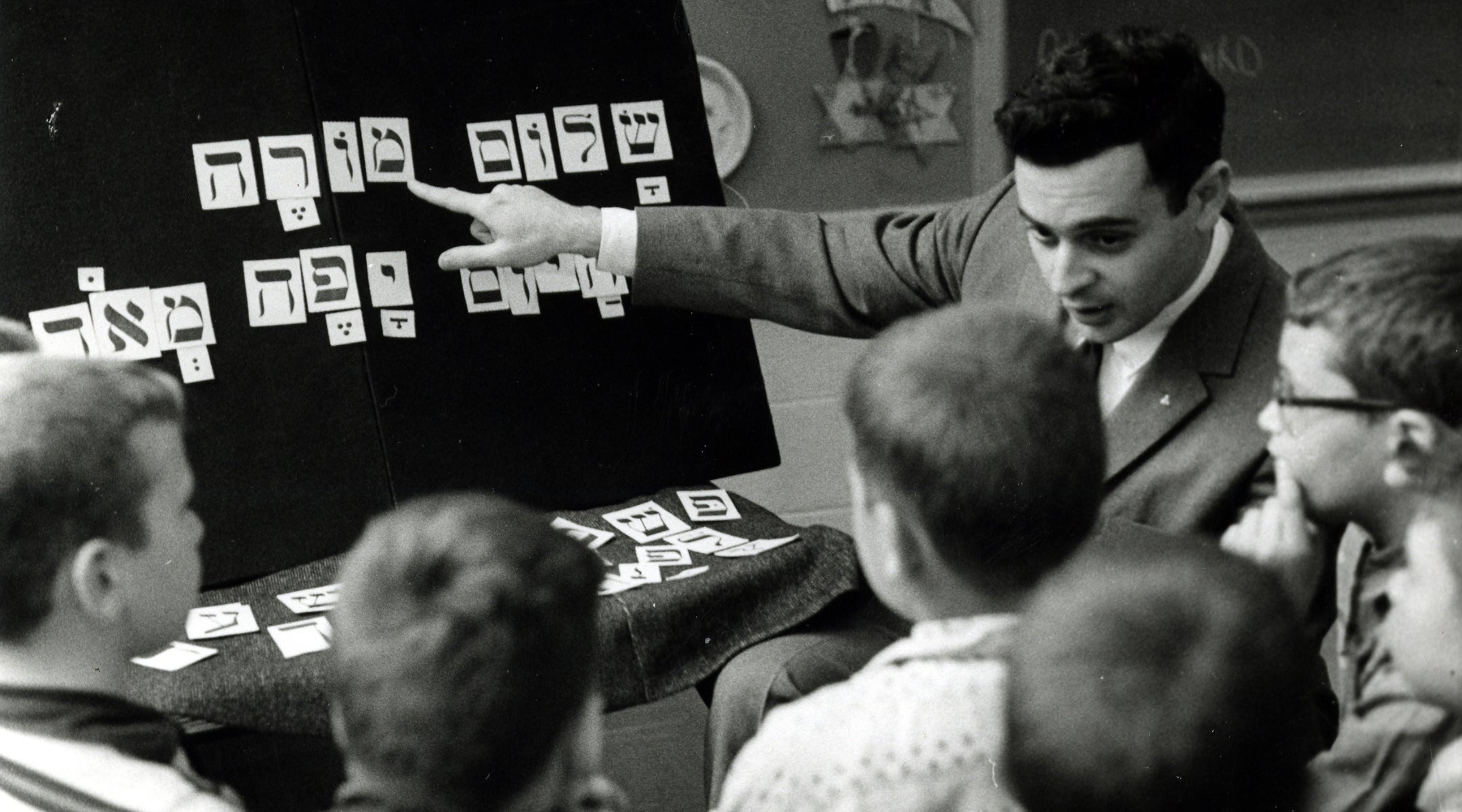
Growing up, “Hebrew school” meant giving up my Sunday mornings and Wednesday afternoons to learn to read and pronounce Hebrew without understanding what we were reading or saying.
As a young adult becoming more involved in Jewish life, I tried to make up for this deficit at a three-month language immersion “ulpan” at a moshav outside Jerusalem. There and at subsequent ulpanim, I mostly learned that the language is really difficult.
And yet if Hebrew broke me, I couldn’t break up with it. Hebrew mattered. As my vocabulary grew, I began to read Jewish texts and prayers with a new appreciation for their nuances and layers of meaning. I understood Israel a little better. I felt more authentic in my Jewishness.
Turns out I am not alone. In “Speaking of Hebrew: What Language Does for American Jews,” Sharon Avni writes about American Jews’ relationship with a language many can read but many fewer can speak or understand. Drawing on over 100 interviews with adults she calls “Hebrew enthusiasts,” Avni, a professor of academic literacy and linguistics at CUNY’s Borough of Manhattan Community College, explores what Hebrew means to American Jews — and why they keep returning to it, even when fluency remains elusive.
“The main argument of the book is that Hebrew is doing important work for American Jews, whether they’re talking about it and discussing their concerns, their values and their commitments, or whether they’re talking in it and just trying to figure out what kind of American Jew they want to be,” Avni, 56, told me in an interview from her New Jersey home.
Avni’s own relationship with Hebrew began in a Conservative synagogue in New York’s Westchester County, where, like me and so many others, she learned to decode the letters. (Despite her Hebrew-sounding name, she is not a native speaker.) She credits her teachers with giving her a solid foundation in reading and writing, but it took years, and several false starts, before the language itself began to make sense.
As a teenager, she attended Young Judaea camps, where Hebrew was part of the culture. (Avni is also the coauthor of a scholarly book on summer camp Hebrew.) Later, she went to Israel on a gap-year program, and eventually lived in Israel for nearly eight years, earning a graduate degree in language education at Tel Aviv University.
Returning to the United States, Avni was struck by how large a role the language played in communal discussions. Often fretting that Americans were Jewishly illiterate, educators, rabbis and communal leaders loaded onto Hebrew, and the lack thereof, all of their anxieties — about assimilation, identity and the “the future of American Jewry itself,” she writes.
“I started to just see that the American Jewish community talks a lot about Hebrew,” she said. “It shows up all the time, just constantly in all sorts of other topics.”
Decade after decade, Jewish thinkers have lamented that English-speaking American Jews lost proficiency in a second, Jewish language. In the 1930s, Rabbi Mordecai Kaplan argued that Hebrew was essential to connecting them to their tradition and to one another. In the 1990s, the literary scholar Ruth Wisse wrote that Hebrew is a “Jewish imperative.”
“Without Hebrew,” the critic Leon Wiseltier wrote in 2008, “Jewish tradition will not disappear entirely in America; but most of it will certainly disappear.”
Kaplan, Wisse and Wiseltier were largely viewing Hebrew as a religious, cultural and historical Jewish heritage, the language of the Bible, rabbinic texts and the prayerbook. Modern Hebrew is also the living language of Israel, and teaching and studying it has become inseparable from all of the joys and controversies of attachment to the Jewish state. “[A]ny discussion about American Jews and Hebrew can never be wholly untethered from American Jews’ relationship to Israel and Israelis,” Avni writes.
There has even been a reprise of the language war of the early 20th century, when Hebraists vanquished Yiddishists in developing a national language for the budding Jewish state. In recent years, Jewish anti-Zionists have embraced the study of Yiddish, deriding Hebrew as a language of the Jewish nationalism they reject. Just last month, Jewish readers recoiled when a new book claimed that punctuation marks in Hebrew “are relics of a brutal colonial system.”
“I think people are looking to language to do their political work, whatever side they’re on,” Avni said.
Avni also challenges the deficit approach to understanding Hebrew in America, which focuses on the lack of Hebrew proficiency among American Jews instead of the many ways Jews are accessing and appreciating the language. That in turn leads to the argument, à la Wisse and others, that a Jewish life lived in translation is inauthentic or lesser.
Avni appreciates that argument — up to a point.
“If English is the means by which American Jews feel like they can engage with this incredible textual tradition,” she said, “the insistence that English is somehow inferior can leave people wondering where that leaves them.”
Zionist educators today still insist on the primacy of Hebrew, and Jewish day schools boast of their immersion curriculums. Avni has particular sympathy for the supplementary school teachers trying to squeeze Jewish history, Israel, the Holocaust, Jewish texts and other subjects into just a few hours a week. And she feels for the many adults who remember “Hebrew school” as a form of punishment for having been born Jewish.
What interested her was what happened next. Many of those same people chose, as adults, to return to Hebrew — without any “practical” purpose.
Why they bother is the core of the book. Sitting in on Zoom and in-person Hebrew clubs and classes, she found the motivations as diverse as the participants. Some wanted to understand the prayerbook better, or read an Israeli poem in the original. Some wanted to strengthen their connection to the Jewish past. And still others were satisfied to find their version of Jewish community among other “meshugayim l’devar,” Hebrew for people who tend to geek out over a topic or hobby.
That last explanation was particularly important for people trying to find a Jewish identity outside of the synagogue and other establishment institutions. Describing one 58-year-old Bostonian, Avni writes, “Hebrew filled a Jewish space in her life, but the boundaries and content of this space were unclear, as she was not observant or affiliated with a synagogue. “
“They see it as a way to do their American Jewish life,” Avni told me. “They don’t need to be fluent for it to be meaningful for them as American Jews.”
That may mean reading a prayer, recognizing a word in a Jewish text, taking a class or dropping a Hebrew expression into an otherwise English conversation. (Avni quotes the linguist Lewis Glinert, who describes the use of a few token words as “smatteracy.”)
I can attest to the pleasures of smatteracy, as I explained to Avni. I’ll use Hebrew terms like “balagan” (a big mess) or “Al lo davar” (don’t mention it) when talking with like-minded Jews. It creates a sense of kinship and belonging. It’s a secret handshake, the password at the speakeasy, a key to the VIP lounge.
Such code-switching, Avni said, also animated her subjects. “They might not be fully experts, but they’re part of something,” she said. “And I think that’s really important.”
A Season of Big Decisions. From the Knesset campaign to American midterms, Jewish communities are weighing what comes next. Help (JR) keep delivering the deeper context.
The views and opinions expressed in this article are those of the author and do not necessarily reflect the views of (JR) or its parent company, 70 Faces Media.


