
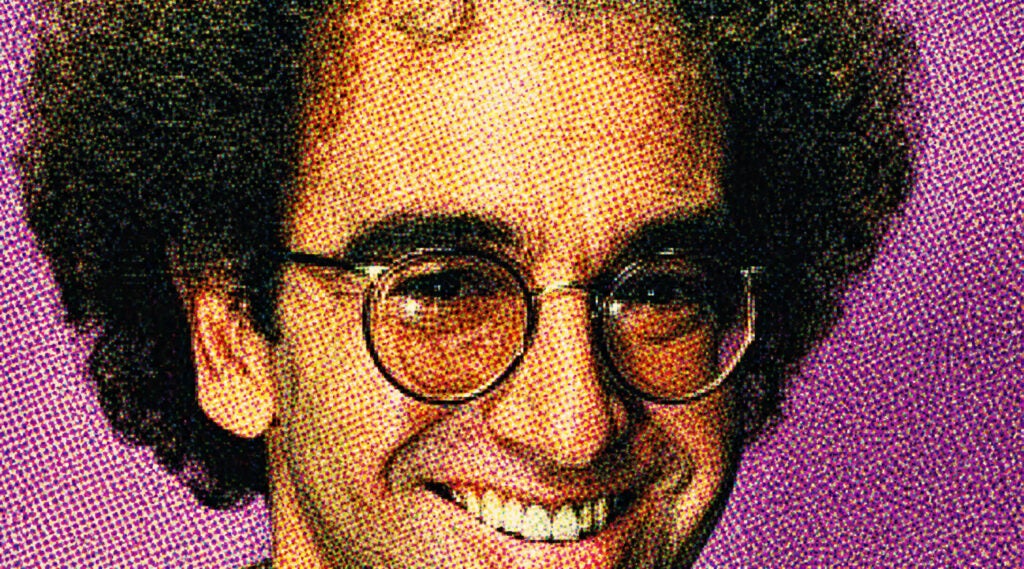
In high school, Blake J. Harris’s yearbook quote was from “Seinfeld,” and he wrote his college admissions essay about the show’s final episode. “Seinfeld,” he says, is why he became a writer.
“It made me fall in love with storytelling,” he told the Jewish Telegraphic Agency in a recent interview.
Little wonder, then, that after he became a journalist and documentarian, he long dreamed of writing a biography of Larry David, the co-creator of “Seinfeld” and creator and star of “Curb Your Enthusiasm.” After a six-year journey that included many FaceTime calls with David and even an appearance in the series finale of “Curb,” Harris wrote “Emperor of Nothing: The Making of Larry David,” which came out last month.
The resulting book traces David’s roots from his Brooklyn Jewish upbringing and early encounters with Jewish comedy to the rabbis, mohels and cultural anxieties that became recurring material in “Seinfeld” and “Curb Your Enthusiasm.” But David himself rarely talked about what being Jewish meant to him as a writer — or whether he saw himself as carrying on a distinctly Jewish comic tradition. That gap makes for one of the more intriguing threads in Harris’s book.
“He’s too smart of a guy to not, you know, be aware of the association,” Harris said of David. “But I don’t think that he ever felt any sense of mission with regard to being Jewish and being a writer and wanting to do or not do certain things.”
The book project began in 2020. Harris met Jeff Schaffer, the Jewish writer and director who worked on both shows, while writing an oral history of “The League,” the TV series Schaffer co-created.
Schaffer liked Harris’s idea for a David bio, though he acknowledged getting Larry on board would take some work, mostly because David values his privacy and “doesn’t believe he’s book-worthy.”
Jewish comedy writer Alan Zweibel, an early “Saturday Night Live” writer, played a key role in facilitating the first conversations between Harris and David. Harris called Zweibel “a real mensch.” In what he called “a George Costanza-style scheme,” Harris told Zweibel to assure David that he wouldn’t ask him any questions about his shows when they first spoke, but would stick to a subject they both loved: the New York Yankees.
The book reproduces the emails between Harris and David in which David ultimately agreed to cooperate with the project.
What followed were countless phone and Zoom calls as the pandemic descended. Ultimately, Harris visited Los Angeles, met with David in person, spent a lot of time on the set of the final season of “Curb”, and even appeared as an extra in the show’s finale.
Harris, who describes himself as a “proud Jew,” said David didn’t talk much about Judaism in their interviews.
“Obviously he was heavily influenced by Mel Brooks and Woody Allen more so than any other comedic voice,” he said. Another influence was Nat Hiken, the midcentury Jewish TV writer who created what became “The Phil Silvers Show,” starring the Jewish comedian as the conniving Sgt. Bilko. Still, David, constitutionally averse to talking about his legacy in general, declined to talk about the American Jewish comedy tradition.
Nevertheless, the book includes quite a lot of Judaism. David was born at Brooklyn Jewish Hospital in July 1947. Harris includes stories about Larry as a Hebrew school student who was frequently sent to the rabbi’s office. David’s father, Morty, worked for a clothing business that was connected to the infamous Jewish organized crime group Murder, Inc.
Once David’s showbiz career gets underway, first in the world of 1970s stand-up comedy in New York City and later in television, he crosses paths with famous Jewish performers, including Jerry Seinfeld and Carol Leifer, who eventually worked as a writer and story editor on “Seinfeld.” He also solidifies his friendship with Richard Lewis, who was born in the same hospital the same week as David, and whom he met at summer camp when they were 12. The two starred together on “Curb” until Lewis’ death in 2024, shortly before the series concluded.
In his stand-up comedy era, David occasionally mined his Jewish background and neuroses for bits. In one routine, he expresses shock about finding out David Berkowitz, the Son of Sam killer of the 1970s, was Jewish.
“You know, sure, there are Jew crooks and Jew gangsters… but a serial killer? Never! Impossible! Then, we found out he was adopted,” David would say.
On the short-lived sketch show “Fridays,” which aired on ABC in the early 1980s, David appeared as an Orthodox rabbi and kung fu master in a sketch about a public-access show called “Matzoi!” His co-star in the sketch was Michael Richards, the gangly comic who’d go on to star as Kramer in “Seinfeld.”
But getting the “show about nothing” off the ground wasn’t guaranteed. Despite Seinfeld’s enormous success as a stand-up (David himself never really rose above cult-favorite, seemingly by design), entertainment execs were wary. NBC suits worried the show was “too New York,” often used as a euphemism for “too Jewish.”
“I’m not from New York, and I’m not Jewish,” Rick Ludwin, the NBC executive who championed the show, said at the time, according to the book. “But I thought it was funny, I thought it could work.”
“Seinfeld” became one of the most successful sitcoms in television history, dominating the ratings in the 1990s, spawning a vast cultural vocabulary and turning its finale on May 14, 1998, into a national television event watched by 76 million Americans.
Although the balding, self-sabotaging George Costanza character on the show is regularly described as a stand-in for David, his inspiration rarely appeared on camera. That changed in 2000, when HBO first aired “Curb,” with David starring as himself in a version of his life as a rich Hollywood kvetch and scourge of those who commit trivial social violations. Harris told (JR) that this mid-career transition into a more forward-facing role for David was a thread that intrigued him.
“Curb Your Enthusiasm” featured numerous episodes about rabbis, synagogues, Jewish country clubs, funerals, Holocaust survivors, antisemites, seder guest lists and other staples of Los Angeles Jewish life. In the famous “Palestinian Chicken” episode from 2011, Larry and his sidekick Jeff (Jeff Garlin) go to a Palestinian restaurant; Larry begins dating what the book terms “a sexy Jew-hating Palestinian woman.” It’s a rare TV show to lean into the enmity between Israelis and Palestinians, and even to propose a solution: Larry insists that if Israelis were to taste the restaurant’s chicken, “They’d take down all those settlements in the morning.”
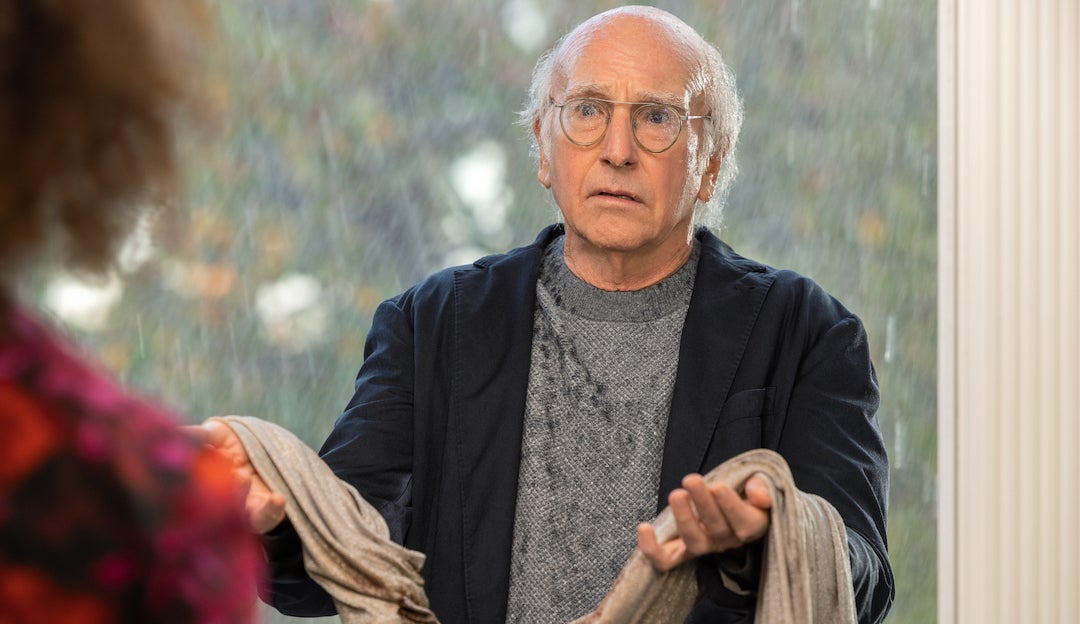
Harris notes that this type of humor might not fly a calamitous 15 years later. In fact, the author had recently had dinner with David and his wife, and David, who does not use social media and is somewhat removed from the things people argue about online, was surprised to learn that some people consider that episode racist.
“How is that racist? I [expletive] a Palestinian woman,” David told him.
In the meantime, David hasn’t shied away from the topic. He recently authored a piece for the website Air Mail, satirizing the more extreme demands of the Democratic Socialists of America. An avowed liberal, David pretended to be a member of the DSA and proposed a “two-state solution”: “Palestinians should be given all the land currently occupied by Israel,” and Israel should “relocate to Pitcairn Island in the South Pacific.”
Harris is also grateful he was able to interview some Jewish comedy luminaries who have since passed away, including Lewis, Richard Belzer, and George Shapiro, Jerry Seinfeld’s manager and a producer on “Seinfeld.”
The book contains a surprising number of stories from David’s life that readers will recognize as later adapted for “Seinfeld” and “Curb” episodes, including his brief stint as a bra salesman. “Curb” fans will be delighted to see the phrase “beloved aunt” in the book’s first few pages.
How different is the real Larry David from the version we see on “Curb” and his associated public persona?
“I think there’s a lot of overlap between TV Larry and real-life Larry,” Harris said. “That said, there are many differences, and even if I were to say it was, you know, an 85 to 90% similarity, those 10 to 15% are important, and they are different… First and foremost, real-life Larry actually has a heart.”
Unlike the childless Larry of “Curb,” the real man has two daughters — Cazzie, a columnist and essayist, and Romy, an oral historian — whom Harris describes as “the most important thing in the world to him.” Harris also remembered mentioning the names of three former “Seinfeld” writers, and hearing David say, “I love those guys.”
“The character on the show never really talks about loving anyone,” he said.
A Season of Big Decisions. From the Knesset campaign to American midterms, Jewish communities are weighing what comes next. Help (JR) keep delivering the deeper context.