


Shall we continue? Last week, when I was writing based on Israel’s exit polls – they turned out to be not the most accurate – I argued that Israel is a state in superposition. This still holds true. In Iran – a superposition that is neither victory nor defeat. In Gaza – a superposition that is neither the eradication of Hamas nor consent to its continued rule. Facing the Haredi challenge – a superposition of mandatory conscription and no enforcement of conscription. The final outcome of the election also placed Israel in a superposition: victory and defeat. The coalition won because it didn’t lose; the opposition lost because they didn’t win. Both sides are now looking for a way out. This requires patience, nerves of steel and some luck. Don’t expect a final outcome anytime soon.
Politicians are used to not telling the whole truth. And there’s no time in which they excel more at not telling the whole truth than the weeks dedicated to forming a new coalition. Thus, we must consider most of what we hear from them as spin. Words and leaks and rumors and interviews all serve one purpose: to improve their chances of getting what they want.
But what is it that they want? If you have an urge to feel sorry for this group of power-hungry leaders, note that Israel’s voters left them with few, if any, good options. Israelis went to the polls and provided a result that leads to no clear path for creating a functioning coalition. The bloc of parties supportive of P.M. Netanyahu got 53 seats in the Knesset. That’s eight short of a majority, and 15 short of what it currently has. The bloc of parties opposing the PM is at 67 – but 18 of these went to Arab parties with whom the leaders of the coalition committed not to form a new coalition.
What are the options available to the parties? Opposition leaders can break promises and try to form a change coalition with the Arab parties or the ultra-Orthodox parties. There will be a high price for both. The first option will be highly controversial no matter how the deal is presented to the public. The second option will require complete surrender on an issue that was front and center in the campaign – drafting young Haredi men to the IDF.
Netanyahu has no path for a coalition except one: getting an opposition party to bolt and join his side. He’d have to give much in return, and it’s not clear he wants to do such a thing. His best option might be a repeat election in three or four months in which he expects to win. Then – there’s the option of a unity government. Netanyahu will not form such a government unless he is the P.M. Other parties will be rightly suspicious of his promises and intentions. They can easily test him: will he agree to pass a strong draft law, that would alienate his ultra-Orthodox partners, in exchange for unity with his Zionist rivals? Probably not. Netanyahu wouldn’t want to be a prisoner within his own government. He wouldn’t form a coalition that would leave him exposed to a sudden change of heart of his reluctant rivals.
So here we are, stuck with just a few bad options to consider. And that’s just the political superposition of undetermined future – alongside it there’s also the possible – probable? – war with Iran.
Consider this: last week I had to write as the polls closed in Israel, thus relying on exit polls for an incomplete analysis. This week I must write as the polls in America close, and a deadline for possible attack on Iran is looming. In fact, if President Trump decided to rush into a conflict right after Election Day, you might be reading this as sirens are already wailing in the region. If not, we have more waiting ahead of us. Politicians will discuss coalition-building. Statesmen will discuss nation-building. Citizens will have to passively wait as their fate is determined by leaders in whom they have little trust (but for whom they chose no clear alternative).
Iran isn’t just a question of when, it is also one of why. Of course, getting rid of Iran’s nuclear program – or belligerent regime – is a worthy cause. But such a saying was true in June 2025, when Israel attacked for 12 days, and the U.S. joined at the last minute, and was true when both the U.S. and Israel attacked in February 2026. What will they do now that could provide us with an outcome more satisfying than the last two rounds? Do they – Trump and Netanyahu – have the same objective in mind as they entertain the idea of launching a third round of attacks?
Brace yourself for more such known unknowns. Look at the locked box and keep wondering: what is the cat inside it doing?
Something I wrote in Hebrew
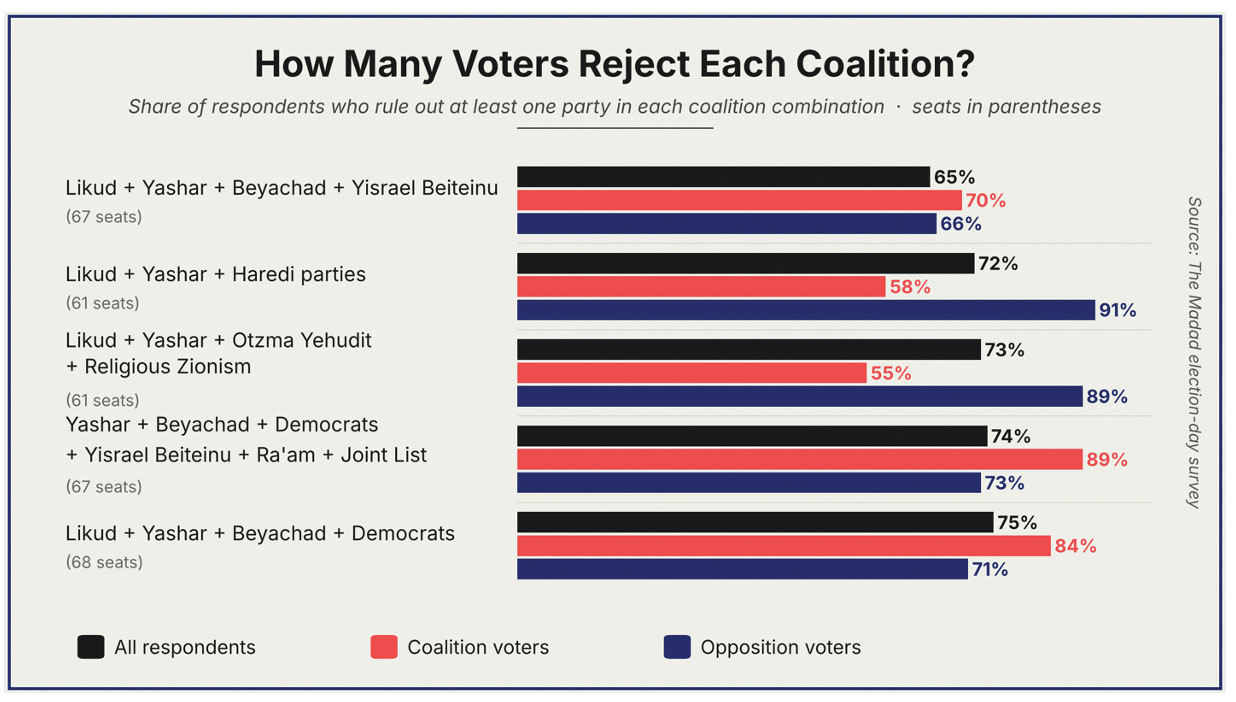
The question regarding which parties Israelis do not want in a coalition (see graph) allows us to examine whether there is any coalition at all that a majority of Israelis would accept (and we are talking here about a 61-seat majority coalition, not a minority coalition, whose time will come). This is not just one question, but actually two. First question: Are there voters whose total disqualifications allow for a 61-seat coalition based on the election results? Second question: Is there any coalition that a majority of Israelis do not disqualify? To the first question, the answer is yes. To the second, the answer is no. There is no combination of parties that can form a coalition supported by a majority of Israelis. At least not according to the answers given three days ago regarding party disqualifications.
A week’s numbers
Why is it so difficult to form a majority coalition? Here are some examples.
A reader’s response
Gabi wrote: “You should never write based on exit polls.” My response: A newspaper deadline is often trickier than you think. But there’s always the next issue.
Shmuel Rosner is senior political editor. For more analysis of Israeli and international politics, visit Rosner’s Domain at jewishjournal.com/rosnersdomain.